PARKING TRENDS REDUX

I just came across an article in the New York Times, “Higher-Priced Developments Providing Parking” by C. J. Hughes, (published on May 26, 2011) that cites two new upscale housing development projects in Manhattan that are providing on-site parking using hydraulic or   “robotic” technologies:
  • An eight-story condo  building on West 24th Street, near Seventh Avenue, with 24 units. the building also will have eight internal parking spaces that are available  through a hydraulic lift.    
  • Also on West 24th Street,, near Lexington Avenue, a 55-unit condo is being developed that is adjacent to a fully automated, “robotic”, 64-space garage. The garage is open to the public, but condo’s residents can lease spaces in it for a hefty monthly fee.

I think these projects are signs that the trend toward internally stacked and automated downtown parking that we at DANTH, Inc identified in our 2008-2013 downtown trends assessment is continuing even during our creeping economic recovery. The eight-space parking for the smallish  condo building may be a particularly relevant model for projects in suburban downtowns that can attract households with comfortable annual incomes.  Below is what I wrote about parking trends and mechanical and automated parking back in 2008. I think it is one of the most important trends identified in our assessment and worth a second presentation. 


A. Slowly, We Are Winning The War For Downtown Friendly Garages


For decades following WWII, new downtown parking garages tended to be physically unattractive, intruding into the urban fabric in ways that disrupted how downtowns are supposed to work, and deprived them of an important competitive advantage. The objective was simply to store vehicles. Little thought was given to whether the garage created a pedestrian discontinuity that discouraged people from strolling and shopping, while too often stimulating fears. Even less thought was given to how the perhaps functional, but blaringly ugly parking structure diminished the downtown’s attractiveness and image.


It was not as if examples of better downtown parking projects did not exist. Walking around Manhattan today, for instance, one may easily find garages in what appear to be ordinary high-rise commercial structures that were built before the 1960s. Their parking use is basically masked, save for the signage and ugly windows.


More impressive is the Carew Tower in downtown Cincinnati that was completed around 1930. It is a mixed-use project with wonderful art deco decorative themes placed throughout its three towers, mainly in the metalwork and grillwork of the elevators and lights. Originally, the project had three towers specializing in three distinct uses: offices, a hotel, and a parking garage that relied on an elevator to move cars between levels.


The John Hancock Center, completed in 1969, on N. Michigan Ave. in Chicago, has 100 stories, a height of 1,127 feet and provides space for offices, retail shops, restaurants, and about 700 condominiums. The ground floor and the floor above it are for retail and commercial uses. Above them on floors 3 through 13, thoroughly masked, are 11 stories of parking. The office and condos are located above the parking. A helix one block down a side street provides entry and egress from the parking.


These examples gained little traction until about the mid-1990s and as more downtown friendly parking structures began to appear a kind of snowball effect emerged and more and more developers proposed such projects without local civic leaders having to bang them overhead. Most influential was the Horton Plaza project in downtown San Diego, which hid its parking behind a “skin” of residential units. They also have begun to appear in medium-sized downtowns such as Cranford and Englewood in NJ and Ithaca, NY.


DANTH has created a photo album of downtown friendly parking projects that is posted on the Downtown Curmudgeon’s website for photos. Feel free to visit and download the photos at no cost. The web address for the photo album is:
https://picasaweb.google.com/dmilder/DowntownFriendlyParking#

Photos like these can help demonstrate to developers, town councils, planning boards and the pubic what can and should be done when it comes to downtown parking structures.


B. The Challenges


1. User Convenience and Safety. The above discussion detailed how the external features and ground floor uses of garages have been improving so they integrated far better with the rest of the downtown. Unfortunately, how garages are configured and operate inside very often still create huge problems.


DANTH has no transportation engineers, transportation planners or parking specialists on staff. However, we do run into parking issues continually as we engage in our consulting assignments. As a consequence, DANTH has developed a deep sense that parking issues are habitually scoped-out incorrectly because conceptual blinders lead to parking solutions are formulated to address the wrong problems. As a result, parking facilities are too frequently designed to store vehicles, with insufficient attention to serving the people they transport. Here are some examples of the “people aspects” of downtown parking problems:

  • One nameless town along the Hudson River in NJ wanted to build a new parking deck although field investigation showed low utilization of municipal parking lots with ample parking spaces. Survey data indicated that many people simply did not know where the lots were or if the lots had available spaces. Was the problem here insufficient capacity? Was the viable solution a big parking deck? No on both counts. The capacity was adequate. Downtown shoppers needed better, up to date information so they could use it. This linkage between information and better utilization of parking capacity is too often overlooked.
  •  For nearly 25 years we have found that on a busy fall Saturday at lunchtime in downtown Wellesley, MA, one can spend a good deal of time searching municipal lot by municipal lot for a vacant parking spot. This strong, attractive and busy downtown is a de facto lifestyle mall without central ownership. Lots of shoppers come not only from the college, but from many other affluent nearby communities. One might hypothesize that such frustrating searching for a parking space erodes shopper interest and visitation. Would a big parking deck be a solution here? How would it fit into the urban context? Would the local female shoppers really use it? If not a deck, what else can be done to ameliorate the need to search for parking spaces?
  • · Some downtowns build new surface lots or decks on the periphery of their districts and then the leaders are surprised when few shoppers or diners want to use them! DANTH does not do brain surgery, but….
  • Multi-level garages have been built to provide downtown shoppers with convenient parking only to have the operators discover that few shoppers will use the upper levels. No one apparently looked at how much time it would take on foot to get from a car on higher levels down to the sidewalk and then back again. No one also probably thought about the confinement of enclosed stairwells and the probable urine and urine smells they would attract. Or the hiding places built into many garages. Or the fear inducing potentials of elevators. Most shoppers are female and if you interview them about parking you will find they do not feel safe in most garages. Guess what makes them fearful! One does not need to be a rocket scientist to avoid this situation.
  • Increasingly, downtown trips are quick, pick up or drop off types of visits and the shoppers do not want to spend more time looking for a space, parking and getting to and from their destination than they will in the shop or eatery. Yet, we have found very, very few downtowns with a short-term parking program aimed at these key consumers.

Because of the nature of our business DANTH is primarily concerned about the people who live, work, play and shop in downtowns and how they engage in those activities. Consequently, DANTH sees the nature of their parking needs not just in terms of needing a place to store a vehicle, but also and primarily about how that parking space will impact on the ways those folks use the downtown and its shops, restaurant’s and entertainment venues. From such a consumer perspective, the key parking issues are first convenience and safety and only then capacity. Few downtowns have their parking problems analyzed in these terms. Far too few parking facilities are designed – even recent ones – to maximize user convenience and safety. Ah, you think we are wrong! Then let us ask: “When was the last time you parked in a garage that had electronic signage directing you to the levels with empty spaces?” Never, probably. Roaming around a deck, searching for an empty space takes time and generates frustration and then perhaps anger. It is an irritating inconvenience. Then it seems to take forever to walk out of the deck and likely requires walking down filthy, foul-smelling, little prisons with stairs. It certainly is a very poor way to welcome visitors into your shopping district. It is the worst kind of customer service.


2. The Cost Of Downtown Land. Downtown land costs are high and rising. Moreover, as a downtown revitalizes land costs will escalate at an increased pace. This means that creating more physical capacity for downtown parking is getting more and more expensive. Parking revenues typically cannot compete with those yielded if the same parcels of land are put to office, retail or residential uses. In fact, without subventions and/or greater project density, parking very often cannot pay its own way.


Finding solutions to this problem is a major challenge to future downtown revitalizations.


C. Technological Responses: Some Examples
To address the above problems requires management and technological innovation. Unfortunately, gene therapy has not matured to the stage where it can be used to cure downtown leaders and city officials who work so diligently to produce ghastly, unattractive and user insensitive parking facilities. Getting rid of them is certainly one alternative, but usually difficult to achieve. Another approach is to find good examples of the people friendly parking projects and then selling local leaders on them because the projects will genuinely improve the downtown, while making the leaders look far-sighted and effective (i.e., like real leaders).


Technology can play a big role in maximizing the amount of parking that can be placed on a piece of downtown land as well as help make a parking facility easier, quicker and safer to use.

clip_image002
Figure 1


1. Stacked Parking. One way to deal with rising land costs is to get more cars parked on the same amount of land. This can be done by going higher—but it also can be done by packing more parking spaces into the same volume of space. For example, in Manhattan, cars have been mechanically stacked on top of each other in small outdoor lots. These parking operations double or even quadruple their capacities without increasing the size of their lots. See Figure 1.


Looking out over the 2008-20013 time period, DANTH believes that relatively small infill residential projects will have growing impotence in downtown revitalization efforts across the nation. The viability of many of these projects will hang on their ability to provide on-site parking.

clip_image004
Figure 2.

The stacking approach pictured above has been adapted for use in basement garages – see Figure 2 – located in such modest infill projects. DAL Design Group and its development subsidiary, in Bayonne, NJ, are working on a number of projects using this technology.
At this juncture, DANTH cannot recommend the immediate adoption of this technology – but, we can state that it is one that certainly warrants serious investigation.


2. Robotic Garages. Another approach, using much more sophisticated and expensive technology, is to build what some call robotic garages and others refer to as automated parking systems. For example, a seven-level municipal parking structure, only 56 ft high and capable of storing 324 cars was built on a relatively modest 100 x 100 lot in downtown Hoboken, NJ. (Martin, 2003). The entering autos are placed on a steel palate, which is then moved mechanically to and from its storage location under computer guidance.


This garage encountered problems with the computer program controlling its operation, resulting in its closure for a time. Although now reportedly fully back in operation, its problems have put a wet blanket over the idea of robotic garages in the Northern NJ area.


But, robotic garages promise at least doubling the number of cars that can be stored on any given piece of downtown real estate, while greatly reducing the personnel costs for attendants and cashiers. These benefits attract a number of developers even though robotic garages cost significantly more to build. For example, at 123 Baxter Street, in Manhattan’s Chinatown, Automation Parking Systems installed and operates what their name says in a new building. It has 24 residential units, ranging in size from 1,200 sf to 4,800 sf. Every unit is guaranteed at least one parking space in the basement garage, which holds 68 cars. The estimated average cost for a robotic garage space is about $40,000, compared with $30,000 for a space in a typical underground garage, although those figures can be considerably higher if the builder has to dig deeper or encounters other problems along the way.


Manhattan’s Chinatown is very densely populated with many narrow one-way streets. Parking is at an absolute premium. New infill residential buildings, such as this, with safe off street parking, are rare. The 44 parking spaces not allocated to residents will be made available to nonresidents, with the revenues raised hopefully more than offsetting the costs of the robotic system’s installation and operation.


Here is a link to a DANTH slideshow on the Automation Baxter Street facility and how it operates:
http://picasaweb.google.com/dmilder/RoboticGarage123BaxterStNewYorkNY

The technology it uses has been used successfully in numerous facilities in Europe, especially Germany. DANTH thanks Jordan Rinzler of Automation for inviting us to visit the facility and being our tour guide.


The Takeaway. Based on the information we have obtained, DANTH believes that robotic parking should be given serious – not knee jerk nor flippant – consideration for any downtown project that requires about 130+ parking units. DANTH also believes that the number of such projects that will find automated parking an appropriate solution will increase with time and the:

  • Accompanying rise in downtown land prices
  • Reduction in the costs of the automated systems
  • Growing acceptability of the approach as more systems are built and operate successfully.
  • DANTH also believes that the automated approach may be appropriate for smaller projects, such as 123 Baxter Street, when the facility can meet, in addition to the needs of building residents, high neighborhood demand for parking among people who can and will pay a high price for it.

3. The Grove. Rick Caruso and his firm, Caruso Affiliated, have created one of the most successful and popular retail centers in the country, called The Grove. Located in Los Angeles – the city famed for reputedly having no there there — its design resembles a small downtown, with its own trolley, bevy of trophy retailers, cinema, restaurants and location next to the locally cherished Farmers Market. It is also across the street from Parc La Brea, a huge housing complex built by MetLife after WWII.


In no small measure, The Grove’s success is due to an insightful understanding of how shoppers behave and a great attention to detail in responding to shopper needs, especially concerning making the visitors experience easy, safe and enjoyable.


This is shown in how they handle parking. The garage has eight levels and – contrary to what happens elsewhere — shoppers have no problem with using the upper levels. In part this is due to The Grove being so popular, but also because the garage uses open escalators and electronic signage to make shoppers feel their visits will be safe and convenient. Here is a link to a brief DANTH slideshow that shows these two features:
http://picasaweb.google.com/dmilder/ParkingAtTheGroveInLosAngeles

The escalators completely avoid all of the garage stairwell problems and make pedestrian egress and entry feel safe, pleasant and quick.


The electronic signage greets the drivers as they enter the garage and indicates how many spaces are available on each level. This type of signage is used all over Europe. It is absolutely astonishing that more garages in the USA do not install them.


Moreover, in Paris, for example, similar sign technology is used to indicate on roads coming into the city the occupancy levels of various municipal garages, which reduces the amount of time, effort and gasoline drives spend on finding a space. Such a technology can certainly be implemented in the USA. Communities such as Wellesley, MA, and the Hudson River community described above would greatly benefit from them.


The Grove exemplifies a level of concern about visitor convenience and safety that many downtowns leaders and business operators can learn from. The Grove also uses modern technologies in ways that many downtowns can use as models.
Some Interesting Research About E-Commerce

The Online Articles

A May 5, 2011 posting on ClickZ,  “Is Facebook Marketing Behind Macy’s Online Sales Jump,” suggests that that Macy’s efforts to pick up Facebook “likes”, which in 2011 grew to 800,000 was responsible for the 50.3% rise in the Macys.com and Bloomingdales.com monthly sales. The article also mentions that Foursquare and Twitter were used in this campaign.


A May 10, 2011 posting to the Business Insider by Pascal-Emmanuel Gobry, “Turns Out Social Media Marketing Doesn’t Work” reports on recent research done by Applied Predictive Technologies. The research tested “how much location-based services like Foursquare and Facebook Places can help local businesses.” It found an impact that is just “close to 2%.” (There is no clarity as to what the 2% refers to in the article, e.g., sales, visits, etc.”

Gobry advises Foursquare investors not to panic because the used social media may not have had enough time in the test to work and “Right now, social media marketing and advertising is in the experimental phase. We don’t really know what works and what doesn’t, fumbling in the dark.”


I consider customer service as a critical marketing tool, so another online article that recently caught my eye was by Joe Light and posted on April 25, 2011 to the Wall Street Journal’s website. Titled “With Customer Service, Real Person Trumps Text,”  the article reports on a large national survey conducted by American Express to find out how consumers want corporations to provide customer service. The survey found:
  • 90% of the respondents wanted customer service handled by live representatives over the telephone
  • About 50% like customer service delivered by online chat
  • Just a little more than 20% would use social networking sites
  • 20% said they would use auto-response phone systems
  • 70% said they would spend more with a company that provides good customer service , an increase from the 58% that felt that way last year.
My Take-Aways

I think Gobry hit the nail on its head, but that his remarks apply not just to social media marketing, but substantially to internet marketing in general. What is obvious is that large, savvy corporations with ample resources and large technical staffs  such as Macy’s and American Express are still trying to discover what really works and what doesn’t and many of them are still “fumbling in the dark.” 

The small merchants that populate so many of our downtowns lack the resources and skilled staffs of the large corporations and the results for them of a failed online marketing campaign are probably more dangerous. Advocating their involvement in unproven and for them complicated and expensive internet ventures is irresponsible. Yet, an internet presence is fast becoming an existential imperative for all merchants, be they large or small! Downtown organizations that want to foster merchant presence on the internet in most cases need to focus on programs that have some real proof of effectiveness and that make merchant involvement less complicated and more affordable.  I have always been fond of the Keep It Simple, Stupid (KISS) approach to program development and to my mind it applies here. For most small downtown merchants small, affordable, simple to do and easy to maintain steps may be the most viable.

Of course, there are always the exceptions, those marvelous exceptions among the small business operators. At the extreme they are the true innovators that may start in garages, small offices and small shops and create firms like Apple, Microsoft, and Limited Brands. While small business innovators of this high caliber are relatively rare, my experience suggests that there are 5% to 20% of a downtown’s merchants who may be open to some innovation and willing to take some risk. Should downtown organizations focus their efforts on this group or do they need to develop two-tier programs, one level for the more innovative-prone merchants, the other for the average merchant?

N. David Milder

Trying to Assess the Impact of E-Retail on Downtown Merchants

The Objective

Since I started working on downtown revitalizations there have always been ogre-like competitors that local merchants see as the primary threats to their financial well-being. First, it was the department store anchored regional malls, then the catalog mail-order operations, which were followed by the big box value retailers. Most recently, e-retailers such as Amazon, are seen as the primary competitive threat. Consequently, I decided to try to assess, as best I could from available data, how strong a threat e-retail has become. My objective was not to be definitive, but to come up with ballpark numbers that would show the dimensions of this impact.

Some Relevant Data

The U.S. Bureau of the Census has long published data on e-retail sales and the proportion of total retail sales that they account for. For the four quarters of 2010 the Bureau found that e-retail sales ranged from $38.7 billion to $44.1 billion per quarter and that these sales accounted for just 4.0 % to 4.3 % of the nation’s retail sales.
These findings are consistent with the hypothesis that e-retail has had little impact. But they are contrary to the widely accepted beliefs that e-retailers have taken over the music and book industries, while squeezing the profits out of brick and mortar electronics stores and even making surprising inroads on the markets for apparel and shoes. One popular argument is that any retail market where the merchandise can be treated as a commodity is prone to deep e-retail penetration.

Unfortunately, the Census Bureau does not provide the e-retail data broken down by retail sectors. But, the Bureau does provide data going back to1992 on national GAFO sales and for sales in NACS 4541 Nonstore retailers — electronic shopping and mail order houses. This category includes the pure play non-brick and mortar e-retailers, but it does not include the online sales of the brick and mortar retail stores. GAFO is a general category that combines the general merchandise, apparel, furniture and home furnishings and other miscellaneous retailing stores sales. GAFO type retailers are usually the ones that are seen by downtown merchants as the most endangered by e-retailers. NAICS 4541 stores are not GAFO retailers.
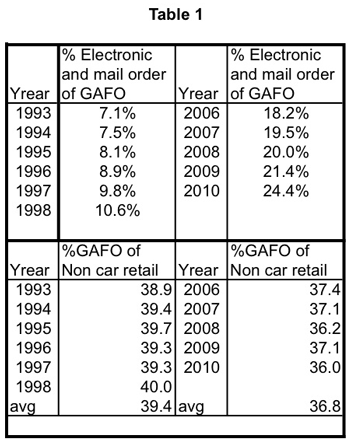
The top part of Table 1 shows the relative strength of the electronic shopping and mail order house sales compared to GAFO sales expressed in percentage terms. The data are for two time spans. The first, 1993 to 1998, is when catalog operations were stronger than the e-retailers; Amazon went online in 1995. The second is a more recent period, 2006 to 2010. In 1993 the nonstore retailers in NAICS 4541 had sales amounting to just 7.1% of the GAFO merchants’ sales, but by 2010 their sales were equal to 24.4% of the GAFO sales. These findings are consistent with the hypothesis that the strength of e-retailing has certainly grown since 1993. Indeed, the fact that NAICS 4541 sales are now the equivalent of about one quarter of GAFO sales is quite impressive.

But, did the NAICS 4541 nonstore sales take sales away from the GAFO merchants? Between 2006 and 2010 NAICS 4541 merchants grew steadily from the equivalent of 18.2% of GAFO sales to 24.4% of GAFO sales or from $202.6 billion to $276.2 billion, while the actual levels of annual GAFO sales in trillions were $1.113, $1.148, $1.144, $1.098 and $1.1320, with a 1.6% net increase over the period. In other words, while the NAICS 4541 had strong growth, there was fluctuation, but no real major erosion in GAFO sales.

The bottom part of Table 1 covers the same time periods, but it shows the proportion of non-auto-related retail sales that GAFO sales account for annually. Both e-retailing and mail order houses as well as GAFO stores are included in the total non-auto-related retail sales figures. So are groceries, supermarkets and pharmacies. Between the two time periods there is a definite drop in GAFO’s share of non-auto-related retail sales:

  • The peak, 40% was in 1998, the low point was in 2010 at 36%
  • The average for the 1993 to 1998 period was 2.7% higher than the average for the 2006 to 2010 period.

These fall offs certainly might be considered as indicators of the sales e-retailers took from the GAFO merchants. If these are valid indicators, then the numerical impacts may not seem large, but events have shown that a 3% to 4% drop in sales can take the wind out of any retail sector.

However, other factors were also present during this time period that could account for the reduction in GAFO sales. For example, as the Great Recession manifested itself, GAFO expenditures, especially for big ticket items, were where consumers cut quickly and deeply, while expenditures for food for the home and health and personal care items grew.


Furthermore, GAFO includes some of the nations largest and strongest retail chains such as Walmart, Target, Home Depot, Best Buy, Macy’s, Saks Fifth Avenue, etc. They are not only strong brick and mortar competitors, but also have developed very strong and elaborate online stores. Many smaller GAFO chains and some independent operators have followed suit. Unfortunately, the GAFO data does not provide sufficiently detailed information to look into these issues.
My Take Aways

Reviewing these data I am inclined toward the following conclusions:
  1. E-retailers have had much more impressive growth than the Census Bureau’s e-commerce data would suggest. The proper benchmark is not all retailing that includes auto dealers, supermarkets and drugstores, but GAFO merchants. The latter sell the department store type merchandise that downtown leaders would like to have available in their districts, though many downtowns are just too small to have numerous GAFO shops.
  2. Pure play e-retailers have knocked out many, if not most, book and recorded music stores, but broad swathes of GAFO brick and mortar merchants remain.
  3. Though some erosion among other GAFO segments has likely also happened, it probably has involved marginal firms that were already poor competitors and/or could not develop significant online presences. Large firms fall into this group — think Borders, Circuit City, Blockbuster — but smaller firms with few financial and skill resources are more prone to having such vulnerability. Of course, many of the GAFO operations in our small and medium-sized downtowns fall into this category.  
  4. Many of these small marginal downtown GAFO firms would still be marginal if the e-retail threat did not exist. They have always been there in the 35+ years I have been working in downtowns. The thing that has changed over time is the nature of the threat.
  5. My reading of various articles indicate that to date, the pure play e-retailers have not captured many sales in the auto, grocery, health and personal care sectors. These often have a strong presence in or near downtowns and are usually where a small or medium-sized downtown’s strongest retail market potentials reside.
  6. E-retailing’s biggest impact is not the “constructive destruction” of most brick and mortar merchants, but in changing what it means to be a retailer: retailing now has an electronic as well as a brick and mortar component.
  7. This means that many small downtown GAFO operations will have to “innovate” by either having their owners/managers learn new internet related skills or by hiring outsiders who have them. This is a strong challenge, as I outlined in my previous blog posting, that admonishments to get on the web alone cannot address.
  8. If the current operations of these GAFO retailers are badly managed — a likely condition if they are marginal — it is unlikely that they will either acquire the necessary skills or be saved if they do.

What do you think?


N. David Milder


The Use of the Internet by Downtown Organizations and Businesses

About a week and half ago I went to a workshop put on by Downtown New Jersey that focused on the use of web sites and social networking media such as Facebook. While I learned a lot and thought the presenters did a good job — they certainly were enthusiastic — I still came away with my major concerns being unanswered.

 
Being Able to Afford the Time, Money and Skill Acquisition Needed to Create and Maintain a Website. For many years I have heard several other downtown revitalization and business development experts strongly recommend that downtown organizations and individual downtown businesses have attractive and effective websites. I certainly concur with the potential positive impacts of effective websites. Moreover, I agree that organizations, with say $300,000+ in annual revenues, can have at least a useful website and that it gets easier for them to have a really effective website as their budget increases.


My problem is: Can most small businesses and small-budget downtown organizations really have effective websites? Many small and medium sized downtowns have numerous businesses that are in the $150,000 annual sales range or perhaps even less. With few, if any, full-time paid employees and modest revenues, these shopkeepers usually work long hours and may not have either:
  • The computer skills needed to create and maintain a website
  • Or the time to acquire them
  • Or the funds and networking skills needed to hire an outsider to build and maintain the website.
These problems can be particularly acute when it comes to a small merchant  building an “e-store.” The chores of keeping the online inventory current and packing and transporting the sold merchandise can be daunting.  
 
Of course, what most downtown managers also know is that getting their small merchants to advertise is very often analogous to pulling teeth. So, if they are resistant to shelling out less than say $100 for a co-op newspaper ad, you can expect that getting them to even entertain a website they fear might cost in the thousands of dollars is likely to be far more difficult. Moreover, if they cannot have online stores, they may doubt the value of a website that is simply something akin to a fancy directory listing.
 
Much the same is true for small downtown organizations — small budgets constrain what can be done — but, my online observations strongly suggest they have both better skill sets for the  electronic media and a greater willingness to spend a significant portion of their budgets on them than the small merchants. Many of their sites are good at promoting their downtown events and sharing news relevant to the downtown community that the local media might be overlooking. They  usually have an online business directory, while some even try to provide a webpage for each business. 


But, too many fail to take on business development functions by providing essential, easy to find and easy to use information that would be useful for a business looking for a new location. This can range from demographic data to information about prevailing rents and the town’s permission and approvals process. 


While small businesses probably will always lag in the creation and quality of their websites, there are reasons to believe that in the coming years there will be significant improvement among them:
  • The younger among them are more adept and comfortable with using computers and the internet — and with time the proportion of the internet capable will rise and be dominant
  • There are website hosting services appearing that make the creation and — most importantly — the maintenance of a website much cheaper and easer to do. They use templates and modules to achieve the fast, easy and affordable website, but they also bound a site’s creative potential.  We are redoing our DANTH, Inc website, under the guidance of our website consultant 180 Interactive,  and using one of these services. I’ll report on the experience in a later posting.

When Is Electronic Social Networking the Answer? At the risk of sounding like an electronic Luddite, I am having a difficult time figuring out how something like Facebook or Twitter could provide real added value in the marketing of DANTH. Though I can see their value to some large downtown organizations and consumer products companies, I keep feeling that many small business people are in a similar position to mine:

  • I barely have the time to operate my business and still write a blog, maintain our website and write periodic email blasts. Where will I find the time and energy to also deal with a Facebook presence, which to me seems like another resource demanding website? 
  • My company does not generate enough “news” to keep a constant information flow through any communication channel  
  • Our clients do not usually come to us from the web, but through word of mouth. They then do go to our website to get more information about us and to “confirm” the positive messages  they have received from other sources. What added value can Facebook offer that has a sufficient cost/benefit justification?
  • The times have been economically desperate and in such conditions people often look for “silver bullet” solutions. The faddish popularity of Facebook and Twitter suggest to me an unthinking groping for magical answers to tough problems. 
I think that there is a real resource threshold for small businesses to properly utilize websites, blogs and the social networking platforms. To do all of them properly and advantageously demands proper staffing and the resources to pay them. To do just one properly takes skill and effort — and time.
 
Our firm’s approach to the design of our website and this blog is based on a set of marketing objectives we want to achieve. So far, we cannot see any objectives that a Facebook or Twitter presence could help us achieve. Perhaps, if we had DANTH events or if we sold my books directly from our website we would have a different assessment of the electronic social networking opportunities.  
 
My fear is that too many downtown organizations are doing Facebook and Twitter without having any substantial strategic justification, but simply because more and more downtown organizations are doing it. I fear, too, that many small businesses are falling into the same trap.
 
 
Are We Taking Our Eyes Off of the Real Prize?  A week or two ago our friend and strategic partner Mark Waterhouse of Garnet Consulting Services sent us this link to an article.
 
It is from a New Haven newspaper and it details how the merchants in downtown Guilford, CT have prospered right through our nation’s Great Recession. No where does it mention the merchants’ slick use of the social networking media. But, there are vivid descriptions of merchants who work hard to have the right merchandise for their customers, who provide a deep level of customer service and who avidly recommend other nearby merchants to their customers. All of this is perhaps just a part of “Being A Successful Merchant 101,” but apparently they are actually doing it in Guilford. The part of the story about the merchant referrals had a particularly strong resonance for me because:
  • I have become increasingly convinced that this is one of the most effective and inexpensive ways to do cross marketing in a downtown
  • I have also become convinced that most downtown organizations do a lousy job of encouraging cross marketing.

Furthermore, I have not heard of any similarly effective downtown cross marketing effort that is based on electronic social networking. 

 
The Bottom Line. I am all for e-marketing and using websites, blogs, social networking platforms, web photo galleries, etc., as long as they can fulfill an organization’s strategic objectives and fit within its resource constraints. Most importantly, I fear that downtown business operators and their downtown organization’s leaders are shifting their attention and resources so much to the web that they will forget the importance of mastering the non-electronic ABC’s of being a successful merchant. If you have dull merchandise, fail in customer service and have not learned how to work with your fellow downtown merchants to generate and SHARE customer traffic, no amount of adept electronic marketing will save you…or your downtown.  
 

The Often Slow Pace of Implementation

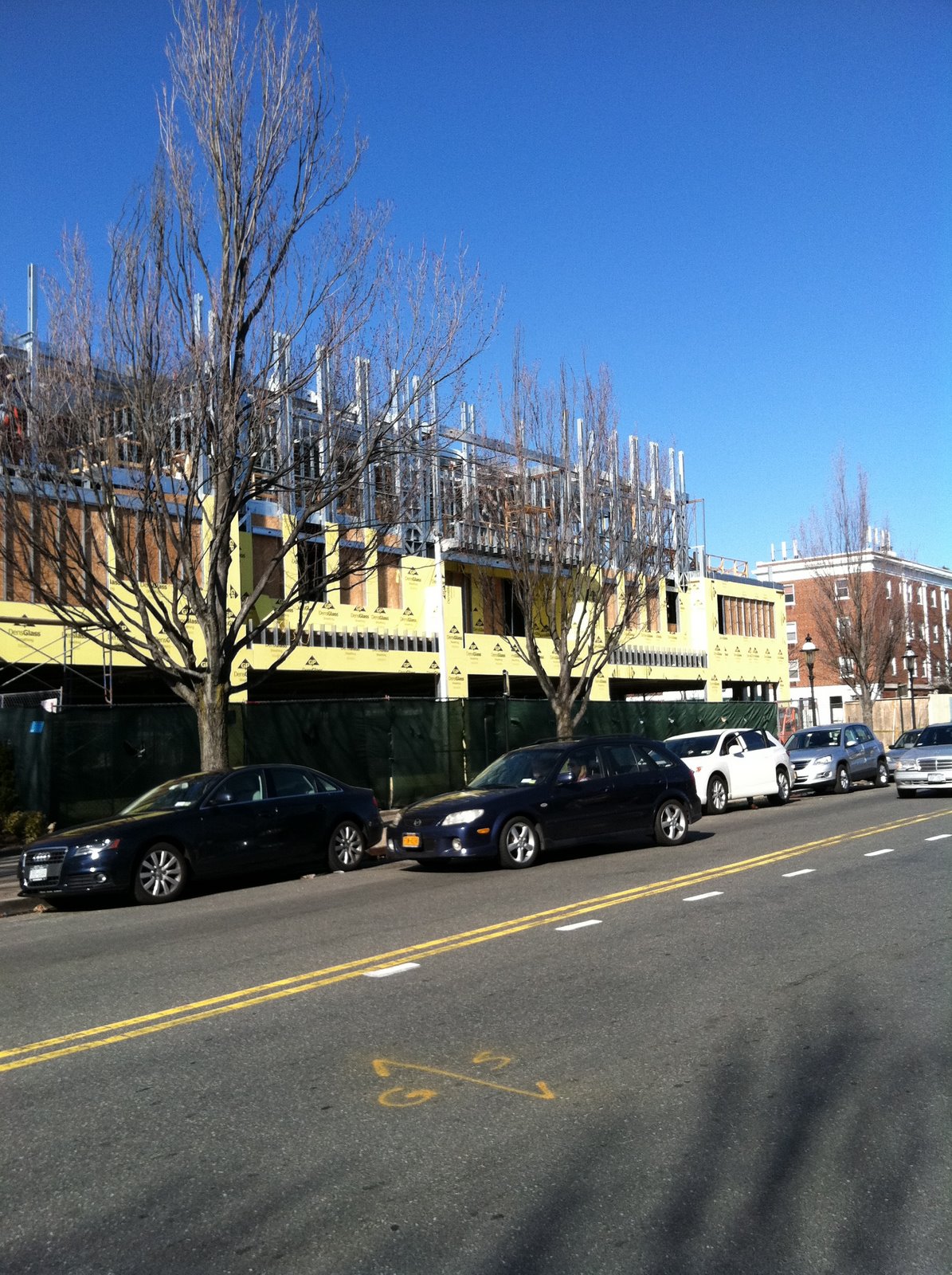
Last week we were in Garden City, NY. Back in 1996, DANTH had recommended that the site of a gas station on the very important corner of Franklin Avenue and Seventh Street would better serve the community’s needs if it were redeveloped by a project having retail on the ground floor and residential units above. I was happy to see that our recommendation finally was being implemented (see photo on right).


The fact that close to fifteen years had passed between recommendation and implementation strongly reminded me that downtown revitalizations seldom occur quickly and usually require patience. Some downtowns have been in the revitalization business for 40 or 50 years. For example, the formal revitalization effort in the Jamaica Center commercial district in Queens, NY, started back in 1968. The improvements have been steady over these years, with the total amount of investment attracted to this district totalling well over $1 billion by 1987 and the investment flow continuing on to this day.

Other downtowns seem to be overnight successes, but years of unnoticed hard work usually precede their rocketing economic upswings. In the mid 1990s, for example, downtown Englewood, NJ, attracted a significant number of national retail chains and eradicated a 20% retail vacancy rate. Many outside observers noted how quickly this downtown had turned around. Mayors and council members in other NJ communities envied this quick success and wanted to replicate it in their downtowns. Few of these observers knew of the 10+ years of prior planning, improvement projects and coalition formation that enabled Englewood’s “overnight success” to occur. 


One of the most important things that Englewood’s political leadership did was to form a common strategic outlook among the city manager, mayor and city council. This took time to forge and energy and attention to maintain. Unfortunately, many local political leaders in other communities do not understand the need for such a strategic coalition and/or do not have the political time or patience to create them. 


Sadly, the need for a revitalization effort to have some patience can slip into lassitude, inaction and redevelopment doldrums. Then, impatient local political leaders can give the downtown revitalization organization a badly needed kick in the butt.


As a general rule, DANTH recommends that clients treat a downtown revitalization effort as never ending, not something that in a few years they can strike from their To Do lists. Success not only has to be won, but then also maintained.   
Posted by Picasa