I greatly admired Steve Jobs for his ability to innovate, but most of all for his view about how to live your life. The latter is captured in this quote from his 2005 commencement speech at Stanford University:
“Your time is limited, so don’t waste it living someone else’s life. Don’t be trapped by dogma — which is living with the results of other people’s thinking. Don’t let the noise of others’ opinions drown out your own inner voice. And most important, have the courage to follow your heart and intuition. They somehow already know what you truly want to become. Everything else is secondary.”
Too many downtown organizations are staid and stale. A strong dose of Steve Jobs’s philosophy would do them a world of good. They need to follow an important Jobs dictum: Think Different! Also, they certainly could benefit from a Jobs-like fanaticism that their programs are well-designed and actually work, producing strong positive results. As a downtown business recruiter, Jobs, who strongly opposed asking consumers about the new products they wanted, would never ask local residents for the names of specific retailers that recruitment efforts should target.
These organizations also could definitely benefit from the kind of strategic vision that Jobs displayed since he returned to Apple’s helm.
And one more thing. In 2007, I bought an iMac and immediately had a lot of problems with it. On a whim, I emailed Steve Jobs and detailed my problems. In response, I received a call from Apple and about a week later a technician came to my office and completed a thorough overhaul of my iMac. Is there another CEO in the USA you can email and get a similar response?
Author Archives: DANTH
A CURMUDGEONLY VIEW OF BID STREET CLEANING PROGRAMS
Can Clean Be Overrated?
An online article that recently drew my attention and got me thinking was “America’s Dirtiest Cities” (http://travel.yahoo.com/p-interests-40390415) by Katrina Brown Hunt. It begins by posing the question: “Can clean be overrated?” It then notes that a survey of the readers of Travel + Leisure magazine found that “America’s dirtiest cities happen to include some very popular tourist destinations” (e.g., New Orleans, Philadelphia, Los Angeles, Memphis, New York City, Baltimore, Las Vegas, and Miami). Hunt goes on to note that “visitors gauge ‘dirty’ in a variety of ways: litter, air pollution, even the taste of local tap water.”
What drew my attention was not which cities were or were not on the “top dirtiest list” — for such lists tend to be not very useful — but, the fact that a group of people who are evidently very interested in being tourists found very popular cities to be “dirty.” Hunt’s question “Can clean be overrated?” seems to me to be a very legitimate one to ask, especially by the leaders of downtown business organizations who spend huge parts of their annual budgets on street cleaning operations.
Should Clean Streets Be A BID Priority? Are Dirty Streets That Big A Problem?
A few years ago while managing a Special Improvement District in a city in New Jersey I gave tours of the district to many developers and savvy commercial brokers. Invariably, they would comment on how good the district looked and the lack of litter on the sidewalks. At the same time the city’s political leaders, especially the mayor, were pressing for cleaner sidewalks. How clean did the sidewalks have to be to be considered clean by the local politicos? I thought it was all a bit too anal and somewhat tragic: sidewalk sanitation was getting all the attention of the political leadership when their focus should have been laser beamed on bringing redevelopment projects into the district. Their priorities were all fouled up. Ultimately, we succeeded in getting the local UEZ to pay for the litter cleaning crew, though the SID still had to manage it. Later on the city’s public works department took on the entire street cleaning responsibility and cost burden.
Quite frankly, that was where I felt the responsibility belonged in the first place. Street sanitation was long a city government responsibility, but in hard fiscal times, many of them successfully off-loaded that function and its cost to special downtown districts. By the late 1980s, as the number of BIDs quickly grew, dealing with “crime and grime” famously became their primary programs — and budget lines. But, I never saw any real evidence or serious study proving that clean sidewalks resulted in either more shopper visits or a significant reduction in the fear of crime.
To the contrary, my own research at that time failed to confirm such relationships. In 1984, for example, I did a telephone survey for Regional Plan Association (RPA) of 600 residents in the trade areas of three outer borough downtowns in New York City — Downtown Brooklyn, Jamaica Center in Queens and Fordham Road in The Bronx. A Pearson correlation analysis found a weak .12 association between how clean the respondents rated their downtown’s sidewalks and how often they visited that downtown.
Clean streets are often viewed as one of the signs of social disorder hypothesized by James Q. Wilson and George Kelling in their famous Broken Windows article to foster the fear of becoming a crime victim. While the RPA survey did find an interesting correlation of .26 between how clean respondents rated the sidewalks and how safe they felt in their downtown during the day, there were two other variables — the downtowns overall attractiveness and the types of people respondents expected to find there — that statistically had twice the explanatory power of the clean streets variable. Furthermore, the correlation between clean streets and how fearful respondents felt while downtown after dark, when fear levels are highest, dropped to .15.
My own conclusion at the time was that while the clean streets factor was one of many that, when aggregated, could impact on how attractive trade area residents felt their downtown was, it was getting a disproportionate amount of attention from downtown leaders and far too big a share of their BIDs’ budgets. I felt a lot of them would be better off if they shifted a lot of their street cleaning expenditures over to improving facades, stimulating nicer store windows, attracting quality business operators and developers, etc. Nothing has happened in the intervening years to change my views. If anything, they have been harden by my SID management experience that I described above and by my observations that some BIDs were paying for sidewalk cleaning services they could not really afford, given that their budgets were less than $250,000/yr.
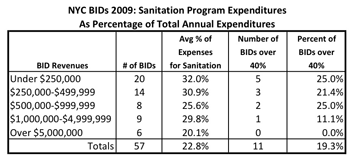
Among New York City’s BIDs, those with revenues under $250,000/yr allocate a higher proportion of their annual expenditures on street cleaning, 32%, than the other BIDs, followed by those in the $250,000 to $499,999 revenue category (see the table above). The largest BIDs, with revenues over $5 million/yr only allocate about 20% of their expenditure dollars on sanitation. Furthermore, among the BIDs with the lowest revenues, about one in four of them are allocating 40% or more of their annual expenditures on sanitation. To my mind, they seem to be more like a sanitation department than an economic development organization. What in the world are their leaders thinking? I use the New York data because they were readily available. The pattern of small BIDs overwhelmingly focusing on street cleaning operations also can be readily found elsewhere.Why Are Street Cleaning Programs Still Big With BIDs?
Though relatively expensive, these programs:
- Do not require rocket scientists to design and implement. There are existing programs to replicate and service providers to hire
- Quickly provide visible evidence of the BID’s presence and ability to do things. Lots of staff in identifiable uniforms provide a presence and cleaning up the litter is proof of efficacy. These are important program impacts for new BIDs
- Have been implemented by the largest and most prestigious BIDS. Unfortunately, too many of the other BIDs have fallen into adopting programs because their prestigious peers are operating them rather than asking whether such programs can really achieve their organization’s economic growth objectives.
- Are seldom terminated because most BIDs seldom, if ever, engage in real program evaluations
- Have developed an aura within the downtown revitalization community that they are always beneficial. After all, how can one be in favor of dirt and litter? But, that is not the real question.
For most downtowns, the real issues are will cleaner streets:
- Bring more shoppers downtown?
- Increase property values?
- Increase investment?
- Produce positive impacts commensurate with the cost of the street cleaning program?
- Have a bigger economic impact than if its operational dollars were diverted to other programs?
I am not against all BID street cleaning programs. Just those that have no proven impact on customer traffic and economic growth.
FROM DECAY TO TREASURE: THE HIGH LINE PARK
For many years an elevated rail line, that ran about a mile between buildings on Manhattan’s west side, sat unused and decaying. It snaked through an area probably made most famous by the title of a Richard Rogers ballet, Slaughter on Tenth Avenue.
Then a small group of people came up with the stunning idea of turning it into a park. They managed to make a viable plan, raise money, rally the support of local landlords and obtain city approvals.The result is a unique and hugely popular public space.
The High Line did not spark the area’s resurgence, but it has certainly reinforced it.
Across the nation, other projects like Millenium Park in Chicago, IL, and Mitchell Park in Greenport, NY, have taken decayed and even brown field locations and turned them into vibrant public spaces. More communities should look into following suit.
The photos in the slide show were taken over an 18 month period.
If you have trouble running the slide show you can go to my web photo album for the High Line.
N David Milder
TOUGH TIMES FOR THE MOVIE INDUSTRY — HOW IS YOUR DOWNTOWN CINEMA DOING?
Some Background
As a result of DANTH’s 2008-2013 downtown trend assessment work, we became very concerned about the future of movie theaters in a lot of medium-sized downtowns,so we keep our eyes out for news about the movie industry. In my February 24, 2008 posting, “DOWNTOWN MOVIE THEATERS WILL BE INCREASINGLY IN PERIL” I noted that according to a PEW survey:“By a five-to-one ratio Americans view films more at home than they do in movie theaters. Move theaters account for only about 12% of the movie industry’s revenues”
As a result of DANTH’s 2008-2013 downtown trend assessment work, we became very concerned about the future of movie theaters in a lot of medium-sized downtowns,so we keep our eyes out for news about the movie industry. In my February 24, 2008 posting, “DOWNTOWN MOVIE THEATERS WILL BE INCREASINGLY IN PERIL” I noted that according to a PEW survey:“By a five-to-one ratio Americans view films more at home than they do in movie theaters. Move theaters account for only about 12% of the movie industry’s revenues”
And, according to that same PEW survey, this trend toward watching movies at home was growing. The implicit danger posed by this trend for downtown cinemas, that often are just scrapping by, is a relentless deterioration in attendance and revenues.
Some Recent Observations in the NY Times
A recent article in the May 29, 2011 edition of New York Times had a title that grabbed my attention: “3-D Starts to Fizzle, and Hollywood Frets,” The reporters, Brooks Barnes and Michael Cieply, state that: “The box-office performance in the first six months of 2011 was soft — revenue fell about 9 percent compared with last year, while attendance was down 10 percent.” That’s off of a 5.25% attendance decine reported by boxoffice.com for 2010. To give those delines some perspective, remember that a mere six percent drop in attendance back in 2000-2001 pushed most of the theater chains into bankruptcy. The current drop in attendance and revenues might be explained by our stalled economy and/or rocketing gasoline prices, neither of which promise to soon disappear.
Many Hollywood big wigs, such as James Cameron and Jeffrey Katzenberg, have argued that 3-D movies would save the industry by bolstering audiences and revenues. But Barnes and Cieply also report that now “there is strong consumer resistance to high 3-D ticket prices” and “the novelty of putting on the funny glasses is wearing off.” While the best 3-D feature films still are doing well at the box office, 3-D films of more ho-hum quality are taking a box office beating in the USA.
Barnes and Cieply also reported that rentals in video stores during the first part of the year fell 36 percent. This fact would be consistent with the crumbling of the Blockbuster chain and a substantial growth in the streaming and downloading of films to home TV and computer screens through Internet services such as Netflix, Amazon and iTunes. The latter was a possibility DANTH’s trends assessment feared would be all too likely.
My Take-Aways
With retail gasping for breath in most downtown and Main Streets commercial areas, their entertainment niches have taken on an even greater importance than they have had in the past. Downtown movie theaters are often the cornerstones of these niches and the recent decline in attendance suggests they may be facing substantially increased financial stress.
Strengthening downtown entertainment niches in small and medium-sized communities will probably follow two strategic paths:
- Buttressing the magnetism of the movie theaters through a package of improvements that includes: 3-D and IMAX screening capabilities; tie-ins with adjacent or in-house restaurants, bars, brew-pubs, ice cream parlors, etc.; clean theaters, with comfortable seating and audiences displaying civil behavior
- Developing non-formal entertainments, most importantly in well-activated public spaces and restaurants.
What’s Happening in Your Downtown?
Please let me know what is happening in your downtown or Main Street district. If thereare sufficient responses, I will report on them in special posting to this blog.
N. David Milder
GETTING THEIR STORIES TOLD — WHAT PETITE BUSINESSES NEED FROM E-MARKETING
Morristown’s Treasured Businesses
France Delle Donne, the director of development at the Morristown Partnership (in NJ), recently sent me a link to a new posting to their website called Morristown’s Treasured Businesses. I took a look and thought it was just terrific! One of the best things I have seen on any downtown organization’s website in a long time. It’s so different from the dull, static, list-based or e-business directory like structures that I typically see on the webpages of these organizations that deal with merchants. It got me thinking about what I liked so much about it and why. I concluded that, though it had many attractive aspects, it was its ability to provide a narrative for each of these business operators that was most important. Storytelling is a critical factor in successfully marketing a downtown and its businesses, though too often overlooked. Branding is a more widely accepted marketing concept, yet the strongest brands gain their power from denoting some kind of story, even a short one.
The High School’s Involvement Was Critical
Morristown High School’s Broadcasting and Journalism departments approached the Morristown Partnership about doing a project on Morristown. After an initial meeting and assessment of resources , the Partnership brought them a proposal for “Morristown’s Treasured Businesses.” With significant development taking place in Morristown’s business district over the past five years and an influx of new businesses moving in, the Partnership felt it timely to focus on independently-owned businesses that have been in operation for 25 to over 100 years and weathered a variety of economic cycles. According to the Partnership:
“We wanted to use this opportunity to connect established businesses with the younger constituency in our community. The hope was to raise a cross-generational awareness and appreciation about treasures in Morristown, including businesses and the human connections associated with them. It had all the components to tell a great story. The High School embraced this idea.”
Fifteen of the 55 businesses that fit the selection criteria were then interviewed and filmed by the students. A total of 48 students were involved in all phases of completing these merchant “documentaries.” The finished films were then posted on the Partnership’s website for the public to view and vote for their favorites.
Downtown organizations seldom have the resources to do everything they want, so having other organizations, such as the local high school, get involved is a really good idea. In Morristown, the high school faculty and students not only got involved, they did so for a novel, needed and effective program.
Additionally, as the Partnership recognized, high school students are an important retail market segment in Morristown — and in many other downtowns — so relationship building with the high school and its students is a good idea for the Partnership as well as many other BIDs and SIDs.
Coping With the Longing for Trophy Retailers Syndrome
Another reason I liked Treasured Businesses so much is that it addresses a critical problem faced not only by the Partnership, but by many other downtown organizations as well: local residents focus on the trophy retail chains that are not in their downtown, but do not acknowledge or appreciate the good small merchants who are there.
Another is its use of the dynamic short movies to enable the local business operators themselves to talk about their shops and their histories in the community. As they tell their stories , these merchants become alive to the viewer, allowing the latter to develop some involvement in the stories and some attachment to the merchants.
The Decline of Storytelling About Local Businesses That Has Accompanied Downtown E-Marketing
For many years, from roughly the mid 1980s until fairly recently, many downtown organizations found that doing newspaper inserts and special magazines were strong marketing tools. They gave these organizations the capability to send strong editorial content, that they created and controlled, to both potential consumers and commercial tenant prospects. At the heart of these publications, their most effective components, were stories that convincingly conveyed to the reader that the businesses or the downtown characteristic covered by that story were interesting, unique and/or — most importantly — a discovery. But, the times are “a-changin.” Downtown organizations are quickly shifting their attention to e-marketing and their websites, e-newsletters and Facebook pages. My visits to many of these websites suggest that this shift from print to electronic marketing has been accompanied by a steep decline in the story-telling their marketing utilizes.
One reason for this trend may be that the easiest, cheapest and quickest ways to present information about local businesses on websites are in list/directory formats that primarily focus on category descriptors of business functions combined with basic contact information. In a few instances a short descriptive paragraph or two, perhaps even a photograph is provided. But, even fewer if any of these formats produce real stories about the local businesses. It’s more like name, rank and serial number, slam, bam, thank you mam. Also, using text to tell a story usually takes more words and time to read than most “webmeisters” advise for a webpage.
The short movies provide an e-commerce, non-text technique for effective short storytelling. It has a strong personal component to it and thus can evoke viewer feelings and involvement.
Storytelling May Be How E-Marketing Can Best Help Really Small Merchants
Since my work on the ‘deliberate consumer” I have been concerned about how the small business operators , say those “petite” firms with annual sales under $300,000/yr
- Can be stimulated to make the management and operational changes they must implement if they are to survive
- And how downtown and Main Street organizations can help them to make these changes.
As I have written in some recent postings to this blog, having an effective e-commerce presence is probably one of these necessary innovations, but:
- A full-fledged e-store is probably too complex and resource demanding to be a viable option for these merchants
- The directory type formats on either the business’ or a downtown organization’s website, even when blown up into full webpage formats, do not have sufficient impact to warrant the time and effort needed to create and maintain them.
I would argue that the best thing that their website or a page on their downtown organization’s website can do for one of these “petite” businesses, is to tell their story. That is what Morristown’s Treasured Businesses does for these businesses. It provides a model for other downtown organizations to emulate, even if some tailoring to their situations probably will be needed.
Again, the teachers and students at Morristown High School are to be strongly commended for their participation in this program and for doing such a good job on it!
N. David Milder