Downtown Formal Entertainment Venues: Part 3

By N. David Milder

Revised April 26, 2014

Introduction

On our downtown revitalization assignments over the years, DANTH has heard many local leaders suggest as a major strategic element either creating a formal entertainment venue or improving an existing one. In many instances, this concern was focused on the issue of maintaining or attracting a movie theater, but in many others, the issue was either the saving and renovation of an old theater or the creation of a performing arts center. Additionally, I have either lived in or frequently visited a number of cities where such issues have arisen. Consequently, I used these communities as an informal sample to investigate how their formal entertainment venues operate. Some of the communities included in this sample were: New York City and White Plains in NY; Newark, Rahway, Englewood and South Orange in NJ; Cleveland and Columbus in OH; Carlisle, PA, and Rutland, VT. Admittedly, this sample is both small and not systematic, but I think the observations presented below still are pretty much on target.

Advocates of these formal entertainment venues often advance a two-pronged argument for them that is well articulated by Cleveland’s PlayhouseSquare on its website:

  • “As the country’s largest performing arts center outside of New York (it has eight venues), the not-for-profit performing arts center utilizes the arts to engage individuals and attract over one million guests per year to its 1,000+ annual events. These audiences act as the catalyst for economic growth and vitality within the region….
  • Stage activity on our multiple performance spaces draws over one million people annually to downtown…people who also dine, shop, work, vacation and help neighborhood businesses thrive.” (Italics added.)

In other words, the audiences of these formal entertainment venues are supposed to have positive impacts on the city or regional economy while generating a lot of new pedestrian and customer traffic for nearby businesses, especially for nearby restaurants and retailers.

In too many instances recently, such advocates also see these formal entertainment venues as providing the missing revitalization engine, the silver bullet solution for their downtown’s renewal. Such advocacy, for example,  is frequently to be found voiced in many downtown revitalization related LinkedIn group discussions.

When are these entertainment venues open and why is that an important question?

We visited the websites of the venues in our sample to count how often and when they were open. The vast majority:

  • Had an event (sometimes two) on between 80 and 150 days per year; though some venues were as low as four events a month. Most days and evenings of the year they are “dark”
  • Most entertainment events occur on weekends; most dark days are midweek
  • Daytime midweek events tend to be “educational,” with a lot of school kids being bused in and out
  • Most entertainment events are scheduled for the evenings
  • A vast majority of these venues are “dead” for three months during the summer, with very few if any events during this time period.

First, it should be noted that most of the venues we looked at do not attract anywhere near the one million visitors a year claimed by Playhouse Square. More typical for smaller communities with populations of less than 25,000 is Theater X, that has 838 seats and in a recent year had 140 events. That translates into a maximum attendance of 117,320, assuming every seat at every event being filled.

More importantly, the audience traffic these venues attract will be arriving at a time of day when most businesses – especially in small and medium sized downtowns — are either closed or getting ready to close. Restaurants and watering holes are the businesses most likely to benefit from this audience traffic. The size of this impact will obviously be related to the size and spending power of the audience flow and the number of events held at the formal entertainment venue.

But, the need for pre-theater meals tends to abbreviate the time available for pre-theater shopping, especially on workweek evenings, even in those shops – most likely chain stores – that are open that late. The truth of the matter is that during most weekdays these venues are generating little or no pedestrian traffic that nearby retail businesses are likely to tap. The same is the case for most evenings and both daytimes and evenings during three summer months.

This, in turn, strongly suggests that the direct positive economic impacts of the formal entertainment venue audiences often are appreciably over-estimated, even the more probable impacts on restaurant revenues. For example, Theatre X claims that it generates about $4 million a year in revenues for nearby downtown eateries and watering holes. That would mean that every one of its maximum 117,320 person audience would: 1) eat a pre-theater dinner downtown and 2) spend $34.09 per dinner. It also means that its downtown eateries can handle a pre-theater dinner rush of 800+patrons. It is very doubtful that every theater patron would have either a pre or post theater dinner downtown or spend on average about $68 for a dinner for two. Also, I seriously doubt that this downtown’s eateries can handle a pre-theater dinner rush of that size in that price range.

Programming: culture, popular entertainment, education

The term “performing arts center” may conjure up expectations of programs filled with high brow cultural events such as classical music, ballets, operas, classic and Broadway plays, jazz, etc. Such performances (including Metropolitan Opera HD broadcasts) are indeed to be found on the calendars of the arts venues we looked at. However, it is interesting to note that PlayhouseSquare says on its website that entertainment is its core and that most of the performing arts venues in our sample have programming that is focused on a broad range of popular entertainments such as:

  • Concerts by acts featuring various types of music: popular, rock and roll, folk, ethnic, etc.
  • Family shows
  • Speakers
  • Comedians
  • Screenings of the broadcasts of NFL playoff games
  • Educational programs and plays for children
  • Motion pictures: some show classics on a limited basis; others show new films in cinemas built into their building or on their campus.

Obviously, these organizations are doing what they feel they need to do to drive patrons through their doors and win the earned revenues that will help them stay in business. For example, Eric Mallette, the programming director of Rutland’s Paramount Theater, says “that he pays a lot of attention to what the local market responds to and tries to book shows and adjust ticket costs to fit those trends” (1). For many years that meant popular music and family entertainment, including the booking of a lot of comedians. According to Bruce Bouchard, who runs the Paramount Theater: “We started booking comedians and it just took off” (2).

The importance of making ends meet is demonstrated by the fact that many of these venues rent out their spaces for business meetings, weddings, bar mitzvahs, etc.

It seems to me that, save for one or two exceptions, entertainment center is a far better descriptor of these venues than performing arts center. This is not pilpul, since the distinction can lead to differing expectations for a formal entertainment venue, how it is designed and the operational decisions its management makes.

Some of these venues provide homes for resident performing arts companies — orchestras, dance companies, theatre companies, performing arts schools, etc. This will influence a venue’s programing and the paths and strengths of its economic impacts. It is one of the things, in my opinion, that differentiates a performing arts center from a theatre or a group of theatres.

Have successful formal entertainment venues directly generated more pedestrian traffic, produced stronger retail or been the prime engines of successful revitalization?

A caveat: the following are my personal observations and conclusions, based on my field visits (often over many years or decades) and limited research efforts that involved internet searches and some personal interviews. Obviously, they are not based on a systematic research effort — that would require resources well beyond those available. Nevertheless. I am hopeful that the reader will find the evidence and arguments presented below convincing.

Lincoln Center for the Performing Arts, New York City. This center is the home of 11 world class resident organizations such as The Chamber Music Society of Lincoln Center, Jazz at Lincoln Center, Julliard School, Lincoln Center Theater, Metropolitan Opera, New York City Ballet, New York Philharmonic and the School of American Ballet. Conceived as an urban renewal project in the 1950s and parented by the Rockefellers and Robert Moses, it opened the doors of its main buildings during the 1960s.

Though it has had its fair share of problems, I think it is accurate to say that Lincoln Center is generally viewed in all quarters as a successful home and vital asset for its resident organizations as well as a very strong cultural and economic asset for the city as a whole.

In the 50+ years since its inception, the Upper West Side of Manhattan, where Lincoln Center is located, has experienced such a strong rebirth as a residential area that many now argue it is the priciest and most coveted in the city. As the old adage goes, retail follows roofs. Retail on the Upper West Side has changed significantly, but mostly over the last 10 to 15 years, when many prestigious retail chains discovered the area (and rising retail rents forced many independents to close). This retail growth lagged, for decades, far behind the success – and audience attendance – of Lincoln Center, but followed more closely the construction of many new high-end condo buildings.

Lincoln Center did stimulate the development of a cluster of nearby restaurants and bars, but the quality of this cluster and the larger Upper West Side restaurant scene also improved substantially with the neighborhood’s residential resurgence. This suggests that Lincoln Center has indeed been an important revitalization engine, but that its most direct impacts have been to make the neighborhood a more attractive place to live in, not by providing more customer traffic for local retailers, restaurants and bars. It also should be noted that the residential rebirth of the Upper West Side cannot be attributed alone to Lincoln Center. The neighborhood’s proximity to Central Park, Riverside Park and the Midtown Manhattan CBD as well as its subway and bus lines also were important factors. Nevertheless, since it has helped attract a larger and more affluent local residential population, Lincoln Center most probably has impacted positively, if indirectly, on the economic well-being of local merchants. Note that this indirect impact flows independent of the center’s performance schedule.

Lincoln Center’s urban renewal heritage also gave it a design that, combined with the operating hours of its venues, made it difficult for local merchants to benefit from the large audience traffic they generated. As Roberta Brandes Gratz wrote so perceptively back in 2003:

“…Lincoln Center has never really worked. This island of culture stands apart from the city like a fortress, with an elevated plaza on the east offering a lukewarm welcome to one segment of society while concrete walls shut off the less fortunate segment represented by the public housing to the west. Centers like this deaden urban street life, bringing a rush of traffic and human activity all at one time and then lying almost dormant the rest of the day, like a stadium without a game” (1).

To rectify this situation, in 2010, Lincoln Center completed a widely acclaimed project aimed at making the center more permeable and to increase the public’s use of its plaza spaces during the daytime hours when there are no performances. On my daytime visits since 2010, I have observed far more people using these public spaces than I had in the past. This has made the Lincoln Center area “stickier” for visitors, which is bound to benefit local businesses.

Some other large PACs around the nation also suffer from being “islands of culture” with impermeable designs and considerable amounts of time when they are “dark” and inactive. This especially seems to occur when they are inserted into a decayed, low income area. Sports stadiums and arenas inserted into a downtown or city residential area also tend to suffer from being functionally dead for substantial amounts of time. Of interest: the planned renovation of Chicago’s Wrigley Field and the area adjacent to it has components specifically aimed at keeping the area activated on non –game days.

The Paramount Theater, Rutland , VT. Rutland is a small city of about 17,000 people, often referred to as a blue collar, beer drinking type of town, that is also the financial and commercial center of central Vermont. During the 1990s DANTH completed two major reports for the Downtown Rutland Partnership and in both we advocated for the renovation of the Paramount Theater as a way of growing the downtown’s entertainment niche. I last visited the theater sometime around 2000, when it was in its final stage of renovation.

For decades, the region’s economy has been slow growing and it did not fare well during the Great Recession. Through these years, Rutland’s downtown has had its ups and downs. In recent years the challenges have grown with the closings of many of its longtime retail shops as well as its movie theater. (Happily the movie theater re-opened under a new owner who upgraded the projection to digital and 3D and it now appears to be doing well).

After reopening in 2000, the Paramount first struggled to establish itself and then, through the Great Recession, grew in strength. Its annual budget increased from about $700,000 to $1.3 million and the number of performances it presented per year swelled by 75%. The renovated theater gave the community a very attractive and badly needed venue for a wide array of entertainment events — and one local residents could take pride in.

In a recent conversation, I asked Dick Courcelle, the former executive director of the Downtown Rutland Partnership, if what the Paramount does for the downtown today was worth all the blood, sweat and tears that went into its renovation or would they have been better off investing in some other type of project? “It’s absolutely done what we wanted it to do; it was well worth all the effort and resources,” he replied.

In terms of economic impacts, the Paramount’s growing success by itself could not turn the tide for Rutland’s downtown retailers, though it obviously has had some benefits for downtown eateries. Neither could the combination of the Paramount and a rejuvenated movie theater serve as a silver bullet cure for the ills of downtown retailers.

Thinking about the situation in downtown Rutland brought to mind the fact that during the deterioration of the Times Square area here in NYC during the 1960s and 1970s, the many legitimate theaters in the area continued to do a brisk business. Their strength, too, could not prevent severe challenges of social disorder and physical decay from emerging in the neighborhood.

PlayhouseSquare, Cleveland, OH. My association with Ohio goes back to the late 1950s when I went to Kenyon College and then I worked in Columbus for 10 years in the 1960s and 1970s. I have returned on personal and professional visits since then, the most recent being two trips to Cleveland in 2009 and 2010.

Cleveland has long been one of my favorite cities because of its treasures in the arts and sports. The Cleveland Museum of Art and the Cleveland Orchestra playing right across the street in Severance Hall are both world class and worthy of repeated visits. They are part of the University Circle cluster of cultural facilities located about five miles east of the downtown’s Public Square, that also includes the Cleveland Institute of Music, Cleveland Institute of Art, Cleveland MOCA, Cleveland Botanical Gardens and Case Western University.

The city also has many active theatres that date back many decades. For example, the Cleveland Play House, America’s first professional regional theatre, was founded back in 1915. Over the years it has staged more than 1,300 productions that included over 100 world and/or American premieres. For many years, CPH was located on a campus well  beyond the downtown on Euclid Avenue near the Cleveland Clinic and about a mile west of the University Circle culture cluster. Recently, it moved downtown to PlayhouseSquare where it will have three venues, including the new Allen Theatre.

PlayhouseSquare is a performing arts center that not only operates eight theaters in downtown Cleveland’s theatre district, but takes on neighborhood real estate development functions and helps local artists obtain needed resources.  The theatre district is a 13 to 15 minute walk from Public Square and Tower City Center. It neighbors Cleveland State University. Its spine is Euclid Avenue which runs from Public Square through the theatre district and then goes on through CSU, the Cleveland Clinic and University Circle.


Figure 1. The Ohio, State and Palace Theatres in downtown Cleveland's Theare District

Figure 1. The Ohio, State and Palace Theatres in downtown Cleveland’s Theatre District


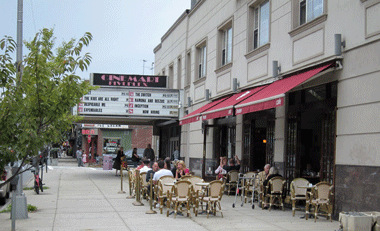
Figure 2. Looking down the sidewalk as the theater district meets the CSU campus

Figure 2. Looking down the sidewalk as the theatre district meets the CSU campus

I first visited Cleveland’s theatre district with friends in the mid 1970s and took a closer look at it, at the suggestion of the Greater Cleveland Growth Association., in the early 1980s when I was working on Regional Plan Association’s downtown security and economic development program. On my more recent visits to Cleveland, in 2009 and 2010, I walked about the district and drove through it on several more occasions at various times of the day and evening. My impression was that the district was in good physical condition and appeared to be on an upward revitalization path. Together with the CSU campus, it provided an attractive  geographic core upon which additional redevelopment might be attracted. While new eateries were evident, I noted little significant retail. I also observed few pedestrians on the streets, save in the early evenings before showtimes. This, I observed in my field notes, was typical of the theater districts I have visited over the years.

The statistics PlayhouseSquare cites also indicate that it is a popular and successful operation:

  • One million + guests per year
  • 1,000 events per year
  • $4 million per year in contributions.

The revitalization of downtown Cleveland is very much still a work in progress. The strength of PlayhouseSquare is obviously a significant asset in that process, but not the sufficient condition for the downtown’s success. The paths of its positive impacts do not involve generating significantly heightened flows of daytime pedestrian traffic in the district or making the area stickier so visitors will stay around longer. Instead, the direct positive impacts are likely to involve such factors as:

  • Making the neighborhoods near the theater district, as well as the larger Cleveland metro area from which PlayhouseSquare draws it patrons, more desirable places to live
  • The jobs and salaries it generates for people who live in the region, especially for those in arts-related occupations
  • The dollars spent in the metro area by PlayhouseSquare productions
  • Making the Cleveland area a more popular tourist destination.

These impacts are primarily regional in nature. The rest of the downtown probably benefits from them in terms of how it fits into the region. On a more local level, PlayhouseSquare’s impacts probably have been:

  • Providing an effective redevelopment organization for an important downtown area that also helps find resources to support the creativity of local artists
  • Creating a healthier and more appealing commercial area, one that also may be attractive to non-entertainment  and non-retail types of businesses
  • Stimulating a district restaurant niche

In the past, I have argued that the geographic dispersion of Cleveland’s cultural assets had weakened the downtown. However, the regional character of so many of PlayhouseSquare’s probable positive impacts suggests that the downtown might get its share of such benefits regardless of where a performing arts venue is located — as long as it is within a reasonably easy travel time of the city’s center. The University Circle culture cluster is only about a 12 to 18 minute drive from the downtown’s Public Square or about a 35 minute trip along Euclid Avenue on a Healthline bus.

In contrast, visual arts entertainment venues, such as museums and galleries, can attract substantial amounts of pedestrian traffic downtown during daylight hours, as the lines outside MoMA in Manhattan often demonstrate.  Viewed from that perspective, not having either the Cleveland Museum of Arts or Cleveland MOCA located downtown is probably a loss. However, a great number of important art museums are not located in or near their downtown’s core. Many are located in park-like settings that would be difficult to recreate given the existing building densities s and high land costs found in many of today’s downtowns.  Moreover, today many museums feel they need very large exhibition spaces  such as those in London’s Tate Modern and Paris’s Gare d’Orsay. The former is a converted power station, while the latter used to be a rail station. As these conversions suggest, finding sites to build such large museums on in choice downtown locations is likely to be difficult and very expensive. DIA’s decision to build in Beacon NY instead of Manhattan is a good example of this.

Similarly, gallery owners are often forced by high rents to locate in secondary neighborhoods near the CBD — that they often help revitalize and the resulting higher rents then forces them to move to yet another neighborhood, that they help revitalize….

Some observations and take-aways

If downtown leaders want to attract more daytime pedestrian traffic and keep visitors longer in their districts, formal performing arts venues probably are not the strategic vehicles to use. The number of events they present and when during the day they are presented prevents them from being effective in this manner. Other potential elements of a downtown entertainment niche, such as well activated public spaces, are probably better able to generate more pedestrian traffic and make the downtown stickier.

PACs with island fortress designs make it difficult to establish a pedestrian friendly environment.

Nor are these venues likely to have direct positive impacts on downtown retailers. To some degree the downtown retailers themselves are at fault here — especially those in small and medium sized communities — since they are loathe to stay open into the early evenings. However, theater goers all too often have very little time to stroll and shop before their events start.

Furthermore, performing arts centers are certainly not silver bullet solutions to downtown revitalization problems. They cannot and do not by themselves produce such a result and their successes can have a substantial lead time on the rebirths of the rest of their downtowns.

Many of the benefits produced by these formal entertainment venues are regional in nature and the other parts of the downtown would probably share in them even if they were located elsewhere. Primary, in my opinion, are their abilities to make the area a more desirable place to live and to provide employment and financial support for those in arts-related occupations.

From a more local perspective the creation or rehabilitation of such venues can lead to the physical improvement of one or more buildings as well as streetscapes in a part of a downtown. They also can stimulate the development or growth of a nearby restaurant niche.

Sometimes, as in the case of PlayhouseSquare, these entertainment centers are managed by organizations that have evolved to perform important real estate development and arts support functions. CAPA, in Columbus OH, is another such organization that comes to mind. They are real assets for their downtowns and their communities. They also have greater economic impacts than those venues that just focus on events/performances. Unfortunately, most of the entertainment venues we looked at did not have an organization of this kind.

Communities are undoubtedly strengthened when they have attractive venues where residents can come together to enjoy entertainments, including the performing arts. Establishing such venues can be complex and expensive endeavors. Their financial futures are likely to be uncertain given their perpetual needs to have sufficient revenues from earned incomes and contributions at a time when arts consumption is falling, entertainment consumption is becoming increasingly electronic and contributions are harder to obtain. Whether the benefits for the downtown of establishing them in the downtown will outweigh their financial operating risks and high capital investments are issues that require close scrutiny. Also needing consideration are the alternate projects that this capital might be invested in that  might produce greater direct benefits for the downtown. The “multipliers” usually trotted out to determine project impacts are ill suited for answering these questions, since their geographic unit of analysis is the region or county, not the downtown.

One way that these formal entertainment venues might increase their direct economic impacts on their downtowns is by incorporating  an activated public space into their designs and operations that would attract more pedestrian traffic during the daytime and make their neighborhood stickier. In effect, this what was done by the renovations to Lincoln Center and to the Tines Square theatre district when the city closed much of the Square and Broadway to auto traffic and provided places for people to sit.

© Unauthorized use is prohibited. Excerpts may be used, but only if expressed permission has been obtained from DANTH, Inc.
The New Normal’s Challenges to Developing a Downtown Entertainment Niche Based on Formal Entertainments: Part 2 the audiences; revised 041214

Posted by N. David Milder

Introduction

This is the second part of the third in a series of articles about the “new normal” for our nation’s downtowns. It focuses on the challenges many downtowns — especially those that are not very large — now face when they decide to bolster their central social district functions by creating and/or strengthening their venues for the performing and visual arts, e.g., performing arts centers (PACs), theaters, cinemas, concert halls, museums, art galleries, etc. Part 1 dealt with a general introduction of the challenges, a discussion of who can afford formal entertainments and changes in the ways governments, corporations and foundations are funding arts projects. Part 3 will discuss a number of formal entertainment venues as examples and then dive into an update of DANTH’s analysis of what’s happening with movie theaters.

Here, in part 2, the discussion will turn to changes in the ways Americans attend performing arts events and visit visual arts venues. Secondary analyses of two kinds of data will be employed: representative sample surveys done for the National Endowment of the Arts (NEA) and other arts related organizations and reports of admissions to various types of arts venues/performances that were obtained from a number of arts sector organizations.

While both types of data can potentially shed light on consumer demand for attending various performing and visual arts events, they are quite different in nature, much as beans differ from broccoli, though both are vegetables. For example:

  • While the surveys ask individuals whether they attended various arts events over the prior year, the admissions data report the number of people who attended events put on by arts organizations or visited their venues. The surveys report on characteristics of individuals; the admissions data are characteristics of the organizations or venues
  • Translating directly between the two usually is difficult because of a number of issues. For example, the NEA survey may ask about attending classical music concerts, but the best relevant  admissions data are only about attendance at concerts done by our largest symphony orchestras. The NEA survey data reports do not detail how often an individual may attend a particular type of arts event, e.g., once to a museum, three times to an opera, six times to a ballet, etc., while the Culture Track report does. The admissions data reports do not detail how many admissions were accounted for by people who had attended multiple times, e.g., subscription ticket holders
  • The survey data also tell us, at least by implication and sometimes overtly, about the percentages of people who did not attend each of the arts events/venues asked about. However, memories about attendance over a prior year can lead to an unknown degree of erroneous reporting. The admissions data are not informative about those who do not attend. They simply indicate an important fact for those operating arts organizations and venues: whether admissions have gone up or down – and usually with a good deal of reliability
  • Population growth is also an important factor. It is entirely possible that the number of people who are buying tickets for a type of arts events, e.g., chamber music, stays the same over 10 years, but, because of population growth, their proportion of the population would decline.

In this article the survey data will be treated as providing evidence about the proclivities of individuals in the USA to attend various arts events/venues and for explaining why they do so. Though their availability are quite limited, the admissions data will be treated as the best data about actual attendance and ticket sales and as the best indicators of how arts organizations and venues are doing. Obviously, the former should have some impact on the latter, but the paths of that influence are often difficult to accurately identify and detail. However, when both show a similar pattern, e.g., declining attendance and admissions, they can help validate each other’s findings.

The Surveys

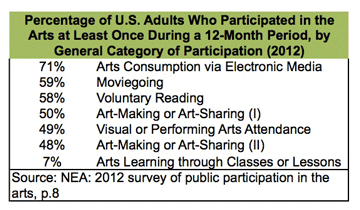
The potential audiences for formal entertainment venues are composed of people who “consume” art by attending performing arts events (plays, operas, concerts) or visiting visual arts venues ,e.g., museums, art galleries, etc. The 2012 NEA survey shows that only 49% of its respondents reported engaging in such attendance behavior in the prior year (see the table immediately below). Movie-going, in comparison, had a 59% attendance rate.

NEA-arts-partcipation-at-least-once-2012

Looking more closely at specific arts, the NEA survey showed that in 2012 only relatively small proportions of respondents attended them: classical music 8.8%; jazz 8.1%; dance other than ballet 5.6%; ballet 2.7% and opera 2.1% (see table immediately below). This suggests that the potential audiences for such arts events are comparatively small, though they will be higher where they are geographically clustered, e.g. affluent neighborhoods.

Moreover, when compared to the findings of a 2002 NEA survey, it appears that there has been a general decline in attendance: classical music -24%; jazz -25%; dance other than ballet -11%; ballet -31% and opera -34%. This would indicate that the audiences for these performing arts are not just relatively small, but they are also dwindling when looked at on a percentage basis.  

NEA arts partipcation table 031514

The National Arts Index Report 2013 (NAI) uses survey data gathered from 210,000 individuals by Scarborough Research to demonstrate that attendance at art museums between 2006 and 2011 was below 2003 levels, down by about 8% in 2011 (1). Moreover during the 2003-2011 period, museum attendance never regained their 2003 level.

Some have argued that the decline in arts attendance revealed in the NEA’s 2008 survey was a result of the Great Recession. However, 2012 is three years after the recession’s official termination, yet the decline continued. The economy is undoubtedly a factor, but probably through economic forces that were in play prior to the recession’s onset and continue to have impacts today. This view will be supported below when the admissions data of arts venues are discussed.

arts-consumed-thru-electronic-media

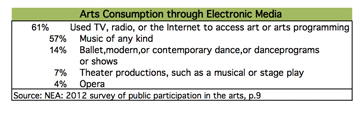
One reason for this decline may be the growing consumption of performing and visual arts through electronic media. For example, the 2012 NEA survey found that 61% of the respondents used TV, radio or the Internet to access art or arts programming (see table above).  A closer look shows that 57% consumed music of any kind via the electronic media;  14% accessed ballet, modern or contemporary dance or dance programs or shows; 7% theater productions and 4% opera. The numbers for dance and opera rival those who attended such performances in person in theaters or other physical venues.

In the near future, technological innovations may increase this diversion to e-attendance. For example, Mark Zuckerberg posted the following comment to explain Facebook’s purchase of the maker of the Oculus virtual reality headset: “When you put  (the headset) on, you enter a completely immersive computer-generated environment, like a game or a movie scene or a place far away. The incredible thing about the technology is that you feel like you’re actually present in another place with other people” (2). The potential for using a virtual reality headset to attend sports events, plays, concerts, operas, etc. appears real; the degree to which it will be realized remains unknown. If not Oculus or some other virtual reality device, then some other technology may emerge to drive more e-attendance. This Pandora’s box has been opened. Also, it should  be remembered that technological impacts on arts attendance are not a new phenomena: back in the 1950s TV viewing drastically decreased movie attendance and changed the way that industry works, but we still keep going to movie theaters.

Other factors are also very important in determining attendance at arts performances. As the Culture Track 2011 report noted: “Decisions about whether to participate in the arts are driven primarily by cost, programming, and convenience. This is true at all ages and income brackets” (3). This report was also based on a large national survey with 4,000+ respondents. The NEA surveys also show that age, education  and ethnicity can be factors, but it notably neglects to discuss the impacts of income. Education is probably acting somewhat as a surrogate variable for income in the NEA analyses because of their high correlation. In today’s economy, one might reasonably argue that admission cost is a major determining factor for persons who are not wealthy and who do not have heaps of discretionary dollars to spend.

Arts-8-distinct-mkt-segments

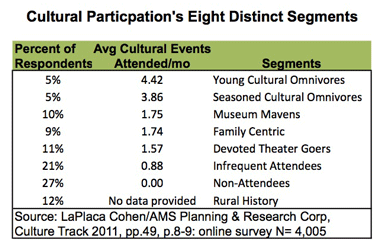
The Culture Track 2011 study did identify a number of high arts consumers: the young cultural omnivores — likely the young hipsters with lots of discretionary dollars to spend — and the older seasoned cultural omnivores, who  appear to be older and affluent. As the word “omnivore” implies, both like to attend a variety of arts/cultural events. However, together, they represent only about 10% of  the Culture Track survey’s respondents. Then there are three segments that specialize in the type of cultural events they prefer to attend: the museum mavens just like to visit museums, the devoted theater goers just like to go to the theater and the family centrics prefer to attend mostly child friendly events. The specialist consumers’ attendance rate is about half of that of the omnivores. The specialists account for 30% of the Culture Track survey’s respondents. Forty-eight percent of the survey’s respondents are non-attendees and infrequent attendees, and 12% are in the rural history segment that basically is lives in very rural areas, far from major cultural venues. 

The Culture Track survey also found that decreasing attendance was being influenced by the general economy and manifested in the reduced number of events culture consumers went to,  not in a reduction of the number of people who are culture consumers.

These findings suggest that besides about half of all adults being hard or impossible to attract to cultural events, substantial portions of those who are culture consumers will opt out if a venue does not put on the particular type of cultural event/performance they prefer. They also show that the economy is having a negative impact on how often American cultural consumers attend cultural events.  

It should be noted that the NEA’s 2012 survey did find art events that were attracting more people, e.g., 5.1% reported going to events where Latin, Spanish salsa music was played compared to 4.9% reported in its 2008 survey. The NAI report, again based on Scarborough Research survey data, shows that attendance at “live popular music,”– which includes country, R&B, rap, hip-hop and rock music performances — equaled or exceeded the 2003 level every year but one between 2004 and 2011. Indeed in 2011,  attendance at live popular music events was 14% above the 2003 level (4).   This reflects another pattern the surveys agree on: some arts forms are attracting stronger audiences. However, the “high brow” culture/arts forms, e.g., opera, ballet and classical music are not among them.

For those believing that the performing arts can be a silver bullet solution for downtown revival, the NEA and similar surveys indicate a changing and too often dwindling potential audience. They also suggest that the demographic characteristics of a market area and its prevailing lifestyle segments can have a big impact on potential attendance for each of the various types of performing and visual arts events. Formal entertainment venues are likely to be intensely challenged when they try to find and capture  audiences for their programs and events. Consequently, the critical ticket and admissions sales portion of their revenues seem to have become more uncertain, just as have their government funding and grants from corporations and foundations.

REVISION 041214: Since the initial posting of this article DANTH has come across survey information released by the Broadway League, “The Audience for Touring Broadway: A Demographic Study 2011­ -2012,” which had the following findings:

  • “Seventy percent of attendees were female.
  • The average age of the Touring Broadway theatregoer was 50.5 years.
  • Eighty ­nine percent of Touring Broadway theatre goers were Caucasian.
  • Seventy-­eight percent of the audience held a college degree and 30% held a graduate degree.
  • Forty­ six percent of national theatre goers reported an annual household income of more than $100,000, compared to only 21% of Americans overall.
  • Thirty ­one percent of respondents were subscribers to the “Broadway Series” at their local venue.
  • On average, Touring Broadway attendees saw 4 shows per year.
  • Women continued to be more likely than men to make the decision to purchase tickets to the show.”

Performing and Visual Arts Admissions

To research annual levels of admissions at various types of performing and visual arts venues, DANTH reviewed relevant data posted online by such organizations as the League of American Orchestras, the Theatre Communications Group, the National Association of Theatre Owners (movie houses), The Broadway League, the American Alliance of Museums, Opera America, et al. Some of the reported data are not specific enough for the needs of the analysis in this article. For example, the Alliance of Museums surveys its museum members asking if attendance went up or down in the reporting year within specific percentage ranges. It does not collect anything like “counts.” Most of the other organizations survey their membership about admission counts and then on the basis of the reported data extrapolate out to the total number of organizations in their field. For example, the Theatre Communications Group, for its 2012 report, collected data from 178 theaters and then used those results to make an estimate of the annual admissions of 1,782 nonprofit theaters. Some of these organizations appear to have ceased publishing data about admissions.

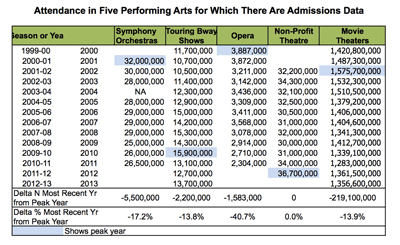
The analysis below only covers five of the six types of performing arts for which we could find count-based admissions data: movie theaters; symphony orchestras; touring Broadway shows; opera, and nonprofit theaters . Although the desired data are available for Broadway shows staged in Manhattan’s theater district, they were not included because of their geographically confined relevancy.

Five-arts-counts-raw2

One of the things to take away from the above table is the relative sizes of the absolute admissions numbers for each of the arts categories. Attendance at movie theaters, which is in the billion+/yr range, simply dwarfs the combined attendance of the other four arts categories. The opera admissions are far, far smaller than those for the symphony orchestras and nonprofit theaters. For downtown leaders who want performing arts to drive more traffic downtown, the implications seem obvious.

Attendance for symphony orchestras, opera and movies began their declines well before the onset of the Great Recession. This strongly suggests that other factors were influential. On the other hand, attendance for touring Broadway shows has certainly varied over the years, but usually has been strong. The non-profits theaters’ admissions did hit bottom during the recession, but they have since recovered and actually peaked in the most recent year for which there is data, 2012.

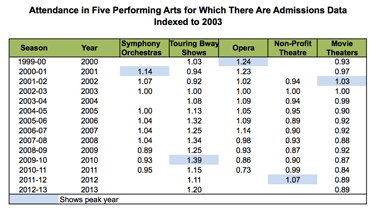
Five-arts-indexed

The above table helps to see historic trends more easily by indexing the attendance statistics for each category to the 2003 attendance:

  • Movies. Movie attendance had an average index score of .923 between 2000 and 2013. It topped out historically in 2002 at 1.03 and then followed a bumpy downward path to .84 in 2011. That is a percentage decline of about -18.4%. However, attendance bounced back with about a 6% increase in 2012 over 2011 and then ebbed slightly, 0.40%, in 2013 (5).  That still left movie attendance about -14% below its 2002 high. As movie attendance has declined, research by Pew found that Americans watch five times as many movies at home than they do in movie theaters — and that study predated  Netflix’s entry into the movie and TV show streaming business (6). To help stem the decline, Hollywood has increased  its annual movie production by about 39%, from 478 in 2000 to 665 in 2012. Over this same period, the number of indoor movie theaters declined by 18.8%, the number of indoor movie screens increased by 9.4% and all distribution and projection functions went digital. Since movie house ticket sales only account for a fraction of movie studio revenues — under 15% — a growing number of movie moguls are pressing for new films to be released digitally at about the same dates as they are screened in traditional theaters
  • Touring Broadway Shows Although this category shows about a -13% decline in 2013 from its peak year in terms of absolute attendance, the 2013 attendance is still 20% above the 2003 benchmark year, and it has the highest average indexed attendance score presented in the above table, 1.14.  Its index scores exceeded the benchmark 1.0 in 12 of the 14 years for which we have data, peaking in 2010 at 1.39. The index scores were relatively high  in the preceding 2006 and 2009  period, with scores of at 1.34 and 1.25 during the two recession years. Its index score has not been below 1.10 since 2004. Attendance is significantly impacted by the number of plays on the road and the lengths of their runs. For example, for Broadway shows there is a .69 correlation between the number of playing weeks in a year and attendance. That can statistically explain about 47% of the annual variation in attendance. From the data the Broadway League publishes about gross revenues of the touring shows, it appears that in 2013 the average revenue per admission was $64.01 (up 22% since 2003). If the average ticket price was around that figure, then a lot of folks probably cannot afford to attend touring Broadway shows.  Not all downtown theaters can attract a touring Broadway play; they must have an ability to generate ticket revenues that are commensurate with the size of the production’s cast and costs.  
  • NonProfit Professional Theaters. There were an estimated 1,782 of these theaters in the USA in 2012, and most were not very large– they averaged just 174 admissions per performance.  For the 11 years that there is available data, the attendance index scores for this arts category are below 1.0 in nine of them. But, the most recent score was its highest, 1.07 for 2012, and it followed a 0.99 score in in 2011 that was a .09 improvement over 2010. These theaters get about 52% of their revenues from earned sources and 48% from contributions.  Using the published expense data and dividing it by attendance indicates that there is about $54.11 in expenses associated with the average admission. The earned income, probably from ticket sales, would cover about $28.26 of the average admission cost, with contributions covering the remaining $25.85. Theater tickets in the $30 range are likely to be affordable to many more people than tickets costing $60+. But, needing this audience subvention certainly contributes to pushing about 50% of these  theaters to operate in the red (7). 
  • Opera. Between 2000 and 2011, opera attendance dropped off dramatically by about 40%. The decline has not been linear. Between 2000 and 2003, well before the recession’s onset, attendance fell by about 24%. It’s attendance index score then increases to 1.09 in 2004 and wobbles up to 1.14 in 2007. It then continues to decline down to 0.73 in 2011, the final year for which we could find data. The difference between the 2000  and 2011 index scores is a stunning 0.51. However, this decline was not linear: an important attendance decline occurred well before the recession, and another and stronger decline started when the pre-recession financial crisis began to emerge. 
  • Symphony Orchestras. For the years the DANTH team was able to find relevant data, attendance at concerts of  187 symphony  orchestras peaked in 2001 and 2002, with index scores of 1.14 and 1.07. It then dropped to 1.0 in 2003 and 2005, well before the Great Recession.  Attendance actually rose to 1.04 in 2006 to 2008 as the financial crisis and the the recession set in, but then incurred a substantial drop in 2009 to its lowest index score, 0.89. Attendance recovered somewhat in 2010 and 2011 with index scores of 0.93 and 0.95, showing something of a recovery trend. But attendance in 2011 still was about 7% off the 2003 benchmark and about 17% below the 2001 peak. While the Great Recession probably had a significant impact on attendance, the drop in 2003 and 2005 suggest that other factors also might be at work. Within the field, there has been much heated debate about whether attendance has ebbed because  the classical repertoire has become too limited, boring or inaccessible and whether substantial efforts are needed to expand its audience by attracting more people from a wider range of ethnic, income and age groups. However, a number of observers have argued that even if attendance may have fallen, the quality of the players and orchestral performances has been very high, and the popularity of classical music has grown in such places as college campuses (8). This raises the question: what, then, are the factors that have been pushing admissions at symphony orchestra concerts down, if it is not the quality of the performances and other than recessionary impacts?

Five-arts-per-capita-redo

The table immediately above takes the absolute admissions data from the table “Attendance in Five Performing Arts for Which There Are Admissions Data” and indexes/standardizes it to the national population in each of the years covered. It is, mathematically, something akin to turning them into percentages.  The results are per capita admissions by year of each of the arts categories in the table. Some things to note:

  • Opera and a classical music subset, symphony orchestras, display strong reductions in attendance in the most recent years for which there is data from their peak years, -46.3% and  -24.3 % respectively
  • These are significantly higher declines than those revealed by the analysis of the absolute attendance data, -40.7% and -17.2%
  • While the touring Broadway shows also show from this perspective a stronger decline, the per capita attendance is still well above the benchmark year
  • Movie attendance also shows a greater decline than the absolute attendance numbers, -21.7& compared to -13.9%; its most recent per capita attendance is well below that of the benchmark year
  • Non-profit theaters had their highest admissions ever in 2012, but the per capita admissions in 2003 were just barely higher, 0.1182 to 0.1169.

Take Aways

  1. This analysis has looked from several perspectives at the issue of what has been happening to the attendance levels for various types of performing and visual arts venues over the past decade or so.
  2. The contention that attendance patterns are changing significantly seems hard to refute.
  3. The contention that forms of “high brow” culture such as opera, classical music and ballet have suffered attendance declines also appears to be supported by the numbers
  4. Art forms associated more with popular culture, e.g., live popular music performances, are those that seem to be doing best. However, movie attendance is not what it has been,  despite huge efforts to buttress attendance by by providing more movies per year on more movie screens and using 3-D and IMAX projection systems to substantially enhance the viewing experience
  5. The impact of technology to provide new ways of e-attending performing arts events or visiting museum art collections (MoMA, the Met, the Louvre, the Smithsonian, the Whitney, etc. all have them) is undeniable, but the extent and pattern of that impact is still uncharted. However, what the movie attendance shows — remember we watch 5 times as many movies at home or on our e-devices than in cinemas — is that to a substantial degree we  still want to  watch/see arts events in person with other people. That does not mean that there will not be adverse impacts — just think of all the closed movie theaters, about 10% of them, some say, due just to the conversion to digital projection and distribution
  6. Whether or not these audience churns and declines reflect a cultural dumbing down of our population or whether performing arts repertoires have become stale or their  performance levels waned are irrelevant issues for downtown leaders who want to enhance their central social district functions by building a stronger entertainment niche
  7. What is important are the changes in arts audience behaviors. They increase the uncertainty of existing arts organizations’ earned incomes and definitely will be affecting the economic feasibility of projects  to create new formal entertainment venues. Creating such formal arts venues is seldom associated with cheap capital costs
  8. Regarding the new projects, given the probable capital expense, the uncertainties associated with earned income and the inherent tendency to best serve an audience that has a significant amount of discretionary dollars to spend, some downtown leaders might do well by considering other types of projects to enhance their entertainment niches. These projects might take the form of new vibrant public spaces that are: open to all;  where plays and movies can be shown, but focused mainly on maximizing informal entertainment opportunities; either free or low-cost; designed  to capitalize on people watching; where participants are both the performers and the audience.

Endnotes

1. Americans for the Arts. National Arts Index: 2013 Report, pp.149,  p.67

2. Ibid., p.64

3  See: http://www.businessinsider.com/zuckerberg-why-facebook-bought-oculus-2014-3#ixzz2x1lgtLVO

4.LaPlaca Cohen/AMS Planning & Research Corp, Culture Track 2011 Market Research Report, pp.87, p.7

5. http://www.boxofficemojo.com/yearly/

6. Pew study cited in:https://www.ndavidmilder.com/wp-content/uploads/2012/05/trends_p1_films_08.pdf

7. The data in this section are drawn from  Theatre Facts. It has been published annually by The Theatre Communications Group since 2000. See the 2012issue at:http://www.tcg.org/pdfs/tools/TCG_TheatreFacts_2012.pdf

8. See for example: http://classicalvoiceamerica.org/2014/03/07/campus-concerts-rebuff-notion-of-classical-decline/  and http://www.city-journal.org/2010/20_3_urb-classical-music.html . Thanks to Andy Menshel for bringing them to my attention.

© Unauthorized use is prohibited. Excerpts may be used, but only if expressed permission has been obtained from DANTH, Inc.
The New Normal’s Challenges to Developing a Downtown Entertainment Niche Based on Formal Entertainments: Part 1

Posted by N. David Milder

Introduction

This is the first part of the third in a series of articles about the “new normal” for our nation’s downtowns. It focuses on the challenges many downtowns — especially those that are not very large — now face when they decide to bolster their central social district functions by creating and/or strengthening their venues for the performing and visual arts, e.g., performing arts centers (PACs), theaters, cinemas, museums, concert halls, museums, art galleries, etc. Part 1 deals with a general introduction of the challenges, a discussion of who can afford formal entertainments, and changes in the ways governments, corporations and foundations are funding arts projects. Part 2 will turn to changes in the ways Americans attend performing arts events and visit visual arts venues. Part 3 will survey a number of formal entertainment venues.

As noted in an earlier article on the new normal for downtown, successful formal entertainment venues undoubtedly can be strong assets for the downtowns in which they are located. However, the success of such venues has long been uncertain and challenged because,  from their get-goes, they are the equivalents of loss leaders for their districts. Most are nonprofit operations that sell tickets  to events/performances or charge visitors admissions fees that seldom cover their full costs. For example, among performing arts centers,, be they large or small, only about 40% of their operating costs usually are covered by performance revenues (1). To survive financially,they must be able to tap a number of “charitable” revenue streams, e.g.,  grants, bequests and other donations from government agencies, corporations, charitable foundations and individuals. This financial dependence makes them vulnerable.  Evidence suggests that recent trends have made their financial success significantly more difficult to achieve. Funding for the arts took a big hit during the Great Recession, with  its full recovery still in doubt, while research studies have consistently shown attendance at performing and visual arts venues  has been changing, in some instances declining significantly for over a decade.

In the performing arts,  the fees of performers — be they individuals or groups — are related to their popularity. The ability of a venue to attract them will depend on its seating capacity and the ticket prices it can command. Consequently, as more communities with comparatively limited market area populations and wealth try to develop such venues, they often find that their smaller potential audience base, seating capacity and financial resources require adjustments of their aspirations and a fine-tuning of their programs. In other instances, formal entertainment facilities have been built that just have too much capacity for their market areas or are weakened by new competing formal entertainment centers within their market areas

The arts as an engine of economic growth and downtown revitalization too often seems to have achieved the exaggerated status of a religious credo among downtown advocates or the unrealistic expectation among some of them of being the “silver bullet” solution path to economic rebirth. While the arts undoubtedly can contribute to economic growth, their ability to do so will depend on arts venues and programs being planned and designed in a manner congruent with local needs, behaviors and resources. This challenge is now made more complicated by the fact that these local needs, behaviors and resources may be subject to substantial change.

Consumer Expenditures for Entertainment Admissions and Fees.

Tickets admission fees are an important revenue source for the organizations that operate formal entertainment venues. The less revenues they realize from tickets and admission fees, the more they must rely on obtaining outside funds from government agencies, corporations, foundations, and individual donors. The fees can vary. For example, the Cincinnati Museum of Art has free admission; the Columbus Museum of Art  charges $12; the Museum of Modern Art in NYC has a $25 fee; the ticket prices for Broadway shows and tickets for concerts by major attractions can reach well over $100 in prime venues.  Obviously, the affordability of these

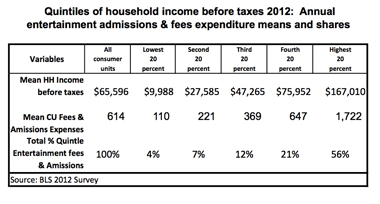
Entertainment-CEX-2011-qunits

admissions is a function of both their prices and the incomes of those who would purchase them.

Formal entertainment venues that charge relatively high prices are in a sense targeting  more affluent households and a downtown entertainment niche based on a cluster of such venues is likely to be a feature that helps draw affluent households or young people with a lot of discretionary spending power to want to live in or very near to the district. During the 1960s, 70s and 80s attracting such residents was just a long-term goal of many downtowns leaders. Today, in a growing number of downtowns, that goal has been achieved  and they are stronger for it. Sophisticated formal entertainment venues that feature major attractions that have substantial admission fees are probably well suited for such downtowns. But, a lot of downtown users, be they current or potential, are being priced out of using these formal entertainment venues.

The table above shows that nationally, in 2012, 56% of the expenditures for entertainment fees and admissions came from those in the top 20% of the households sorted by annual incomes. The mean annual household income in this quintile was about $167,000.  Those in the top two household income quintiles, with average annual incomes over $75,900, accounted for 77% (56% +21%) of all entertainment fees and admissions.

The general thrust of these findings is not new: the more affluent have long spent more on entertainment, especially the arts. What is new are:

  • The emergence of deliberate consumers  in middle income households who have reduced discretionary incomes and for whom discretionary entertainment expenditures now are a lower priority than in years past (2)
  • The income stagnation and general economic decline of middle income households, a trend that preceded the Great Recession, but recently has become a hot political issue.

NEA--Percent-Adult-attendance

The implications for many downtowns are:

  • More than ever, ventures to establish new formal entertainment venues must be calibrated in their ambitions, designs and costs to the financial resources of local residents that might be tapped through admissions, fees and donations
  • Such ventures are more likely to succeed in communities that have greater residential wealth, especially if capital investments in new buildings,  busy event/performance schedules and pricey admissions fees are involved
  • In smaller and less affluent communities such ventures are very likely to need strong long-term government subventions and grants from corporations, foundations and community organizations. Most downtowns are likely to fall in this category. In these communities, the presence or absence of very broad support among local residents, the business community and elected officials can be the deciding factor in whether this critical external financial support will be obtained. Often such strong support is mobilized around something or someone that is a source of considerable community pride or identity, such as the artist Grant Wood in the Cedar Rapids (IA) Museum of Art and life on the plains and the Oregon Trail in the Legacy of the Plains Museum in Gering NE.
  • Many of the downtowns with weaker financial resources to tap  might do well to consider that many Americans see art exhibitions and attend performing arts events not only in museums, theaters and concert halls, but also in parks or other open air facilities, restaurants, bars, nightclubs, community centers, places of worship, college campuses, etc. (See table above).

 Grants for Arts Nonprofits

Since the onset of the Great Recession, it has become more difficult for arts nonprofits to get the grants they need from public sector agencies, corporations and foundations. An unanswered question is whether this funding trend will turn around as the nation’s economy improves. Downtown leaders considering the development or expansion of formal entertainment venues might benefit from understanding the topography of these new financial support patterns for the arts.

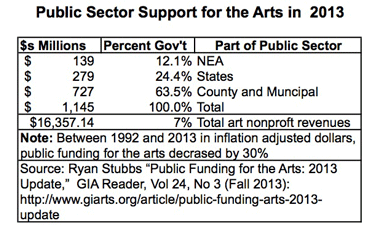
Public-Funding-for-the-Arts-2013

Public Sector Funding.  It is important to understand the magnitude of the public sector’s financial support for the arts. It now only accounts for about 7% of the revenues of arts nonprofits nationally and, adjusted for inflation, between 1992 and 2013 public funding declined by about 30%.  FY2013 was the first fiscal year since FY2008 that aggregate public sector funding for the arts has increased, but it is still far below former high years (3).  The National Endowment for the Arts (NEA) only accounts for about 12% of the public sector funding. Its expenditures are not expected to increase significantly anytime soon.

County and municipal governments account for 63% of the public funding for the arts and they recently have shown signs of increasing their funding levels as their economies improve and the impacts of natural catastrophes (e.g., Hurricane Sandy) abate. However, local governments in more densely populated areas often face a large number of requests for arts funding and that usually results in many relatively small grants.

Corporate Support. Unfortunately, data are  unavailable for small and medium-sized corporations, but the major findings of a recent report by CECP and The Conference Board on giving in 2012 by large corporations are still illuminating (4):  though large corporation giving increased by 42% from 2007 to 2012, funding for the arts decreased by about 40% during that period (5)!

On the hopeful side for a resurgence in corporate arts funding is the fact that giving to the arts remains popular among the corporations; it is the size of their contributions to the arts that have decreased. But, changes in corporate behaviors and preferences suggest that such a resurgence is not likely to happen any time soon:

  • Education and economic development have become much more important funding priorities
  • More corporations want to make in-kind donations and arts organization may find it difficult to benefit from bulk product donations
  • Corporations are increasingly seeing giving as part of their corporate strategy and less as charity
  • Corporations are increasingly reviewing their giving from a return on investment (ROI) perspective and nonprofits often do not know how to provide the needed metrics (6)

Foundations. Since about 81% of America’s larger corporations have foundations and they account for about 35% of their corporations’ total giving, there is some overlap between corporate and foundation funding (7).

In 2011, the last year for which there appears to be available data, there was a familiar pattern: while there was a 25.3% increase over 2010 in overall giving by 419 foundations, the increase for the arts was a marginal 0.5%. Here again, the arts’ share of the number of grants remained unchanged (8). However, a “larger share of arts grant dollars provided operating support than most other fields” (9).

 Endnotes

1. Harac Consulting, “Evaluation of SOPAC.” October 2011, p.3. http://southorange.org/SOPAC-finalPDF.pdf

2. See: https://www.ndavidmilder.com/downtown-revitalization/the-deliberate-consumer

3. Ryan Stubbs “Public Funding for the Arts: 2013 Update,” GIA Reader, Vol 24, No 3 (Fall 2013): http://www.giarts.org/article/public-funding-arts-2013-update

4. CECP and The Conference Board, “Giving in Numbers: 2013 Edition.”

5. Ibid, page 20.

6. See:ARTSblog » Blog Archive » Michael Stroik. “Corporate Funding Came Back After the Recession, But Did it Leave the Arts Behind”_ (from The pARTnership Movement, an initiative of Americans for the Arts) posted Oct 4, 2013 and ARTSblog>> Judy Belk, “As Corporate Giving Bounces Back, Six Things Nonprofits Need to Know,” posted December 13, 2013.

7. See endnote 4, page 5.

8. Steven Lawrence and Reina Mukai, “Foundation Grants to Arts and Culture, 2011 A One-year Snapshot,” Foundation Center, GIA Reader, Vol 24, No 3 (Fall 2013), http://www.giarts.org/article/foundation-grants-arts-and-culture-2011

9. Ibid.

© Unauthorized use is prohibited. Excerpts may be used, but only if expressed permission has been obtained from DANTH, Inc.

Some Key Aspects of the New Normal for Downtowns: the “good news” ©

Article 1

N. David Milder

Author’s Note for Downtown Curmudgeon Blog and Newsletter Readers

A number of readers of the Downtown Curmudgeon blog have asked me to write an article on the new normal for downtowns that I have referred to in many of my blog postings in recent years. In response, I have planned a series of articles that will be posted over the coming six to eight months.

This is the first in that series and focuses on providing a description of the critical characteristics of the new normal and some of the emerging challenges downtown organizations now may face under it. Proper treatment of this subject requires sufficient space and cannot be done within the usual short take format of most blog posts and email blasts. While I have tried to be economical in my use of words, this article is almost 12,000 words long, even when I have skimped on examples and skipped using data tables and other illustrations. I have divided it into two parts. Each part will be posted to my blog and emailed separately.

Later articles in this series will cover such topics as the arc of downtown revitalization, the potential implications of the new normal for downtown development projects and BID programs.

Part 1 – What’s Now Normal for Downtowns: The Good News

1. The Expectation and Ability of Downtowns to Prosper.  When I first became involved in downtown revitalization issues back in the mid 1970s, downtowns across the nation were weakening and often visibly decayed because of the impacts of business and residential flight, suburban residential growth, suburban sprawl, the rise of shopping malls, the creation of suburban office clusters, the fear of downtown crime, business flight, reduced investment, etc. (1). Civic and business leaders often despaired that their downtowns were literally going to hell, with few prospects of salvation in sight.

While these declines were most easily noted in cities after the urban riots of the late 1960s, the decay soon also was being found in many non-rioting big cities as well as in many of our older and well-established suburbs, large and small.

Early downtown revitalization efforts that used urban renewal, office growth or physical improvement (“beautification”) strategies were almost complete and disheartening failures. In too many instances they created sterile fortress dominated environments that were antithetical to pedestrian activity and multi-purpose downtown trips – and very hard to rectify – or “decorated coffins,” prettier, but still devoid of activity and growth.

However, about 15 to 20 years ago, our downtowns started to tell a far different story, one that has grown stronger and stronger with each passing year. More downtowns appeared to have bottomed out and then established an upward thrust on their revitalization arcs. Today, the increased flows of pedestrian traffic, the after five o’clock activity levels, the new or rehabilitated buildings, the shops and entertainment venues, the influx of businesses and jobs, and the growing numbers of downtown residents all signal that many of our downtowns have advanced quite far on their revitalization arcs and are doing quite well. Still other downtowns, often inspired by and following the best practices of their more successful brethren, are rapidly improving.

These prospering downtowns are large (e.g., Midtown Manhattan, Center City Philadelphia, downtown Chicago), suburban (e.g., Wellesley MA, Old Pasadena CA, Englewood NJ) and even relatively small (e.g., Cedarburg WI, Galena IL, Durango CO, Brattleboro, VT).

The new prosperity of our downtowns is powerfully described by Paul Levy and Lauren Gilchrist in a recent publication they prepared for the International Downtown Association:

“Downtowns across the United States are thriving. From Boston to San Diego, Seattle to Miami, cities are diversifying their economies and land use, restoring and enlivening public spaces. During the last three decades, city centers have been adding  arts, culture, dining, education, medical, and research institutions, along with hospitality, leisure, and sports venues. Simultaneously, there has been a dramatic and sustained increase in residents, living both within business districts and adjacent neighborhoods.

Places once shunned as empty and unsafe at night are being redeveloped at higher density and are thriving after dark. They  have become preferred places for work, entertainment, and living. Patrons of downtown regional destinations mingle with office workers, resident young professionals, empty-nesters, and, in many cities, an expanding number of families with children. The trends of diversification, animation, and residential revival are occurring as well on and around urban colleges, universities, medical centers, research parks, and other urban commercial zones” (2).

This trend of resurgence has been accompanied by the appearance of a capable cadre of downtown leaders, managers and professionals.  If all the answers to our downtown problems are not yet known, today’s downtown leaders seem confident they can develop viable solutions to them as they emerge in their districts. The 1,000+ BIDs and numerous local Main Street operations provide these leaders with the needed organizational vehicles.

We certainly have come a long way, and it is important that the progress that has been made be amply recognized and celebrated. However, there is still a way for our downtowns to go. While downtowns overall have been strengthening, the pattern is understandably uneven.  Downtowns started their revitalization arcs in different places, with some facing many more serious problems than others. Furthermore, downtowns also differed in the types and levels of redevelopment assets and financial resources they could mobilize. Finally, if a downtown’s revitalization is to really take hold and last it must be viewed as a perpetual process.

Bottom line: in the new normal for downtowns, they prosper!

2. Significantly Reduced Fear of Crime. For several years I have been writing about the apparent significant reduction in the fear of crime or its effects on our downtowns. However,  the “crime problem” still exists in some districts, usually those where nighttime activities are not well established or that have problems associated with gangs or the use and sale of methamphetamine.

I came to this conclusion not on the basis of any series of systematic research or solid opinion surveys, since I could not find any to analyze, but because my visits to many downtowns indicated that consumers, investors and businesses no longer seem to be engaging in the downtown injurious behavior patterns that the fear of crime previously caused. The thriving downtowns with vibrant after dark activities noted by Levy and Gilchrist above are consistent with this conclusion.

The crime problem did not cause the post WWII decline of our downtowns. That was the result of greater auto use, the move to the suburbs by residents and shoppers, followed by the move of retailers and office based businesses and the consequent downtown disinvestments. However, for about three decades, crime did make downtown revitalization extremely difficult. Crime became one of the most important factors corporations looked at when considering new locations for offices, retail stores, restaurants and entertainment facilities, and all too often downtowns were deemed too dangerous and undesirable. The fact that Levy and Gilchrist can state that downtowns “have become preferred places for work, entertainment, and living” means that the avoidance behaviors of shoppers, residents and businesses are no longer occurring, making the crime problem moot.

It is important to understand why the downtown crime problem has diminished so substantially, because it can shed light on the effectiveness of the policies and programs of our municipalities and downtown organizations and the processes by which they were formulated and implemented. Nationally, since about 1993 or 1994, FBI statistics have famously shown a continuing decline in the number of criminal acts normalized by population, i.e. the crime rate. Its abeyance in our large cities has received much media attention because it has been so significant, though it also has been uneven, with our poorer cities showing fewer declines. Statistics on the number of crimes occurring in and around our downtowns, when available, reflect that trend. However, our downtown crime problem was less a result of the number of crimes perpetrated in a district or its crime rate, but more about downtown users’ fears of becoming victims of criminal acts while in the district. For example, in the 1970’s, 80s and most of the 90’s, the leaders in many of the large downtowns I visited reported their frustration that the fear of crime was a very damaging problem, although their crime rates were average or even low compared to other parts of their communities.

Academic research findings supported this disconnect: statistically the fear of becoming a crime victim in the downtown is not strongly associated with how many criminal acts occur within the district:

“Evidence provided by many studies suggests that the relationship between the fear of crime and actual crime rates is very loose and indirect. One study, for example, found that although the likelihood of being robbed was actually 20 times greater in Washington, D.C. than in Milwaukee, the residents of Milwaukee only felt slightly safer than did the residents of Washington. Another study concluded: ‘the patterning of fear across areas does not match the patterning of crime levels. Although some studies do find that actual victims of crime are more fearful than non-victims, it is not the case that areas with higher crime or victimization rates have residents who are more fearful.’ There is a weak correlation between fear levels and crime rates” (3).

The fear of crime hurt downtowns by causing the residential, worker and visitor avoidance behaviors and lack of investment described above that strangled the economic and social life out of these commercial districts — even when crime rates were low. For example, a study I did of three outer borough downtowns in NYC showed that how safe trade area residents felt in their downtown during the day had a stronger impact on their visitation rates than how they felt about the merchandise they could buy there, the physical attractiveness of the downtown or the ease of getting there (4). The fear of crime also impacted on those who did visit their downtowns by influencing where and when they would walk and how many destinations they would visit. That diminished a key competitive advantage of downtowns: multifunctional multi-destination visitor trips.

The programs needed to reduce the number of crimes can be quite different from those that can effectively reduce fear. Our downtowns most needed programs that could reduce fear and such programs were not easy to fund, design or implement.

In a later article in this series, I will present an analysis of the causal factors I think best explain the reduced fear of crime problem in our downtowns. Because of limitations on the existence or availability of needed data, this analysis will not claim to be definitive, but it hopefully will be received as thoughtful and provoke discussions and research on this topic within the downtown revitalization community. At this time, as “teasers,” here are some of the points I will expand upon in the upcoming article:

— What the cities and BIDs did definitely had strong impacts on reducing the fear of crime, but some programs were probably not as important as many might think, while other effective actions may have gone unnoticed or under appreciated

–Jane Jacobs was very probably correct when she argued that more pedestrians on the streets would help reduce the fear of crime and that, in effect, successful urban revitalizations self-heal their fear of crime problems. But, how were the crime problem’s impacts overcome in the initial revitalization stages before the pedestrian flows were sufficiently strong to heal the fear of crime problem?
— Much anecdotal evidence suggests a destination’s magnetism can offset fear of being a crime victim in a downtown user’s decision-making calculations. With revitalization, a downtown gains numerous destinations with stronger magnetism, so the impacts of fear may be meaningfully offset by them
— In 1970s and 1980s, a lot of the fear of becoming a victim of a downtown crime among the downtown’s trade area residents was generated and/or validated by downtown residents, workers, merchants, etc. or those who had fled their downtowns, who sent negative messages through their personal social networks. By now, they have either died off, shut up, or been drowned out by the new downtown users who instead are sending very positive messages through their personal social networks
— Today’s downtown users are often wealthier, better educated and younger than those in the 1970s and 1980s. These characteristics tend to make people feel more empowered and less likely to be fearful.

Bottom line: in the new normal, in downtowns well along on their revitalization arcs, during daytime or after dark, downtown users do not frequently engage in avoidance behaviors associated with the fear of becoming crime victims.

3. The Emergence of Downtowns As Their Communities’ Central Social District.  For decades, the terms Central Business District, CBD and downtown were used almost interchangeably because, functionally, downtowns were dominated by retail stores, office based businesses, professionals and government agencies, along with some hotels and maybe entertainment venues. Early downtown revitalization efforts were able to attract office tenants and –aside from the impacts of fluctuations in our economy — downtowns have continued to grow office-based activities. Retailing was far more difficult. By the late 1970s and through the 1980s, national retailers might locate in enclosed downtown shopping centers or off-street networks, though these centers seldom met expectations and did little to liven downtown sidewalks. By the late 1980s major retail chains began to again consider downtown street level storefronts, and this interest picked up considerably over the 1990s.

Levy and Gilchrist have argued convincingly about the importance of people working downtown wanting to live in or near the downtown. However, to my mind, equally important to the resurgence of downtowns has been the emergence of a group of interrelated functions focused around the downtown being the community’s Central Social District (CSD): housing, restaurants and watering holes, vibrant public spaces and other locations for informal entertainments, and formal cultural and entertainment venues (5). These CSD functions establish a downtown as a place to relate to and play with significant others and makes living and playing variables as important as working, selling and buying in any viable formula for downtown success. The interrelatedness, the “dynamics,” among the CSD functions is important. For example, living downtown would be far less attractive without these other CSD functions being present. Conversely, without the downtown residents many of these CSD functions would have far fewer customers and less pedestrian traffic after dark to help reduce the fear of crime.

Underlying all of these CSD functions is the ability to spend quality time with loved ones and significant others. For example, a recent report on participation in cultural events found that: “The level of enjoyment and the opportunity to spend time with loved ones play the most influential roles in deciding whether to attend a cultural event (6).

Below are a few comments on some of these CSD functions that I believe are most important.

Housing. Without a doubt, housing in and very near to downtowns has had a huge beneficial impact. Its importance has been noted by countless others in recent years. The strength of downtown housing was amply demonstrated by how well it did, comparatively, during the Great Recession.

As Eugenie Birch noted in her seminal study, in the 1970s and 1980s, downtown residential populations declined in America’s larger cities. But, in the 1990s, downtown populations grew by 10 percent, a marked resurgence. Furthermore, in these downtowns homeownership rates more than doubled during the thirty-year period, reaching 22 percent by 2000 (7). Since then this growth has continued.

Overall, these new downtown residents contain higher percentages of young adults (Millennials), empty nesters, and the college-educated than other communities in their regions (8). They often have created subcultures characterized by creativity, hipness, tolerance and a sense of being empowered in downtowns and nearby neighborhoods.

The growth of downtown housing is not restricted to large cities. In New Jersey, for example, significant downtown housing projects have been constructed in such communities as Cranford, Englewood, Hoboken, Livingston, Morristown, New Brunswick, Rahway, Somerville and South Orange. Much of this also has been stimulated by a work connection: the downtown housing’s proximity to a commuter rail station.

While the demand for downtown residential units is substantial, and downtown living has its ardent fans, not everyone wants to live in a big city downtown. For example, a national survey done for the National Association of Realtors found that only 8% of the respondents preferred a city downtown residential location, while 11% preferred living in city residential areas. Another survey found that Millennials preferred living in a suburb (43%) to living in a city (17%) by almost a three to one margin (9).  Creative Millennials, however, may well have a greater preference for urban living than their non-creative brethren. Whatever the situation, there plainly are a sufficient number of them living in and near our downtowns to have an undeniably positive impact on housing and other functions. The same point is true looking at the overall demand for downtown housing: most people may not want to live in a downtown, but the demand has sufficient numerical strength and emotional depth to continue to be a very viable engine for downtown economic growth. Indeed, the demand is strong enough that in many downtowns only those who are fairly well off or able to share rents can now afford downtown residences.

Restaurants. Restaurants not only provide food, but also entertainment in the forms of people watching and observing restaurant operations as well as providing felicitous opportunities for social interactions. If clustered, they also can help bring downtown streets to life after dark. Furthermore, they bring in a lot of customers that retailers can benefit from if they are open for business and sufficiently proximate.

Developing restaurant niches has become an essential, if too often underappreciated, ingredient in the revitalization strategies of most downtowns, especially those that are of comparatively small or medium size. They can be especially important in suburban downtowns, e.g., Cranford, Englewood, Hoboken, Morristown, Ridgewood and Teaneck in NJ, where niches of 20 to 35 restaurants are not uncommon. There is usually strong demand in suburbs with affluent, time-stressed residents. They also often play important roles in small rural or metro fringe communities, e.g., Sherwood, WI. One reason is that it is often possible for some type of downtown eatery or watering hole to be economically viable in communities with populations in the 1,000 to 5,000 range, where a GAFO retail operation would likely have far less viability (10). Restaurants also are often urban pioneers. Drawn by lower rents, they may succeed because, as research has shown,  “a poor (restaurant) location can be overcome by a great product and operation” (11). Restaurant niches can also be large and extremely important assets in downtowns where retail is not very strong, e.g. downtown Austin, TX and downtown Morristown, NJ.

Downtown merchants can benefit from lunchtime restaurant customer traffic, but from the eateries’ dinner traffic only if they are open after 6:00 p.m. The stores of retail chains are more likely to be open in the evenings than the small merchants.

Vibrant Public Spaces and Informal Entertainments. Formal entertainment venues such as museums, theaters, movie houses, concert halls have long been located in or very near their downtowns. Our national downtown resurgence has witnessed countless successful projects that have created or strengthened formal entertainment venues, such as:

  • The refurbishment of grand old theaters, e.g., the Pantages and El Capitan in Hollywood; the Paramount in Rutland, VT; the Ohio Theater in Columbus, OH;
  • The revitalization of theater districts, e.g., Cleveland OH, Houstoun TX, New Brunswick NJ
  • The creation of performing arts centers, e.g., Newark NJ; Raleigh NC; Englewood NJ; White Plains NY; Carmel IN; Greenville SC;
  • New or expanded art museums, e.g., Berkeley CA; Los Angeles CA; Chicago IL; New York, NY; Roanoke VA; Seattle WA; San Antonio TX;
  • The revival of small town movie theaters, e.g. Crosby ND; Bucksport ME; Clayton NM; Old Forge NY.

While the contributions of such projects to their downtowns’ economic health is undeniable, it strikes me that the emergence and strength of what I have come to call “informal entertainments” is of equal and possibly greater importance.

During the decades of our downtown “troubles,” countless pedestrian malls were built and closed, and many of the public plazas built by office developers in exchange for greater building densities turned into playgrounds for drug dealers and sleeping places for the homeless. Other plazas were so badly designed or located that absolutely no one used them. Also, during the “troubles,” many of our parks were vandalized and/or badly maintained.

Today, our downtowns increasingly have attractive, well-activated public spaces, be they parks, public squares, building plazas and even some pedestrian malls. Here are some examples of the places I have recently visited that quickly come to mind: Bryant Park, Central Park, The Highline, Paley Park, Herald Square, Times Square and Madison Square in Manhattan; Millennium Park in Chicago; Discovery Green in Houston; Rittenhouse Square in Philadelphia; Mitchell Park in Greenport, NY; Brooklyn Bridge Park, Brooklyn; Division Street in Somerville, NJ.

A lot of this is due to the influence of William H. Whyte and his numerous apostles (12).  The emergence of organizations such as the Central Park Conservancy and the BIDs and municipal agencies that placed a high value on the creation and/or maintenance of vibrant public spaces also stoked this movement.

Great public spaces are not just attractive; they also broaden and strengthen a downtown’s entertainment niche (13). They do so by providing opportunities for people to engage in activities that they enjoy and that also interest and amuse nearby people-watchers. Think of the ice skaters drawing the ever-present crowds above the rink in Manhattan’s Rockefeller Center. Similarly, in Manhattan’s Bryant Park, you’ll find young men and women seated and watching each other and chess players, who always attract an audience. Greenport, NY, a much smaller community, has used a carousel and waterfront location to create a wonderful public space where people can watch and be watched by other people. Other downtowns have fostered entertainment with facilities such as:

  • A model boat pond
  • A children’s pony ride
  • Tables where people can play chess, checkers, or dominoes
  • A Wi-Fi hotspot to access and cruise the Internet on a laptop
  • A place to catch the sun — a favorite pastime for office workers and young tourists in the spring and summer
  • Places to buy food and eat lunch alfresco
  • Outdoor cafes for sipping coffee and eating snacks
  • Slot car racing for kids
  • An interactive surface that passersby can not resist looking at to see their reflections – and how people next to them react when they see their own.

Visitors will “perform,” if the opportunities are there. To sail a model boat, a suitable pond or pool is required. To sit in the sun and people watch requires an attractive place with benches and chairs to sit on.

Sometimes an informal entertainment requires special personnel. For example, in Meredith, NH, local residents, hotel guests and second homeowners are really into bird watching; birding tours for them of the Meredith area might require a knowledgeable and experienced “birder” to guide them.

Nationally, households in the top income quintile account for about 50% of consumer entertainment expenditures, while long term forces have been reducing the ability of middle-income households to afford formal entertainments. In contrast, Informal entertainments are usually public and priced right – either free or, when there are fees (e.g., to ride a carousel), affordable. They are also “sticky” activities. Retailers can feed off of the traffic the informal entertainments bring in, as demonstrated by the busy pedestrian traffic on the street next to Mitchell park in Greenport, NY and the hotel that was built next to it. Informal entertainments are also liable to be open when the public would want to use them as opposed to theaters, concert halls etc. Most often they are children friendly – and therefore mommy friendly, too.

The Creatives Connection. Richard Florida has made the “Creative Class” and its association with dense urban environments so well known and widely accepted that there is no need to expand upon it in this article. However, it is mentioned here because the interrelated CSD functions are what draws creatives so strongly to downtowns and their nearby neighborhoods. Of course, a downtown’s density and compactness also facilitate the social networking, interactions and collaborations that have become so essential in the innovation process.

Bottom line: in the new normal, downtowns are great places to live and to play as well as work.

4. There Are Behavioral and Attitudinal Trends That Now Support Strong Downtowns. Besides the increasing numbers of downtown residents, the growing pedestrian counts and popularity of downtown venues, etc., here are just some of the societal level behaviors and preferences that are making more people increasingly eager to live, work and play in our downtowns:

  • Americans are very time pressured and this has heightened their appreciation of such things as: short and easy commutes and living close to their work places; having lots of shops, restaurants, parks and entertainment venues within a reasonable walk of their abodes and being close to mass transit (14)
  • Most households in the US do not have children. Such households are much more likely to prefer urban living than households with children as demonstrated by the numbers of singles and empty nesters who now live in downtowns or nearby neighborhoods. However, if cities cannot improve their educational systems, then the outflow of young parents to the suburbs will likely continue (15). Their perceived alternative choices are unpalatable: either paying $20,000 to $30,000 in after tax dollars a year per child for a private school or risking their children being badly educated in a public school
  • America’s infatuation with the auto, which helped fuel the post WWII population flight to the suburbs and suburban sprawl, appears to be on the decline. Recently the U.S. Pirg reported that, after 60 years of annual increases in driving, in the middle of the 2000s, the number of miles Americans drove began to drop. Part of this is caused by retiring Baby Boomers who are no longer commuting, but more influential are the Millennials who “aren’t driving cars” and soon will be our largest age cohort. Moreover, another study at the Transportation Research Institute at the University of Michigan found that these young people are getting driver’s licenses in smaller numbers than previous generations (16).
  • Conversely, a 2013 study done by APTA found that:
    • “Millennials are multimodal, they choose the best transportation mode (driving, transit, bike, or walk) based on the trip they are planning to take.
    • Communities that attract Millennials have a multitude of transportation choices, as proven by Millennial hotspots, popular zip codes where residents have self-selected into a multi-modal lifestyle” (17).
  • The end of suburban sprawl? Our cities are now growing faster than our suburbs. Furthermore, John K. McIlwain, an ULI senior resident fellow, has argued that the Great Recession just may have triggered the demise of sprawl: “Suburban sprawl, that seemingly inexorable, inevitable spreading of the population to the outer edges of metropolitan areas, may well be over in the United States.” The major thrust of his argument is that: 1) there is no large demographic group to drive suburban housing demand; 2) there is a large supply of available suburban housing, and 3) consequently, these factors were more causally responsible for was the recent low rate of single-family home production than the recession’s housing crash (18). While the end of sprawl may be debated – some argue that the pivotal behavior of the Millennials will alter as they age, nest and procreate – it seems safe to conclude that, minimally, it probably has been substantially weakened.

Bottom Line: In the new normal there now are strong behavioral and preference patterns within our population that support successful downtowns.

Endnotes

1. Small rural downtowns also went into decline, but because of other economic factors.
2. Paul R. Levy and Lauren M. Gilchrist , DOWNTOWN REBIRTH: DOCUMENTING The LIVE-WORK DYNAMIC IN 21ST CENTURY U.S. CITIES. Prepared for the International Downtown Association By the Philadelphia Center City District. October 2013 – pp. 57, p.8
3. N. David Milder, “Crime and Downtown Revitalization,” Urban Land, Sept. 1987, pp. 16-19  https://www.ndavidmilder.com/wp-content/uploads/2012/05/dt_crime_article.pdf
4.  N. David Milder, et al. Downtown Safety Security and Economic Development.  New York: Downtown Research and Development Center. 1985 – pp. 141, pp.38-39.
5. I first came across the term Central Social District in a paper by Richard Rosan some years ago. Unfortunately, I cannot find it either in my files or on the Internet, so I cannot say that my use here concurs with his. Borrowing from factor analysis in statistics, I see the central social district as the underlying dimension or factor and housing, restaurants, public spaces, etc., as the constituent strongly inter-related and measurable variables
6. LaPlaca Cohen /AMS Planning & Research Corp, Culture Track 2011 Market Research Report, pp.87, p.7. Italic emphasis added in quote.
7. Eugenie L. Birch, Who Lives Downtown, November 2005, Washington, DC, The Brookings Institution, Living Cities Census Series. pp. 20
8. See Birch above and Richard Florida, http://www.theatlantic.com/magazine/archive/2013/10/the-boom-towns-and- ghost-towns-of-the-new-economy/309460/
9. Belden Russonello & Stewart LLC, “The 2011 Community Preference Survey: What Americans are looking for when deciding where to live”, Analysis of a survey of 2,071 American adults nationally conducted for the National Association of Realtors. March 2011, p. 16; Morley Winograd and Michael D. Hais, “The Millennial Metropolis” 04/19/2010 http://www.newgeography.com/content/001511-the-millennial-metropolis .
10. Bill Ryan, Beverly Stencel, and Jangik Jin, “Retail and Service Business Mix Analysis of Wisconsin’s Downtowns,” Center for Community & Economic Development, University of Wisconsin – Extension Staff Paper, Sept. 1, 2010.
11. H. G. Parsa,  John T. Self, David Njite and Tiffany King, *Why Restaurants Fail,” Cornell Hotel and Restaurant Quarterly, August 2005.
12. William H. Whyte, “The Social Life of Small Urban Spaces”. Conservation Foundation. 1980.
13. This section on informal entertainments is taken from: N. David Milder, “Rethinking Downtown Entertainment Niches,”  Downtown Trends 2008: Part II         https://www.ndavidmilder.com/wp-content/uploads/2012/05/rethinking_downtown_entertainment_niches.pdf
14. N. David Milder, “The Nexus of Time Pressure, Downtown Proximity, Convenience And Customer Service: downtown retailing’s best friend,”  Downtown Trends 2008: Part II           https://www.ndavidmilder.com/wp-content/uploads/2012/05/time_pressure.pdf
15. See: Morley Winograd and Michael D. Hais, “The Millennial Metropolis” 04/19/2010 http://www.newgeography.com/content/001511-the-millennial-metropolis and William Sander and William A. Testa, “Children And Cities,” 08/23/2013 http://www.newgeography.com/content/003889-children-and-cities
16. John Schwartz, “Young Americans Lead Trend to Less Driving,” New York Times, May  13, 2013 ww.nytimes.com/2013/05/14/us/report-finds-americans-are-driving-less-led-by-youth.html?pagewanted=2&_r=0&hp&pagewanted=print
17. APTA, Millennials & Mobility: Understanding the Millenial Mindset, 2013 –pp.47  http://www.apta.com/resources/reportsandpublications/Documents/APTA-Millennials-and-Mobility.pdf
18. John K. McIlwain, “The Great Recession: A Slayer of Sprawl,” Urban Land, April 5, 2012, http://urbanland.uli.org/Articles/2012/April/McIlwainSprawl?utm_source=uli&utm_medium=eblast&utm_campaign=040912

© Unauthorized use is prohibited. Excerpts may be used, but only if expressed permission has been obtained from DANTH, Inc.