Helping Independent Downtown Merchants Engage Effectively In E-Marketing: Part 2

Introduction

This is the second of a two part article. Part 1 can be found at http://tinyurl.com/bxhdx8a

Over the past year, DANTH Inc. has experimented with such social media as Facebook, LinkedIn, Twitter and Pinterest and revamped our website, blog  and email program. To support this effort we did a lot of research on what the various e-marketing tools do best and the challenges small firms like ours have in using them. In this two-part article I would like to share with the downtown revitalization community what we learned from our e-marketing overhaul, so that more independent downtown merchants (e.g., retailers and restaurateurs) might make an effective transition to e-commerce.

What we learned was the importance of an analytical process able to identify the e-marketing tools that will most effectively use an organization’s scarce resources to achieve critical marketing objectives. This process:

  • Starts off by looking at and prioritizing the organization’s marketing objectives
  • Then matches them with the e-marketing tools (e.g., website, emails, Twitter, Facebook, blog, etc.) that can best achieve each of those objectives. These two topics were covered in Part 1
  • And next selects those objective-matching tools that  can be implemented, because the organization has the required financial resources and either has or can acquire the needed skilled employees. This topic will be covered here in Part 2.

Selecting the objective-matching tools that  can be implemented, because the organization has or can hire the required resources

The types of resources required to use a particular e-marketing tool will vary by the package of objectives it is targeted to achieve and the amount and complexity of the usages that are required to achieve them. In my field observations, this is the second area where small merchants are likely to encounter problems — or have them made by consultants who just focus on the mechanics of using the e-marketing tools with which they are enthralled.

In Part 1, I argued that “being found” online is probably the e-marketing objective most independent downtown merchants should focus on first. The initial inclination of these merchants – or their formal or informal “consultants” – might be to create a complex website with many pages, a full catalog of its merchandise, a matching e-store purchasing capability and to fill the site with lots of short marketing movies. Nonetheless, many small firms plainly lack the resources for such a robust effort and, more importantly, they probably do not need it to accomplish their e-marketing objectives.

Here are three brief case studies DANTH encountered over the past few years to demonstrate this point

The High Effort E-Store For A Fast Food Shop. Last year, in a NYC neighborhood that had sustained impressive economic growth through the Great Recession, I interviewed a fast food operator in the 6-10 employees category, who was very interested in penetrating the rapidly growing nearby office worker and high rise residential markets. Though both market segments were strongly represented within a 5-minute walk of the eatery, neither accounted for many of the pedestrians passing by or entering its doors. The owner was interested in creating a website where office workers and residents could find and learn about the eatery and its menu, order from the menu and daily specials, have their orders charged to their credit cards, and have their food delivered to their workplaces or homes.

This small merchant was unaware of the intricacy and full costs of such an operation. He was expecting to pay consultants to set-up his website, merchandise basket and credit card charging. However, he did not foresee that he would also need:

  • Someone to update the “specials” daily on the website and to periodically keep the overall menu up to date. Updating and maintaining a website can easily eat up far more resources than creating it
  • Additional part-time employees to process the lunchtime orders
  • Additional part-time employees to deliver the ordered food
  • Someone to provide the copy for his website pages
  • Someone to provide the photos and other graphics for the website pages
  • To spend a lot more of his time and money  putting together the needed new team and then managing a complex new operation.

A year later, this small operator has no website, but has affiliated with a telephone-based service that takes orders and delivers food if customers know about the delivery service and call them. The eatery also does have a simple “name, rank and serial number” page on its BID’s website, a Facebook page with one like and no postings and is listed on a few special websites such as Foursquare. Right now, not much info is to be found on the web about this eatery. It still needs a much stronger “being found” on the web capability.

This could be accomplished by a modest website, without the e-store. It would successfully provide name and contact information as well as information about the menu and reasons to patronize this eatery. Such a website would provide an affordable and acceptably better, if not optimal, penetration of the office worker market. Website visitors, for example, could see the full menu and be invited to visit or phone the eatery to learn about and order the daily specials. An even simpler solution would be a substantial improvement of the information provided on the eatery’s BID web site page, combined with a campaign to get it listed on more special web pages.

The prime take aways from this case study are that:

  • Small merchants should be wary of complex uses of e-marketing tools that are beyond their resources
  • More modest deployments of these tools are often more viable and ultimately more effective
  • BID/SID web pages can be very useful for a small merchant if they do more than just provide the store’s name, contact information and business category. They need to also provide space for information about the shop’s merchandise and to tell the merchant’s story. This is the prime way that BIDs can help their merchant members gain a viable e-commerce presence.

The Low Effort Ice Cream Parlor. In Part 1 of this article, I mentioned a very popular ice cream parlor in a New York City neighborhood. It is a unique and highly regarded operation that has been around for over 50 years and, for decades before that, it was an ice cream parlor under a different owner and name. Today, it is “a functioning antique,” with an old soda fountain, tin ceiling and marble small tile floor. It makes its own ice cream and is famous for its fresh home-made whipped cream.

When I spoke to the owner about his e-marketing activities, he smiled, reporting that he knew nothing about such things, but his workers, most of whom are high school or college students, had created a Facebook page that gathered 8,000+ likes. He felt Facebook definitely had helped generate some additional sales. The shop occasionally offers special flavors only to its Facebook page visitors, with the young workers doing the postings, and they are always quickly sold out. The owner said, with another smile and shrug of his shoulders, that he would like to do more with Facebook, but…. My guess is that the shop was doing well enough that there was no great need now to do more online marketing.

Googling the shop’s name showed that this ice cream parlor had a lot more going for it than just its Facebook page.. The search showed that its authentic, old time story and favorable customer reviews and contact information were available on a whole slew of specialty web sites such as: google.com, plus.google.com, www.yelp.com, www.facebook.com, patch.com, newyork.seriouseats.com, www.zagat.com, www.urbanspoon.com, newyork.citysearch.com, untappedcities.com, www.tripadvisor.com, www.delivery.com, www.menupages.com, www.bridgeandtunnelclub.com, events.nydailynews.com, newyork.grubstreet.com, www.scooponcones.com, chowhound.chow.com, www.flickr.com. That these positive reviews were coming from customers and not the parlor’s ownership enhances their credibility and power.  Aside from the Facebook page, all the other listings, came about organically without any effort by the ice cream parlor owners or employees.

The net result is that this ice cream parlor, with little effort on its part, can be very easily found on the Internet and its story is certainly being told. The very nature of its limited menu means that people do not really need to know much about all the flavors to be convinced they should visit the shop. Consequently, it probably can do fairly well without its own website. On the other hand, given its ability to easily attract a significant number of Facebook likes, it also might easily garner many Twitter followers and  also use Tweets to inform followers of special flavors or coupons. It might then also use its Facebook and Twitter capabilities to further cultivate its existing store apostles –frequent customers who advocate a shop within their social networks– and garner new ones.

This ice cream parlor had very substantial name recognition and a bevy of store apostles well before or separate from any of its e-marketing activities. The strength of this non-electronic customer network substantially eased the challenge and costs of collecting 8,000 Facebook likes. A new ice cream parlor would need to expend a lot of resources to get enough Facebook likes to make its use worthwhile. The same is true of using Twitter. Indeed, one might ask if the use of these social media is cost effective for small merchants with say 30 transactions or less a day. Might they achieve the relationship building and customer service functions much more effectively and efficiently by focusing on face-to-face interactions? However, they still would need to be found online.

One thing the ice cream parlor owner probably should do is to have his young, Internet capable,  employees check their listings on the special web pages to make sure they are accurate and up to date. Research has shown that this is where most small businesses are apt to  fall down (1). Another thing he certainly needs to do is to keep hiring young employees who know how to use Facebook.

The prime take aways from this case study are that:

  • Strong small businesses that have been around for a while probably will have strong assets that can make their entry into e-marketing a lot easier than start-ups  or weaker operations
  • A robust easy-to-be –found on the Internet capability does not always require a complex website if the merchant has sufficient positive listings and reviews on the special website pages and a narrow range of products are offered
  • These special website pages are too often overlooked, especially by the food related operations that they so frequently cover and that account for such a high proportion of downtown businesses
  • Young, internet savvy, employees can often be a source of the internet related skills a small merchant lacks, but needs.

A Well-Calibrated Retail Website. A toy retailer has two brick and mortar stores in the Chicago suburbs and a very interesting website. The retailer quickly appears at the top of searches for toy stores in its two towns. Its website does not present a catalog of all of its toys, but has a page that shows all the toymaker brands it sells with their logos. It does not have an e-store that sells scads of different toy products online. Its e-store is limited to selling just one new toy a week. Customers can sign up to get the “new toy” newsletter each week via email. The website has short movies, one to two minutes long, for each of the new toys. The website shows that the “new toys” are sold out every week. That they are sold out so often strongly suggests that the retailer is building up a core of repeat purchasers. Repeat customers are the makings of a band of store apostles, a solid revenue stream and a strong word of mouth network.

The website reportedly was put together and is maintained by a relative of the store’s owner who is skilled in developing websites.

It also has a Facebook page that has garnered 604 likes. People in the 35-44 year old age group are its most frequent visitors and they are most likely parents.

I do not know what this merchant’s e-marketing objectives are, but I hope to connect with him in April, when I am again in the Chicago area. I am particularly eager to find out about their website’s impact on their brick and mortar store’s customer traffic and sales.

The important take aways from this case study are:

  • The one new toy a week strategy is a great example of how calibrating a small firm’s deployment of an e-marketing tool to its level of available resources can help assure its successful use
  • The site appears to be meeting all of the “being found” challenges, while also building a core of store apostles and making significant online sales
  • Family members can often be a source of the internet related skills a small merchant lacks, but needs.

How Can Downtown Organizations Help?

The transition to e-marketing calls upon small merchants to innovate, something most of them feel very uncomfortable doing. DANTH’s experience with trying to get them to improve their facades suggests that many more – but not most – would innovate, if innovating can be made easier for them  to do (4). This means providing them with needed information in easy to digest terminology and helping to bring the costs of their innovation down to affordable levels.

Some questions to which they may need answers are:

  • What can they do and accomplish with e-marketing, what are the benefits and how much will it cost?
  • Are there local merchants who have made this transition who they can talk to?
  • Which types of skilled people will they need help from to get into e-marketing? Where can they find them? Or who can do a whole package for them?
  • How can they afford to create and maintain the e-marketing effort?

Here are some actions downtown organizations and other EDOs might take:

  • Post a 20-minute webinar or podcast on the organization’s website — that the merchants can access at their discretion, when they have sufficient time —  focused on what small merchants can do with e-marketing, its benefits and costs
  • A tie-in to SCORE or other free or low cost consulting assistance to help clarify the connections between the e-marketing tools and the frm’s overall marketing objectives
  • A mentoring program that connects e-marketing “newbies” to local merchants who have successfully made the transition
  • Provide a vetted list of technical assistance providers
  • Most importantly, offer each merchant who lacks a website a web page on the organization’s website that can provide name, contact information, information about products or services sold and the firm’s story.
  • Perhaps the downtown organization can charge a fee for an “enhanced page”, i.e., updating, writing copy, supplying graphics, creating movies, etc., that would be meaningfully lower than what the merchants would have to pay if they did it by themselves
  • Provide website consultants to merchants at a lower than market rate cost, because the downtown organization can aggregate member demand and “buy in in bulk”
  • Provide an expert, on a reduced fee basis, who can help merchants get listed on special web pages. This is something different than search engine optimization
  • Use a downtown organization’s strong Facebook and Twitter presences to help the merchants get sufficient likes and followers to be able to effectively use them. It is getting followers, not setting up and using the Facebook or Twitter page that now impedes most small merchants from effectively using these e-marketing tools
  • Set up an “e-department store” where merchants, like the toy store described above, would only sell a few items. A dedicated and limited e-department store may be a good way to strengthen a downtown niche.

N. David Milder

Acknowledgement: Thanks to Mark Waterhouse of Garnet Consulting Services for his input and editorial assistance.

Endnotes

  1. MarketingCharts staff, “1 in 2 Small Businesses Fail to Update Their Online Listings, Find Inaccuracies”  February 6, 2013,  http://tinyurl.com/atexhky
  2. Mitch Lipka, “These Big Companies Are Abandoning Twitter And Facebook For Customer Service” Business Insider 1/18/13   http://read.bi/11EbziS
  3. Findings of a survey of small businesses conducted for the Center for the New West as summarized in an email by the center’s former CEO, Phil Burgess
  4. N David Milder, “BEING A DOWNTOWN CHANGE AGENT: Facilitating Change for Downtown Business Operators” June 3, 2007, https://www.ndavidmilder.com/category/formats-facades-signs

Invitation: Please join me at Session S681: Integrated Small Town Planning at  APA’s 2013 National Planning Conference in Chicago, April 17, 2013, at 10:30 a.m. I will be presenting along with Andrew Dane of SEH.
Many Downtown Movie Theaters Have Closed: Some Lessons For Downtown Organizations

Introduction.

Across the nation, about 10% of our movie theaters recently have closed or will do so in the near future. They are folding because of long term declining attendance and, more immediately, their operators’ inability to pay for the equipment costs of transitioning to the digital film distribution and projection techniques that the major Hollywood studios have made mandatory – no digital, no films. Most are relatively small houses located in small and medium-sized downtowns. Obviously, their closings probably will have huge adverse impacts on their downtowns.

The tragedy is compounded by the fact that, while some were seedy and many others had very low ticket sales, there were still many of these critical downtown assets that might have been saved. It was well known that these theaters were in danger and that the major studios were moving toward costly digital film distribution and projection upgrades. Tools for potentially saving these theaters were available. However, few downtown organizations had formulated viable action plans they could quickly implement should their cinema be threatened with closing. Once the problem appeared, they were overwhelmed by its complexity, the money needed to remedy it and the short time available to formulate a viable plan for the cinema, win community support and implement it.

The Need for Strategically Critical Business Retention Efforts.

In many ways the closings of these movie theaters are classic examples of failed business retention, but they are obviously something much more significant for their downtowns than the closing of the average retailer. Closed cinemas can mean the loss of important customer traffic generators, big hits on downtown images and the throwing of large vacant commercial spaces on the market that are difficult to lease or restructure for reuse. Far too often closed movie theaters become long-term downtown eyesores.

Most downtowns usually have a handful of establishments – businesses, museums, sports teams, cinemas, etc. — that are disproportionately important to their economic well being. Strategically, they are of critical importance. This, in turn, means that they are worth saving and warrant the investment of a downtown organization’s scarce resources.

The closings of the movie theaters suggests that downtown organizations should be aware of strategic downtown assets that are at risk and have at the ready at least the basic outlines of the actions they quickly can take to help retain these assets.

Determining what is and is not a strategic asset is a critical step. A movie theater, for example, is not a strategic asset by definition. A cinema that is in very bad condition and that attracts few patrons will not have strategic import and my observations suggest that some downtown organizations have indeed written off their movie theaters for these reasons. However, in these situations, the question about retaining the cinema then often turns into an even more complex question about the viability of reviving it.

The Downtown Organization’s Role?

In a recent conversation, the manager of small downtown district “X”, with a movie house that is in deep financial trouble, explained that there was little that the downtown organization could do because so much money would be needed not only for the digital projection upgrade, but also for substantial physical improvements. Of course, most downtown organizations, like this one, will never have the financial or staff resources needed to retain through their own actions the critical strategic establishments that are at risk. Nevertheless, that does not mean that they do not have a pivotal role to play in the retention of these critical assets.

Downtown organizations are effective not only because of their own activities, but also because of what they can get other people and organizations to do: e.g., they not only run street fairs and hang Christmas Decorations, etc., but they also get municipal and state agencies to fund wayfinding programs, support façade improvements, fund performing arts centers, etc. I would argue that this means that the most effective way that downtown organizations – especially small ones –   can successfully retain imperiled strategically important downtown assets is to lead the mobilization of the community and its resources in a retention effort. Downtown district X may not have the resources to save its movie theater, but if it can get the municipality, businesses, nonprofits and residents in the community to contribute money and staff, the future of its movie theater probably would be quite different.

If downtown organizations do not play such a role in retaining these strategically important downtown establishments/functions, then who in the community will?

Furthermore, if playing such a role in retaining critically important downtown assets is not a key element of the downtown organization’s mission, then why does it exist?

The Existing Challenges Often Have Been Around For Quite A While.

As the travails of the movie theaters show, the challenges that these critical economic assets were facing were not surprises, but have existed for several years and were well known. In Downtown “Y” in NJ, for example, the possible closing of its cinema has repeatedly come to the fore since the mid 1990s, yet the recent announcement of its demise has sparked a fragmented and desperate effort within the community to save it, in which its downtown organization seems paralyzed. Many other downtown cinemas have had similar histories of teetering on the financial abyss. The downtown organizations in these communities should not have been surprised that their cinemas were on the verge of closing, but my interviews and review of published reports indicate that too many were.

Downtown organizations – even in relatively modest-sized communities– need to proactively identify their critical downtown establishments that are facing challenges and learn about what is happening in the industries they are in. By doing so, those with cinemas would have learned much to alert them of potential problems. For example, about a decade ago the movie industry took a big hit, with many of the chains flirting with bankruptcy or closing and many independents following suit. Furthermore, industry observers for many years have been writing about the attendance decline caused by the public’s growing home film viewing. Back in 2008 DANTH became so aware of this trend that we issued a major report on the challenges downtown movie theaters were facing. Despite the easy availability of such information, too many downtown organizations were caught unaware of the imminent danger their movie theaters were in.

Which Actions Are Timely Depends On When They Are Needed.

When an operator announces the closing of a movie theater, there is little or no time for the downtown organization to determine the economic viability of a movie theater operation, assess how much the community wants a local cinema and then formulate and implement an action plan to retain or save the existing operation. A successful retention effort under this scenario would most likely only occur when the downtown organization has the components of a relevant action plan in hand ready to tailor to the current situation and then implement.

Failing that, the retention focus would probably shift from the operator to the function, i.e., having a strong, viable movie theater in the downtown. This simply may involve the landlord seeking another operator to take over the theater or the far more complicated routes of creating of a community-owned corporation to take over the movie operation or perhaps even integrating it into a new performing arts center.

It is important to note, however, that for several years it has been known that theater operators would need to go digital, that the process would be costly -between $65,000 and $125,000 per screen – and that industry subsidies would not go to theaters with very low ticket sales. Earlier retention interventions would have had more time to work in and probably involved relatively simpler efforts. Instead of finding and recruiting a new operator or having to create and fund a new entity to operate the movie theater, the focus could have been on helping the operator pay for the digital upgrade through traditional bank loans or even crowd funding websites.

Some Relevant Reading:

N. David Milder, “Downtown Movie Theaters Will Be Increasingly In Great Danger”, Downtown Trends Assessment 2008, DANTH, Inc. March 2008 https://www.ndavidmilder.com/wp-content/uploads/2012/05/trends_p1_films_08.pdf

Joshua Bloom, “Community-owned Businesses: How Communities Become Entrepreneurs”, Main Street Now, March/April 2010  http://www.preservationnation.org/main-street/main-street-now/2010/marchapril-/community-owned-businesses.html

Kennedy Smith, “Capital Thinking: Creative strategies to support at-risk businesses”, Downtown Idea Exchange, February 2012     http://www.downtowndevelopment.com/perspectives/dixperspectives020112.pd

Amanda Palmer & The Grand Theft Orchestra are putting out an album. Pre-order it / get more info on the art book & gallery tour, here!

Patricia Leigh Brown, ” Movie Houses Find Audience in the Plains,” New York Times, July 4, 2010 Article


THE NEW NORMAL REQUIRES MORE DYNAMICALLY MANAGED DOWNTOWN ORGANIZATIONS

Introduction

Since even before the onset of the Great Recession at the end of 2007, a new normal for downtowns has been emerging. Downtown retailing, office use, entertainment niches, housing development, population growth, transportation use, etc. have all experienced significant changes. From my discussions with downtown leaders and merchants, municipal economic development officials and developers, my reading of many articles, my participation in online discussions and my assessments of a number of revealing recent RFPs, I have concluded that the vast majority of downtown leaders and their organizations are not adjusting to these rapidly occurring changes. Too often they demonstrate that they are scarcely aware of them, let alone adjusting their operations to deal with them. Some of these changes represent potential growth opportunities, while others pose strong existential threats.

Downtown Retail’s New Normal

In this posting I will focus on retail. Over the past five years the demand for retail space has changed dramatically. For example:

  • There’s been a paradigm change in consumer behavior with the emergence of the “deliberate consumer” who spends less and with greater deliberation, considers needs more than wants, and who uses credit far less often.
  • The Internet is now involved in over 45% of all retail sales — if retailers are not in on the search, they are unlikely to be in on the sale
  • An integrated multichannel approach to retail is increasingly necessary– brick and mortar, internet, b2b sales, trunk shows, concierge services, etc. —  for merchants large and small.
  • The impacts of the internet and the recession have been strongest on GAFO merchants, with the big box stores and small merchants among them hit the hardest. Small downtown merchants who sell GAFO type merchandise are at a growing disadvantage if they do not have an effective presence on the Internet to complement their brick and mortar stores, yet most lack the required resources and skills to create and maintain such a presence. Without an effective e-commerce capability, these small merchants are likely to fail and produce more vacancies that are hard to fill.
  • In many medium and large downtowns, small independent merchants are disappearing at alarming rates because of unaffordable high rents, decreased consumer demand and strong e-commerce competition.
  • Nationally, the amount of retail space decreased by 259 million SF between 2001 and 2011 and is expected to drop by another 210 million SF by 2016. (1).  The number of real estate experts who recognize that the nation has far too much retail space has grown substantially.
  • The suburbs are saturated; growth opportunities are shifting to dense urban areas and possibly some ex-urban areas.
  • Today, only about one-third of the 1,300+ malls in the U.S. are high-growth, investment-grade properties; another one third are in deep trouble and prone to either closing or being re-purposed. (5) The successful malls are increasingly taking on the look and functions of successful downtowns and adding many non-retail functions.
  • Big box and category killer stores – e.g., Best Buy, Staples, Circuit City, etc. – have been hit hard by both the recession and strong e-commerce competitors.
  • Generally, retail chains are looking for fewer and smaller locations. Internet sales mean that many now require less on site storage space for inventory (4).  Many use the resulting cost savings to pay for improvements in their own e-commerce capabilities, while others are developing the smaller formats to ease entry into tight urban contexts.
  • But, the smaller formats eventually may also go into suburban and ex-urban locations, once the chains master them. This may mean that Walmart, Target, Best Buy, et al may be trying to enter more, not fewer communities.
  • Banks are no longer gobbling up prime downtown retail sites with their branches as a result of e-banking, especially the growth in mobile.
  • Many downtowns continue to report significant vacancies and that, when filled, the likely new tenants are personal and professional service operations, not retailers.
  • Downtown food related operations (e.g. groceries and restaurants) and personal services have been the most successful sectors from 2007 through 2012.

Current Response Patterns

Here are some of the response patterns I have observed:

  • There is a strong propensity to believe that, once the ill effects of the Great Recession are overcome, there will be a return to the way things were prior to 2007. Few are aware of the structural changes in the demand for retail space and many of those who are have not really grasped their full implications.
  • There seems to be little recognition that for the foreseeable future it will be much harder for most downtowns to attract retail chains than in the pre-2007 years and that if they want to have any significant retail, they increasingly will need to:
    • Accurately know which retail chains they can realistically expect to attract
    • Go beyond traditional retail marketing and promotions and get deeply into economic gardening type operations aimed at developing and growing small merchants.
  • No one is talking about whether, in the new retail environment, a small “big box” store, like a 15,000 SF Walmart, could be a good thing for their downtown. But, I bet that within the next five years this will be an issue for a surprising number of communities.
  • As talk of downtown multi-use projects has started to come back, the inclusion of retail seems to be divided between those who see retail returning to its pre -2007 days and those who believe retail is now too risky to include at all. Perhaps there is a viable middle ground of fewer retail tenants who can be recruited to and succeed in such downtown projects.
  • Local political leaders too often still expect new downtown mixed use projects will attract a bevy of trophy retail tenants.
  • A surprising number of downtown leaders will acknowledge the need for local merchants to develop a multichannel approach with a strong e-commerce component, but not want their organizations to get too involved in assisting their merchants make this transition. This seems to be largely due to their own lack of knowledge about e-commerce , often age related, and their organizations’ financial constraints.
  • On the other hand, a good number of downtown leaders do want to help get their merchants involved in e-commerce and some have programs to do so. However, too many of these programs are simply e-directories and do not provide the merchants with needed marketing and transaction functions. Few appeared to based on a knowledge of how websites, emails and the social media are used by shoppers and which market segments are most drawn to each of them.
  • The complexity of developing an effective downtown program that can facilitate small merchant e-commerce capabilities is evidenced by the fact that our largest retailers are still trying to figure out how to merge their e-commerce and brick and mortar operations and how to effectively use the social media.
  • The recently announced reorganization of Staples is a good example of this. Motivated by declining sales, adverse consumer trends, the growing importance of its online sales, Staples’ new strategic plan calls for: increased investment in its online and mobile capabilities, further enhancing its multi-channel strength by uniting the management of its online and brick and mortar operations, expanding the range of the merchandise it sells, and an overall 15% reduction in retail store square footage to increase their productivity. The later will entail both store closings and downsizings. (2, 3).
  • Few downtown or Main Street organizations have tried to strategically face the problem of what to do with their excess and often vacancy –prone retail spaces.
  • Faced with vacancies, many downtowns have welcomed, as inevitable, personal and professional service operations as tenants for vacant prime retail locations. However, the lack of enough high quality retail spaces has long been a fundamental barrier to revitalizing downtown retail sectors, so communities following this tack may be severely harming their long-term retail prospects. Admittedly, filling these vacant prime storefronts is highly desirable, but perhaps more innovative and retail-friendly responses could be developed, such as:
    • Tying rentals to service operations to a high vacancy rate (say 12%) in the downtown or blockface
    • Targeting the vacant prime storefronts for such uses as a retail incubator or a location for other types of start-ups
  • The vast majority of the staff and financial resources that downtown organizations now allocate to improving their district’s retailing still goes for old style events and marketing programs. Few of these programs have been evaluated to determine their ability to stimulate more sales and customer traffic. Too often, however, their expense and organizational inertia leaves few dollars left for the development and testing of new and more effective marketing programs.

What Is Needed

The response patterns described above strongly suggest that if downtown leaders and their organizations continue in their “same old, same old” views and operational behaviors, painful failures and missed opportunities are highly probable. What is happening with retail is also frequently happening in the office and entertainment sectors.

Downtown leaders need to recognize that the new normal has emerged and that it is very dynamic, characterized by a frequently changing socio-economic environment. This means that their organizations’ strategies and programs must be frequently assessed and updated to assure their continued relevancy and efficacy. It also means that downtown organizations need to have strong line items in their budgets for developing and testing out on new programs, program evaluations and strategic updates. It also means dropping or down-sizing longstanding, but ineffective programs. All of these are now quite anathema in too many downtown organizations.

Endnotes:

  1. Mark Heschmeyer, “Storefront Loss Equals Warehouse Gain”, CoStar Group News: National, Dec. 14, 2011
  2. Joe Weisenthal,  “Staples Announces Major Store Closures — Will Take A Charge Of More Than $1 Billion”, Sept. 25, 2012, 8:21 AM Business Insider www.businessinsider.com/staples?store?closures?2012?9
  3. Lisa Eckelbecker, “A change of space: Staples again finds smaller is better”, Worcester TELEGRAM & GAZETTE, June 26, 2011
  4. Mark Heschmeyer, “ Virtual War Games: Brick and Mortar Retailers Battle Online Retailing,” CoStar Group News: National, November 09, 2011
  5. Randyl Drummer, Can This Mall Be Saved? Elements Needed for a Turnaround Include Lower Debt, Deep Pockets, CoStar Group News: National , October 10, 2012

Downtown Multichannel Retailing

DANTH, Inc. has just released a research paper I wrote on downtown multichannel retailing.  I prefer to think of it as backdoor retailing, with electronic and non-electronic variations. In any case, the topic is important because downtown retailing is undergoing an enormous change — one that will not be reversed even when the economy recovers from our Great Recession — towards multichannel/backdoor retailing. Downtown merchants and leaders who do not adapt to this new paradigm will be left behind, more dross produced by capitalism’s creative destruction.


You can download a free copy of the research paper at: 
http://danth.com/storage/pdf/Multichannel.pdf

N. David Milder

A CURMUDGEONLY VIEW OF BID STREET CLEANING PROGRAMS

Can Clean Be Overrated?

An online article that recently drew my attention and got me thinking was “America’s Dirtiest Cities” (http://travel.yahoo.com/p-interests-40390415) by Katrina Brown Hunt. It begins by posing the question: “Can clean be overrated?” It then notes that a survey of the readers of Travel + Leisure magazine found that  “America’s dirtiest cities happen to include some very popular tourist destinations” (e.g., New Orleans, Philadelphia, Los Angeles, Memphis, New York City, Baltimore, Las Vegas, and Miami).  Hunt goes on to note that  “visitors gauge ‘dirty’ in a variety of ways: litter, air pollution, even the taste of local tap water.”

What drew my attention was not which cities were or were not on the “top dirtiest list” —  for such lists tend to be not very useful — but, the fact that a group of people who are evidently very interested in being tourists found very popular cities to be “dirty.” Hunt’s question “Can clean be overrated?” seems to me to be a very legitimate one to ask, especially by the leaders of downtown business organizations who spend huge parts of their annual budgets on street cleaning operations.  

Should Clean Streets Be A BID Priority? Are Dirty Streets That Big A Problem?

A few years ago while managing a Special Improvement District  in a city in New Jersey I gave tours of the district to many developers and savvy commercial brokers. Invariably, they would comment on how good the district looked and the lack of litter on the sidewalks. At the same time the city’s political leaders, especially the mayor, were pressing for cleaner sidewalks. How clean did the sidewalks have to be to be considered clean by the local politicos? I thought it was all a bit too anal and somewhat tragic: sidewalk sanitation was getting all the attention of the political leadership when their focus should have been laser beamed on bringing redevelopment projects into the district. Their priorities were all fouled up. Ultimately, we succeeded in getting the local UEZ to pay for the litter cleaning crew, though the SID still had to manage it. Later on the city’s public works department took on the entire street cleaning responsibility and cost burden.

Quite frankly, that was where I felt the responsibility belonged in the first place. Street sanitation was long a city government responsibility, but in hard fiscal times, many of them successfully off-loaded that function and its cost to special downtown districts. By the late 1980s, as the number of BIDs quickly grew, dealing with “crime and grime” famously became their primary programs — and budget lines. But, I never saw any real evidence or serious study proving that clean sidewalks resulted in either more shopper visits or a significant reduction in the fear of crime.

To the contrary, my own research at that time failed to confirm such relationships. In 1984, for example, I did a telephone survey for Regional Plan Association (RPA) of 600 residents in the trade areas of three outer borough downtowns in New York City — Downtown Brooklyn, Jamaica Center in Queens and Fordham Road in The Bronx. A Pearson correlation analysis found a weak .12 association between how clean the respondents rated their downtown’s sidewalks and how often they visited that downtown.

Clean streets are often viewed as one of the signs of social disorder hypothesized by James Q. Wilson and George Kelling in their famous Broken Windows article to foster the  fear of becoming a crime victim. While the RPA survey did find an interesting correlation of .26 between how clean respondents rated the sidewalks and how safe they felt in their downtown during the day, there were two other variables — the downtowns overall attractiveness and the types of people respondents expected to find there — that statistically had twice the explanatory power of the clean streets variable. Furthermore, the correlation between clean streets and how fearful respondents felt while downtown after dark, when fear levels are highest,  dropped to .15. 

My own conclusion at the time was that while the clean streets factor was one of many that, when aggregated, could impact on how attractive trade area residents felt their downtown was, it was getting a disproportionate amount of attention from downtown leaders and far too big a share of their BIDs’ budgets. I felt a lot of them would be better off if they shifted a lot of their street cleaning expenditures over to improving facades, stimulating nicer store windows, attracting quality business operators and developers, etc. Nothing has happened in the intervening years to change my views. If anything, they have been harden by my SID management experience that I described above and by my observations that some BIDs  were paying for sidewalk cleaning services they could not really afford, given that their budgets were less than $250,000/yr.


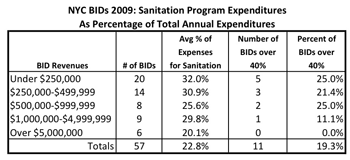
Among New York City’s BIDs, those with revenues under $250,000/yr allocate a higher proportion of their annual expenditures on street cleaning, 32%, than the other BIDs, followed by those in the $250,000 to $499,999 revenue category (see the table above). The largest BIDs, with revenues over $5 million/yr only allocate about 20% of their expenditure dollars on sanitation. Furthermore, among the BIDs with the lowest revenues, about one in four of them are allocating 40% or more of their annual expenditures on sanitation. To my mind, they seem to be more like a sanitation department than an economic development organization. What in the world are their leaders thinking? I use the New York data because they were readily available. The pattern of small BIDs overwhelmingly focusing on street cleaning operations also can be readily found elsewhere.Why Are Street Cleaning Programs Still Big With BIDs?

Though relatively expensive, these programs:

  • Do not require rocket scientists to design and implement. There are existing programs to replicate and service providers to hire
  • Quickly provide visible evidence of the BID’s presence and ability to do things. Lots of staff in identifiable uniforms provide a presence and cleaning up the litter is proof of efficacy. These are important program impacts for new BIDs
  • Have been implemented by the largest and most prestigious BIDS. Unfortunately, too many of the other BIDs have fallen into adopting programs because their prestigious peers are operating them rather than asking whether such programs can really achieve their organization’s economic growth objectives.
  • Are seldom terminated because most BIDs seldom, if ever, engage in real program evaluations
  • Have developed an aura within the downtown revitalization community that they are always beneficial. After all, how can one be in favor of dirt and litter? But, that is not the real question.

For most downtowns, the real issues are will cleaner streets:

  • Bring more shoppers downtown?
  • Increase property values?
  • Increase investment?
  • Produce positive impacts commensurate with the cost of the street cleaning program?
  • Have a bigger economic impact than if its operational dollars were diverted to other programs?

I am not against all BID street cleaning programs. Just those that have no proven impact on customer traffic and economic growth.