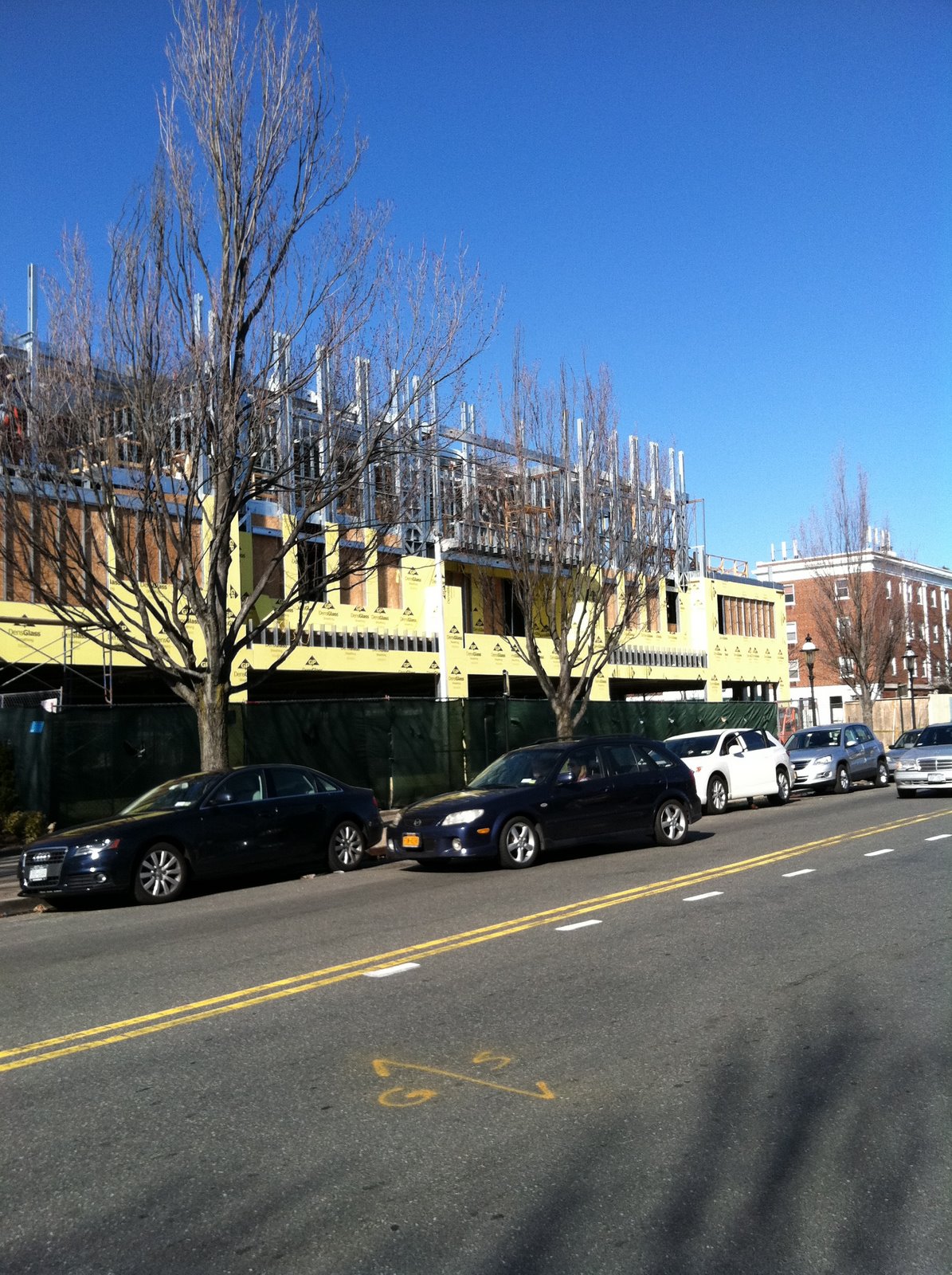
 Last week we were in Garden City, NY. Back in 1996, DANTH had recommended that the site of a gas station on the very important corner of Franklin Avenue and Seventh Street would better serve the community’s needs if it were redeveloped by a project having retail on the ground floor and residential units above. I was happy to see that our recommendation finally was being implemented (see photo on right).
The fact that close to fifteen years had passed between recommendation and implementation strongly reminded me that downtown revitalizations seldom occur quickly and usually require patience. Some downtowns have been in the revitalization business for 40 or 50 years. For example, the formal revitalization effort in the Jamaica Center commercial district in Queens, NY, started back in 1968. The improvements have been steady over these years, with the total amount of investment attracted to this district totalling well over $1 billion by 1987 and the investment flow continuing on to this day.
Other downtowns seem to be overnight successes, but years of unnoticed hard work usually precede their rocketing economic upswings. In the mid 1990s, for example, downtown Englewood, NJ, attracted a significant number of national retail chains and eradicated a 20% retail vacancy rate. Many outside observers noted how quickly this downtown had turned around. Mayors and council members in other NJ communities envied this quick success and wanted to replicate it in their downtowns. Few of these observers knew of the 10+ years of prior planning, improvement projects and coalition formation that enabled Englewood’s “overnight success” to occur.
One of the most important things that Englewood’s political leadership did was to form a common strategic outlook among the city manager, mayor and city council. This took time to forge and energy and attention to maintain. Unfortunately, many local political leaders in other communities do not understand the need for such a strategic coalition and/or do not have the political time or patience to create them.
Sadly, the need for a revitalization effort to have some patience can slip into lassitude, inaction and redevelopment doldrums. Then, impatient local political leaders can give the downtown revitalization organization a badly needed kick in the butt.
As a general rule, DANTH recommends that clients treat a downtown revitalization effort as never ending, not something that in a few years they can strike from their To Do lists. Success not only has to be won, but then also maintained.
One of the most important things that Englewood’s political leadership did was to form a common strategic outlook among the city manager, mayor and city council. This took time to forge and energy and attention to maintain. Unfortunately, many local political leaders in other communities do not understand the need for such a strategic coalition and/or do not have the political time or patience to create them.
Sadly, the need for a revitalization effort to have some patience can slip into lassitude, inaction and redevelopment doldrums. Then, impatient local political leaders can give the downtown revitalization organization a badly needed kick in the butt.
As a general rule, DANTH recommends that clients treat a downtown revitalization effort as never ending, not something that in a few years they can strike from their To Do lists. Success not only has to be won, but then also maintained.
