3-D Television

This past Saturday my wife and I stopped by the Samsung showroom at the Time Warner Center in Manhattan. They were featuring a number of 3-D TVs and we were able, after donning the appropriate glasses, to see what their images really looked like.

I was frankly surprised by how good it was. This technology is worthy of respect.

For downtown theaters it is one more technological improvement that makes home movie viewing their most serious competitor.

That said, it also should be noted that using the glasses is a pain in the butt and one wonders just how many films and TV programs would benefit from 3-D imaging. However, technology for a 3D TV system that does not require special glasses is now in development.


The future is ever present.

Movies Update

For several years now, I have been arguing that the average downtown movie theater is in trouble as more and more people watch more and more films at home or even on their mobile devices. To counter this trend I have encouraged downtown theaters to rekindle “going to the movies” as a special occasion by adopting modern digital, 3D and IMAX projection systems and/or by integrating their cinemas with a restaurant, brew pub or ice cream parlor.

An article in today’s Wall Street Journal shows that 3D and IMAX are indeed having a positive impact on attendance:

  • “After a record-shattering year of revenues last year, when the box office soared beyond $10 billion for the first time in history, revenues are running about 10.3% ahead of the same point last year, with attendance up by more than 8%.”
  • “3-D has helped boost those figures. Last weekend, some theater owners significantly raised ticket prices—mostly on 3-D and Imax showings. In some cases, the price increases ran as high as 26%.”
  • “Consumers, so far, don’t seem to mind the higher prices, as long as they come with premium experiences.” And we are still climbing out of the Great Recession!

Article Here

AVATAR AND DOWNTOWN MOVIE THEATERS

I have been an avid film buff since my Mom took me to see Anchors Aweigh in 1945. Though I liked James Cameron’s Terminator 2, one Alien was more than enough for me and I could not bring myself to see Titanic. Cameron, in my book, did not belong in the same league as Lean, Ford, Hawks, Lubitsch, Capra, Wilder, Spielberg, Cukor, Hitchcock, Coppola, Scorsese et al.

But, on Christmas Eve I went to see Cameron’s latest, Avatar, a 3D film, in all of its glory on an IMAC screen. I went despite my opinion of Cameron as a film-maker/director because I have been reading that the latest 3D technology would be the savior of movie theaters against the growing trend for people to watch films on their home TV screens, laptop computers and even small mobile devices such as iPods. I was particularly interested in how the 3D technology might impact on downtown movie theaters, many of which are relatively small, with fewer screens and less able to support badly needed investments. The primary question I brought to my viewing of Avatar was: Could the 3D technology produce a movie experience that was so unique that it could draw people off their couches or away from their handheld devices and back to movie theaters – especially those in downtowns?

Avatar plain blew me away! It is a watershed in movie-making and one of the most impressive films I’ve seen since Lawrence of Arabia. Watching it you keep asking yourself what kind of mind conjured this reality up and what technologies are putting it on the screen so realistically and so competently? Your immersion into a totally strange, yet coherent, detailed and comprehensive new world is staggering – so much so, that the storyline, which is too often hokey and filled with 60’s political stances, seems acceptable. I intend to see Avatar on a regular 3D screen to determine how much of this impact was due to the huge IMAC screen and the immersive experience it supports, though published film reviews also report about the strong, unique viewing experience Avatar generates on normal 3D screens.

Avatar definitely created a type of experience that I would abandon my easy chair and ignore the four full length films on my iTouch to enjoy again in other movies shown at my local cinema.

However, this experience may be due as much or more to computer-generated, special effects that are not 3D related. For example, the Na’vi, a humanoid race at the core of the film, are completely realistic, with little evidence of contrivance. The biggest grossing movies for the last 10 years (Transformers 2, The Dark Knight, Spider-Man 3, Dead Man’s Chest, Revenge of the Sith, Shrek 2, Return of the King, Spider-Man, Harry Potter / Sorcerer’s Stone, The Grinch) all were either heavy on computer generated special effects or computer animated. These movies are costly and studios are making about 15% fewer films than last year, probably as a result.
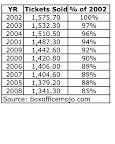
The studios’ emphasis on big budget, high tech films that are sequels or remakes increased attendance at movie theaters in 2009 by close to 8%, according to data published by boxofficemojo.com. With recession restrained ticket prices remaining steady, box office receipts increased by about the same magnitude as attendance. That would place 2009 as the fifth highest in attendance over the past 10 years, still 8% less than the peak in 2002.

It appears that evidence is starting to accumulate indicating that downtown theaters that can show films using 3D and other digital special effects technologies will be able to compete with home theaters and personal film viewers such as the iTouch and iPhone.

But, I doubt that 3D or other digital special effects can be used to enhance the viewing experience for movies such as Casablanca, The Maltese Falcon, On The Waterfront, A Streetcar Named Desire, Annie Hall, The Godfather or the vast majority of lower budget films such as Juno, Education and It’s Complicated, that have recently been turned out by independent production companies. The “indy” films have been a source of strength to some of the most successful movie theaters in large urban neighborhoods and medium-sized downtowns. The audiences at these often packed theaters are overwhelmingly composed of the almost 25 million Americans aged 55 or more who go to the movies every year.

But, the competition is also getting stronger. High tech innovations are also increasing the lure of home entertainment equipment. Tim Bajarin, of Creative Strategies, who I think is the best in the business on computer related markets, sees 3D television taking hold soon, while DVDs rapidly are being displaced by on-demand streaming of movies. (See: PC Mag Article Here).

Consequently, I think that downtown cinemas need to not only be capable of digital projection and showing 3D films, but they also need to:

  • Make watching a movie with others in an audience a very pleasurable and therefore desirable experience. This not only means clean and comfortable seats, clean floors, good sound equipment, etc., but the enforcement of rules that are absolutely intolerant of patrons acting without civility to those around them
  • Integrate the movie-going with unique eating and drinking opportunities such as a quality restaurant, a coffeehouse, a first-rate ice cream parlor or a brew pub
  • Court and pamper the 55 year old + audience. It has accelerating growth.

N. David Milder

Teenage Retail Market Update

This is a follow up to my 3/10/09 and 4/24/09 posts on this subject.

Same store sales in November 2009 reported by retailers specializing in clothing and accessories for teenagers showed a 7.8% yr2yr decline, making it the worst performing retail sector.

Even Hot Topic, a former high flier, had a double digit drop, while Abercrombie & Fitch had its 19th straight month of reduced sales revenues.


The Bureau of Labor Statistics puts the current teenage unemployment rate at 26%.
With fewer jobs and mommy and daddy being more careful with their dollars, teenagers have a lot less money to spend.

See the article by Stephanie Rosenbaum, “Recession? Teenagers Get It and Are Cutting Back” on NYTIMES.com, December 26, 2009.

Repositiong For The Future During The Great Recession: The Bayonne Town Center

This posting was updated on 12/10/09.
 

Bayonne, NJ is the kind of place that folks form deep attachments to. Even when they move away or find another workplace, those warm feelings remain.

Last week I had lunch in Bayonne with an old friend and colleague, the city’s planner. It had been almost a year since I was last in the Bayonne Town Center and I was eager to see how it had held up during the Great Recession. After walking around the district for about an hour and a half, taking photos and shopping in some of the new stores, I was impressed by what I saw. Here was a perfect example of a downtown that, while experiencing higher than usual vacancies, was repositioning for the future by working to attract and create strong new assets.

Back home, I quickly sent Mary Divock, the district manager, an email message saying:

“…during the Great Recession the Town Center managed to make some really strong retail additions that will be even more important as the economy improves. I have attached snaps of the stores I feel are good additions. Most other downtowns I’ve visited recently cannot say the same. You should be proud.”

Here are some of the things I found:

  • A new and popular green grocer
  • ShopRite, located very close to the district, has doubled its size to 70,000 SF. I am hopeful that the district will be expanded to include the ShopRite and other nearby establishments. See: Article
  • A new shop featuring silver products had opened
  • So had a hearing aid shop
  • Another firm featuring medical equipment had moved from a side street to Broadway
  • GameStop and Petland had opened. According to a report in the Leisure eNewsletter, between 2007 and 2008, nationally, annual household expenditures for pets, toys, hobbies, etc. increased by almost 26%
  • Plans for a nursing home, across from the Bayonne Medical Center, with Class-A retail space on the ground floor had obtained city approvals
  • Plans for adding 14 residential units and renovating the store facades on an existing building were proceeding and there are expectations that some other buildings may follow suit
  • There were more than normal vacancies, but really not that much more and certainly their perceived impact was more than offset by all the new shops. As the economy improves the vacancies will ebb, but the new shops will only get stronger.

After my visit I learned that with the bottoming out of the economy merchants were again applying to participate in the BTC’s Jump Start Facade Improvement Program.

Here are some relevant photos: