N. David Milder at DANTH, Inc.

Downtown Revitalization Specialist

Main menu

Skip to content
  • Home
  • About NDM
  • News
  • Downtown Curmudgeon
  • Reports
    • Long Island City (pdf)
    • Manhattan
    • Meredith (pdf)
    • Morristown (pdf)
    • Peoria (pdf)
    • Sherwood, WI (pdf)
  • Downtown Revitalization
  • Contact

Category Archives: Public Spaces

Post navigation

← Older posts
Newer posts →

A Critical Question Under the New Normal for Our Downtowns: Can Autonomous Cars Cure Growing Traffic and Pedestrian Congestion?

Posted on April 29, 2018 by DANTH

By N. David Milder

Introduction

A key facet of the New Normal for Our Downtowns is that many of the most important challenges they now face result from their successful growth and increased popularity — not from their failures. Nowhere is that more evident than with the issues of traffic and pedestrian congestion. Meeting those challenges probably means that many of our downtowns will have to develop and operate in new ways. Many observers believe the changeover to autonomous vehicles will have enormous positive impacts on how many of our downtowns operate, most notably in the ways vehicles structure the uses of downtown spaces. Yet, the transition to automated cars probably will be slow, with completion requiring 30 to 50 years.  The objective of this article is to explore this transition and some useful actions downtowns might take during this crucial and lengthy period of time.

First, it’s important to be clear about the problems that many experts believe automated cars hopefully will successfully address.

Traffic Congestion Is an Old Problem That Is Now Growing Exponentially in Importance.

By 1908, the term “traffic jam” was already in popular use, so traffic congestion is a problem that has long been with us (1).

It also can be found in towns of all sizes. I remember in the late 1960s sitting in our car for over an hour in a traffic jam just outside the small town of Waynesville, OH, (population under 3,000) because the town’s streets and parking lots could not easily accommodate all the people that wanted to visit its large niche of attractive antique shops. Similarly, in the 1990s, I sat in stalled traffic for what seemed like an eternity in the small town of Manchester, VT, (population around 4,400) because so many shoppers were visiting its many outlet shops. These examples illustrate how successful small towns with strong attractions have long experienced significant traffic congestion problems.

Larger communities, especially in their downtown areas, also have long experienced traffic congestion simply because of their compactness and density – characteristics that give them a competitive advantage. However, under the new normal, their downtowns are now so successful that they are experiencing even higher levels of traffic congestion that threaten their future well-being. As a terrific report on traffic congestion in Center City Philadelphia noted:

“The revival in Center City in the last 30 years has contributed to the problem (traffic congestion), bringing a greater density of development: taller office towers, more hotels, expanding health care and educational institutions, conversion of parking lots, older industrial and office buildings to residential use and the addition of new retail, restaurant, entertainment, cultural and tourist destinations. Greater density means more people at more time times of day animating the (downtown’s) 2.2 square miles….”

“Parking and traffic regulations remain essentially unchanged in the central business district from the era when Center City was a 9-to-5 downtown with two rush-hour peaks. But today Center City is filled with office workers freed from their desks by digital technology, eating lunch and holding meetings in restaurants and cafes. It’s a destination for tourists and shoppers, animated by tens of thousands more residents, students and visitors to medical and cultural institutions. It’s become a place pulsing with vehicular and pedestrian volumes continuously throughout the day and evening hours.”  (2).

The tie between a downtown’s economic success and traffic congestion also is demonstrated by this finding about traffic in Manhattan: “Since 2013, as the city’s economy and population increased, daytime speeds in the Manhattan Central Business District (from 60 Street to the Battery) declined by 11 percent” (3).

In 2017, average traffic speed in the Midtown core of that CBD was 4.7 MPH, not all that much above the 2.91 MPH average walking speed in NYC found in 2006 (4).

Traffic congestion has reached such levels in NYC that city and state leaders have tried (and failed so far) to introduce “congestion pricing” to keep vehicles from entering  Manhattan. It has been implemented in London, Stockholm, and Singapore and on a few toll highways in the US such as I-66 in the Washington D.C. area and I-15 in San Diego. In other communities, altering regulations and strengthening enforcement are the major tools to cope with increased traffic congestion.

The table above shows the 25 cities with the worst traffic congestion in the USA, according to INRIX Research. They are located all over the nation. Our most populated cities certainly rank high, but it is also notable that five of these cities only had populations in the 58,000 to 212,000 range – Stamford, Tacoma, Santa Cruz, San Rafael and Santa Barbara – and that three were in the 58,000 to 91,900 range – San Rafael, Santa Cruz, and Santa Barbara.

It’s Not Just the Downtowns, It’s Also the Roads/Highways That Connect to Them.  The economic health and well-being of most downtowns depend not only on the ease and costs of moving around within them, but also on how difficult and costly it is to get to and from them. The frequent traffic congestion found on the major roads leading into them can be very off-putting to those that have to work or do business in a downtown, not to mention those who want to visit for pleasure and entertainment reasons.

It’s Not Just Cars on the Roads – It’s Parking Them, Too. Many of the cars that enter a downtown stay dormant, i.e., parked, for substantial parts of the day. These parked vehicles occupy a significant proportion of a downtown’s land. As one recent report noted: “Parking consumes a significant amount of land, especially in suburban areas where auto use is highest and surface lots are more common than multi-story garages” (5). Shopping malls notoriously dedicate most of their land – about 80% — to the parking and movement of vehicles.

The extent to which downtown spaces are dedicated to auto-related uses depends a lot on how many people use cars to get to and from them. There can be considerable variation. For example, back in 2003 Michael Manville and Donald Shoup noted:

“If you took all of the parking spaces in the Los Angeles CBD and spread them horizontally in a surface lot, they would cover 81 percent of the CBD’s land area. We call this ratio—of parking area to total land area—the “parking coverage rate,” and it is higher in downtown LA than in any other downtown on earth. In San Francisco, for instance, the coverage rate is 31 percent, and in New York it is only 18 percent” (6).

Other observers have noted that: “streets and parking take up 45% of land in downtown Washington, D.C. and up to 65% in downtown Houston” (7). This variation in parking coverage rates means there will be variation in the ability of reduced parking demand to translate into freeing up land that can be put to more pedestrian friendly uses.

Downtown parking structures are also very expensive to build – about $50,000 per parking space – and add significantly to downtown development project costs, while using a lot of scarce and valuable land.

The Obvious Thing That Any Solution Must Achieve. Traffic congestion essentially means that there are too many vehicles in a defined geographic place. The obvious thing that any solution to traffic congestion must achieve is to reduce the number of vehicles in the place of interest, e.g., a downtown. Fewer vehicles means less land need for the vehicles’ movement and parking. That is precisely what many advocates (e.g., Uber, Lyft) claim that a system of automated ride-sharing vehicles can accomplish. However, as will be detailed below, there are substantial reasons to question those claims, especially for the early decades of the transition period. In turn, that can have important implications for the actions municipalities may want to take during those crucial years.

Yogi Berra: “No One Goes There Anymore – It’s Too Crowded!” 

Pedestrian congestion is more of an emerging problem. Pedestrian activity can have two faces. On one hand, over the past 15 to 20 years, significant levels of pedestrian activity have become an essential element in our understanding of how successful downtowns and Main Street districts work. The well-deserved and growing attention that downtown “walkability” has garnered reflects the concerns of those active in downtown revitalization about the physical and social conditions that encourage strong pedestrian activity. It is also a de facto acknowledgment of the importance of such activity.

On the other hand, there is ample evidence that pedestrian activities can reach levels that are too dense, induce avoidance behaviors and tarnish the image of a downtown in the eyes of the public. The above statement, by the oft astute Yogi Berra, depicts a growing threat that is present daily in many of our larger downtowns and to lesser extents in some of our smaller cities. The situation here in NYC has become fairly obvious. For example, a headline in a 2016 article in the New York Times blared: “New York’s Sidewalks Are So Packed, Pedestrians Are Taking to the Streets” (8).

While this congestion may happen unsurprisingly in Manhattan on 5th Avenue in and near Rockefeller Center, in the Times Square Bowtie, along Broadway and elsewhere in Lower Manhattan, around Macy’s and near Penn Station, I have been in similar pedestrian traffic jams, though less frequently, on the sidewalks of Austin Street in Forest Hills, NY; Main Street in Flushing, NY, Jamaica Avenue in Queens, and on Fordham Road in The Bronx. Indeed, pedestrian activity has been increasing throughout the city as the table below demonstrates.  NYCDOT has been counting pedestrians at 100+ locations throughout the city since 2007 annually in the spring and in the fall. It creates a Pedestrian Volume Index based on the counts at 50 of those locations. Between the Spring of 2007 and the Spring of 2016, there has been an 18.3% increase in pedestrian activity in NYC. 

New York is not alone in experiencing pedestrian congestion. I have also observed it in such diverse places as Main Street in East Hampton, NY, Michigan Avenue in Chicago, Newberry Street in Boston and Ocean Drive in Miami Beach.

N.Michigan Ave in Chicago. Too many or too few pedestrians?

How many downtowns are inducing avoidance behaviors and having their images tarnished by too much pedestrian traffic congestion? My suspicion is that it is happening far more often than their leaders and stakeholders either realize or would want. Perhaps this is due to their focus on building up pedestrian activity, so the downtown can be well-activated and have ample users when that focus is no longer needed. Whatever the reason for this disregard, once again, it is the success of our revitalization efforts that creates a new challenge – too much pedestrian activity.

In turn, this situation raises the question of: at what point does the density of pedestrians begin to significantly make walking an irritating, joyless labor and an inducement for avoidance behavior? How much pedestrian traffic is too much? One suggestion is that a pedestrian needs a space envelope of about 1m2 (9). My bet is that number has no empirical data about individual behaviors, preferences and attitudes to support it! My stride alone could take up most or all of that space and I am of average height. The most important issue is how much space allows a pedestrian to feel comfortable and safe – not how many of them can be crammed onto a length of paved sidewalk.

Research also suggests that walking speeds are influenced by a community’s population size and level of economic development (10).  Consequently, they may be expected to increase as a downtown revitalizes. However, increased walking speed once it crosses an unknown threshold, may deter pedestrians from strolling and window-shopping – activities critical to a downtown’s retail and entertainment operations. Moreover, as anyone visiting Times Square these days probably will attest, high volumes of pedestrian traffic can bring walking speeds down to a crawl.

High pedestrian volumes also can impede strolling and window-shopping. Retailers definitely want significant levels of pedestrian traffic, but if the volume gets too large it can become superfluous or provide too much friction for comfortable strolling and window-shopping or entering/leaving shops. This is reflected in two of my findings about the 34th Street district in Manhattan:

  • The highest retail rents were not on the blockfaces with the highest pedestrian counts.
  • Major retailers seem to appreciate high pedestrian counts close to Macy’s and clusters of other major retailers more than the very high pedestrian counts close to Penn Station (11).


What, then, is an optimal pedestrian flow for retailers? The Traffic Engineering Handbook 2015 (TEH) – citing data that has been in the Handbook at least since the mid-1960s – suggests that pedestrian flows larger than 1,100 to 1,600 people per hour per 22” lane are not conducive to retail activities. On a sidewalk along a downtown commercial street that has an 8’ to 12’ pedestrian zone – as recommend in Boston — that would mean between four and six 22” wide pedestrian lanes (see above table).  The TEH’s recommended pedestrian volumes for retail would mean between 4,400 and 6,400 pedestrians/hr in a four-lane zone and between 6,600 and 9,600 pedestrians/hr in a six-lane zone.

However, if we look at the NYCDOT p.m. counts for the 50 locations used to construct its Pedestrian Volume Index, we find that:

  • 9, or 18%, had counts above 4,400/hr
  • Only 5, or 10%, had counts above 6,400/hr
  • Only 2, or 4%, had counts above 9,600/hr. (One location is by Macy’s, the other is across from Penn Station.)

The 1,600 people/hr/lane rate seems to result in a very high pedestrian flow even by NYC standards, one that makes me doubt it is conducive to strolling and window- shopping. The 1,100 people/hr/la rate is still relatively high, but probably closer to what is conducive to having successful retailing. More research on this question is needed.

Under the new normal, as more and more downtowns succeed, as more of them have significant levels of pedestrian traffic, more of them probably will have pedestrian congestion problems.

The Auto-Pedestrian Congestion Interaction. Of course, there also are basic relationships between pedestrian and auto congestion. They each can reinforce the other. For instance, dense auto traffic makes it harder for pedestrians to cross streets, while dense pedestrian flows at corners makes it more difficult for autos to make turns. To help cope with this situation in NYC “a new tool has emerged to help increase pedestrian safety: The Pedestrian/Traffic Manager—an individual trained and certified exclusively in the movement and safety of pedestrians in high density areas (12).

Spaces for vehicles turned into spaces for people. Broadway near 36th Street in Manhattan

Historically, auto traffic and pedestrian congestion also have fought each other. For example, early in the transition to automobiles, wide city sidewalks were reduced in size to provide more room for vehicle traffic. Of late, cities such as NYC, have been doing the opposite, emptying road bed spaces of vehicles to provide more room for pedestrians – see the above photo. Many urbanists believe that autonomous vehicles will enable much more of the street spaces used by vehicles to be converted into vibrant public spaces for pedestrians.

The Promises of the Automated Car Revolution

These are the major positive impacts that the changeover to automated vehicles promises to achieve:

  • Much safer vehicles due to automation/computerization of driving functions and new safety features.
  • Reduced CO2 emissions created by the switch to automated vehicles powered by electric engines.
  • Reduced need for parking spaces created by:
    • Reduced private ownership of vehicles means less need for residential parking.
    • Increased use of ride for hire automated vehicles for work and pleasure trips means reduced need of parking spaces for visitors to office buildings, manufacturing plants, shopping malls, sports stadiums and arenas, government offices, etc.
  • Reduced need for land used for highways, roads, and streets because:
    • There will be significantly fewer vehicles because there will be vastly increased ride-sharing.
    • More, importantly, there will be fewer vehicle miles driven since there will be vastly increased ride-sharing.
    • Vehicles will need narrower road spaces because vehicles will be more accurately guided by GPS or road beacon systems.

In 2017, these promises stimulated the National Association of City Transportation Officials (NACTO) to issue its future-peering and optimistic Blueprint for Autonomous Urbanism (13). In this vision of our urban future, the adverse impacts of automobiles are substantially diminished, and the needs, comforts, and pleasures of people are the engines for urban design. For example, under the Blueprint, people would have more spaces for walking and leisure and vehicle speeds would be so slowed pedestrians could even cross streets midblock! There is much to admire in this vision, but there also are many questions about when and how it might be realized.

Some of the claimed benefits of the automated car revolution, especially when made by people with strong vested interests in it, strain credulity and seem more like marketing puff. Often this puffery also is full of politically tenuous positions. The leaders of Lyft are good examples. As reported in a 2018 article on Verge:

“Lyft’s… co-founders, John Zimmer and Logan Green, have released policy papers predicting the end of personal car ownership in major cities by 2025, and calling for more people to carpool by charging a fee to those who don’t” (14).

With about 263 million passenger cars, motorcycles, lorries, buses and other vehicles now registered in the US, it is certainly dubious that personal car ownership will end in our major cities by 2027. Also, only political naïfs would believe that fining people who do not carpool would not create huge political problems.

More generally, Lyft stresses that ride-hailing could reduce the number of personally owned cars on the roads (15). According to its spokesman: ”Lyft is focused on making personal car ownership optional by getting more people to share a ride, helping to reduce car ownership, and partnering with public transportation”(16). Uber, according to its spokesman has a similar goal: “Uber’s long-term goal is to end the reliance on personal vehicles and allow a mix of public transportation and services like Uber” (17).

Of course, there is another possibility: ride-hailing services will increase the number of vehicles on the road and significantly worsen urban traffic congestion.

The Predictions

The Importance of the Long Transition Period. There is a real need for downtown and municipal leaders to recognize that the transition to autonomous vehicles will take decades to complete (18). Until then, there will be very long periods when roadways will be shared by autonomous vehicles, those that are legacies, and those that are driven, but have lots of hi-tech safety features to protect their drivers and passengers. Even the transition away from gasoline powered vehicles will likely take decades to complete. One of the most important issues for downtown and municipal leaders is when, if ever, will the number of automated vehicles reach the point where they will reduce the need for parking spaces, roads and highways?

Autonomous vehicles will have a relatively small presence in the near future. In its 2016 report, McKinsey concluded that worldwide: “Once technological and regulatory issues have been resolved, up to 15 percent of new sold cars sold in 2030 could be fully autonomous” (19). McKinsey also concluded that by 2050, about 33% of new cars sold worldwide could potentially be a shared vehicle (20). That suggests that the vast majority of vehicles sold 30 years from now will still be of the unshared variety!

IHS Markit looked at autonomous vehicle sales in the 2020 to 2040 period in the Americas (see above chart). It predicted that autonomous vehicle sales in the U.S. would reach 7.9 million units/yr by 2040 (21). Given that annual vehicle sales in the US in recent years have been in the 15 million to 17 million range, it appears probable that most vehicles sold in the US for the coming 20+ years will be legacy type vehicles, though many of their operations and safety features may become automated.

Municipalities and downtowns that forget to take into account the very large number of legacy and unshared vehicles do so at their own economic peril! Yet, the growth of autonomous and shared vehicles will mean that they, too, cannot be ignored.

BP, the big oil company, in its Energy Outlook 2018, sees only 25% of the car sales worldwide in 2040 being electric powered. Even if we allow a 100% or even a 200% error factor to offset any possible BP bias, that still leaves a whole lot of non-electric vehicles being sold – and many more will still be on the road. These data suggest that the ability of autonomous electric-engined cars to reduce CO2 emissions probably will take many decades to reach significant levels!

The BP data are also interesting because they show that the number of passenger vehicle kilometers (vkm) powered by electricity will grow significantly faster than the sales of electric powered vehicles in 2040. This also points out that the numbers of miles/kilometers traveled by vehicles, with and without passengers, probably are far more important variables for analyzing traffic congestion than auto ownership statistics.

The following quote from the Driverless Future report is extremely important. It notes that:” The possibility that millions of car owners could shift to ridesourcing and give up car ownership offers an opportunity to alleviate congestion, provide equitable access to jobs and services, and create development that is more inclusive and sustainable. However, it is also expected that vehicle miles traveled will rise as consumers are exposed to new mobility services. This would lead to more congestion” (22). This illustrates the importance of the vehicle miles traveled variable and its associated data.

The Speed of The Transition Will Probably Vary by the Type of City or Town. The McKinsey study also concluded that: “City type will replace country or region as the most relevant segmentation dimension that determines mobility behavior and, thus, the speed and scope of the automotive revolution” (23). In McKinsey’s view, in the US, regions automated vehicles will have marginal penetration in small towns and rural areas, where private cars will continue to be the preferred means of transportation. However, in the larger, most congested cities car ownership and use is more burdensome and shared mobility has significant competitive advantages and consequent higher probabilities of adoption (24).

Another relevant study, “Driverless Future: A Policy Roadmap for City Leaders”, by Arcadis, HR&A, and Sam Schwartz, argues that the shift from car ownership to using shared automated vehicles will vary according to the strengths of the following variables:

  • Population density.
  • Level of car ownership.
  • Strength of public transit.
  • Residential density (units/acre).

 The above table is constructed from data on page 9 of the Driverless Future report. The analysis of shifts from personal car use for commuting to the use of shared automated vehicles is cost driven. This analysis then ties the shifts with residential unit density. Areas with 0-3 units per acre are deemed now likely to prefer autos for commuting; places with 10-20 units prefer bus transit and places with 30-150+ units per acre prefer rail. The analysis projects that car ownership will probably shift into the use of shared automated vehicles (AVs) to a much greater extent in the NY-NJ MSA, 46% to 60%, than in either the L.A. MSA, 36% to 46% or the Dallas-Ft Worth MSA, 21% to 31%.

The conclusions that the shift from the use of personal cars to shared automated vehicles will be greater in the NYC Metro than in the L.A. and Dallas-Ft Worth Metros, and that it will be lowest in the Dallas-Ft Worth Metro appear to me to be correct. The overall differences on the estimates for the NY and Dallas Metros are 25% for the low estimates and 36.4% for the high estimates. However, to me, there appears to be a number of questionable things about this analysis. For example, the ranges between the lowest and highest estimates of the reductions in personal vehicle ownership in all instances are quite high. That strongly suggests these should be treated as ballpark estimates – valuable if used carefully, but far from definitive. In all fairness, the study’s authors do state conditionally that the MSA in question “could experience a shift of….”

Also, the residential density variable really does not seem to make all that much difference:

  • For the NY Metro the range for the low estimate across the five residential unit density categories is 37% to 45.7%, a delta of 8.7%. The range for the high estimate is 66.7% to 70.0%, a delta of 3.3%
  • For the L.A. Metro the range for the low estimate across the five categories is 35.5% to 38.6%, a delta of 3.1%. The range for the high estimate is 44.2% to 46.8%, a delta of 2.1%
  • For the Dallas -Ft Worth Metro the range for the low estimate across the five categories is 18.3% to 20%, a delta of 1.7%. The range for the high estimate is 25.0% to 33.6%, a delta of 8.6%.

The focus on car ownership is questionable. As the BP and Driverless Future reports discussed above indicate, vehicle miles traveled is probably the really crucial variable. Certainly, it is more probative when analyzing the issues of CO2 emissions, road safety, traffic congestion, and the land needed for roads and highways. However, data on the use of personal cars to commute to work may be far easier and cheaper to obtain.

Most importantly, the assumption that the shift away from personal car use will be based solely on economic factors should be strongly questioned. The reasons why only 25% of NYC’s residents use their personal cars to get to work and 52.9% use public transit, while 75.6% of Dallas’s residents drive their cars to work and only 9.5% use public transit are probably far more historical and cultural than economic. These cultural factors are also present in L.A., as well as in such cities as Charlotte, NC, and Columbus, OH. They are why these communities do not have stronger and better utilized public transit systems – it isn’t that these cities lacked the wealth or economic strength.

In such communities, it will not be easy for even cheaply priced rides in shared automated vehicle to overcome the feelings of power, control, freedom, comfort, and even joy, that riding in their own vehicles provides to a whole lot of Americans. For these car owners, the benefits may be worth spending a good deal of money to retain them. Just consider that the average cost of an off-street parking space in NYC is about $400/mo and in Manhattan, as shown in the illustration below, the prices can be a whole lot higher, $600 to $1,000. These car owners have a proven ability to accept an awful lot of financial pain in order to drive to work. Forecasts of their abandoning their own vehicles for cheaper shared rides to my mind lacks similar levels of evidentiary support!

Of course, the implementation of a steep congestion pricing program could make the economic factors much more salient. But, but, but….


Already, in many of our largest cities, less than half of their residents commute to work alone in their private cars: 22% in NYC; 35% in San Francisco, 38.9% in Boston; 49.2% in Seattle and 49.5% in Chicago. The introduction of shared autonomous vehicles into their congested areas seems unlikely to capture customers from those driving their cars. More likely are those already using other transportation modes. Because of that their introduction might actually increase congestion. Some evidence for this contention is provided by a very solid study of the impacts of “TNCs”, a.k.a. Uber and Lyft, on congestion in NYC by Schaller Consulting. While the vast majority of the TNCs’ trips are neither shared nor automated, Schaller’s major findings are still salient because they strongly indicate the types of riders who are prone to be attracted by automated ridesharing services:

  • “TNCs accounted for the addition of 600 million miles of vehicular travel to the city’s roadway network over the past three years, after accounting for declines in yellow cab mileage and mileage in personal vehicles. The additional 600 million miles exceeds the total mileage driven by yellow cabs in Manhattan.”
  • “Growth in trips, passengers and mileage is seen throughout the city as TNCs attracted yellow cab riders, those who would otherwise use the bus, subway or their personal vehicle, and people who would not otherwise have made the trip.”
  • “TNC mileage nonetheless continues to grow rapidly because exclusive-ride trips still predominate, and because most TNC customers are coming from transit, walking and biking. Migration from public transit translates to increased mileage even if the trips are shared.”
  • “Trip growth in Manhattan has been concentrated during the morning and evening peak periods, when yellow cab shift changes produced a shortage of cab availability, and late evenings and weekends when passengers may prefer the comfort and convenience of TNCs over yellow cabs or transit services”.
  • “A continuation of TNC-led growth in travel is not a sustainable way to grow the city” (25).

Models, such as the one employed by Driverless Future, predict that the highest conversion from commuting by car to the use of shared automated vehicles will be in many dense urban residential areas where that often will mean relatively few people actually make the change because so few are now using their cars On the other hand, the introduction of many shared automated vehicles into such urban environments may worsen traffic congestion. It may well be, that congestion in Manhattan will only be reduced if shared automated vehicles are only used to transport out-of-town commuters.

Finally, the modeling of, and discussions about automated vehicles have almost exclusively focused on those carrying passengers, but auto makers, such as Ford and even Tesla, see huge market opportunities for those that will deliver freight to companies and purchases to consumers. A major feature of the current retail revolution is the quest to provide at least same day, if not same hour delivery of online purchases. The numbers of these vehicles could rival those used for conveying passengers.

One solution may be limiting freight deliveries to slow, after dark hours, though some businesses definitely will strongly resist. The real challenge is the final 100 yards problem of getting the package from the automated delivery vehicle into the hands of the customer, where after dark deliveries probably will pose a problem. Amazon currently is experimenting with using drones for package deliveries, which may pose still other problems. One way or another automated package delivery may pose major problems for downtowns and cities sooner than the automated passenger vehicles because it may be relatively easy for companies like Amazon, Walmart, Kroger, Best Buy, Macy’s or even Uber and Lyft to field fleets of them to meet already proven demand. Downtown and municipal leaders need to keep the regulation of automated freight and package deliveries high on their agendas – and finding the right ones probably will not be easy.

 The Sine Qua Non for Solving the Traffic Congestion Problem

It’s been said that our dense urban areas, such as downtowns, have a geometry problem: there is a finite amount of land and a growing number of automobiles that want to use it. Passenger vehicles can vary both in how many passengers they have the capacity to transport and how many they actually do carry. The photo montage below assembled by Jon Orcutt demonstrates that if each only carries one passenger, then the same number of vehicles, occupying the same amount of road space, regardless of whether they are private cars, Uber vehicles or autonomous cars. If all the seats in these vehicles were occupied, then about four times as many people could be transported without increasing the number of vehicles or the amounts of needed road and parking spaces to accommodate them. Those are the basic advantages for the community of ride-sharing/carpooling efforts.

Recent simulations, however, have indicated that for ride-sharing to have meaningful positive impacts, they will have to carry more than the four or five passengers that is the capacity of our average passenger cars. The ride-sharing vehicles will need to carry between 12 to 18 passengers. As one very astute observer has noted: “… governments will need to support the growth and development of fleets of 12- or 18-seat minibuses, to supplement (rather than replace) public transit systems, which they will also need to support” (26).

Riding in shared minibuses may not have as much allure for the riding public as the image of riding alone in a well-appointed automated vehicle. One may also wonder what the images of Uber and Lyft may be once they become fleets of minibuses or what the value of their shares of stock will be.

One also might wonder about the appeal of riding in close quarters with a group of strangers. To many, it may sound like being in the rush-hour in the NYC subway. A 2018 study in Greenwich, England found that survey respondents associated a good deal of potential social discomfort with ridesharing. They felt that a “key emotional benefit to travelling by car or taxi is the sense of control and personal space.” While public transport does not have such spaces, it does have informal ‘social rules’ that are applied. Respondents were “unsure on how such ‘unwritten rules’ would apply to ride-sharing.”  (27).

Uber and Lyft are the current major pretenders to the shared automated vehicle service throne, though they are basically still app-initiated ride- hailing operations. So far, the public’s disposition to using them is not favorable. A 2016 survey for Vox found that 53% of its respondents said it was unlikely they would ride in an Uber or Lyft vehicle in the next ten years and 61% reported they were unlikely to use an Uber-style self-driving car service if it becomes available in their area. That is a lot of people who do not want to use the largest wannabe automated rideshare services (28).

A rigorous study by researchers at UC-Davis of their current actual users in seven major metro areas — 4,000 users in the metro areas of Boston, Chicago, Los Angeles, New York, the San Francisco Bay Area, Seattle, and Washington, D.C. — produced many interesting findings:

  • “In major cities, 21% of adults personally use ride-hailing services; an additional 9% use ride- hailing with friends….”
  • “Parking represents the top reason that urban ride-hailing users substitute a ride-hailing service in place of driving themselves (37%).
  • “Avoiding driving when drinking is another top reason that those who own vehicles opt to use ride-hailing versus drive themselves (33%).”
  •  “The majority of ride-hailing users (91%) have not made any changes with regards to whether or not they own a vehicle.”
  • “Directionally, based on mode substitution and ride-hailing frequency of use data, we conclude that ride-hailing is currently likely to contribute to growth in vehicle miles traveled (VMT) in the major cities represented in this study” (29). In other words, the ride-hailing services right now appear likely to make traffic in our cities more congested.

If people are afraid to ride in self-driving vehicles, then they surely will not be ride-sharing in them. A survey done for the AAA in 2017 found that: ‘Three-quarters of U.S. drivers would be afraid to ride in a self-driving vehicle, while 19 percent would trust the vehicle and 4 percent are unsure’. Baby Boomers were more afraid (85 per cent) than Millennials (73 per cent), but the latter’s percentage is still very high (30). A year later AAA’s annual survey found that fear levels had dropped to 63 percent (31). However, that survey was completed before the well-publicized death caused by an Uber automated vehicle in AZ.

If ridesharing is indeed the key to reducing traffic congestion, then the strategic imperative for downtown and municipal leaders concerned about this problem must be to devise and implement policies and programs that will sufficiently incentivize the public’s use of fleets of 12- or 18-seat minibuses. Simply getting them out on the road will not be enough. They probably will need to be very appealing in terms of safety, convenience, comfort, and enjoyment as well as price.

The Probable Persistence of the Multi-Modal Regional Traveler

The essence of suburban communities is that their residents are relatively dispersed and, perhaps outside of their downtown or Main Street areas, walking to destinations is rather difficult, while they lack public transportation, so residents are very car-dependent. To a lesser, but still significant extent, the same can be said of some the suburban-like neighborhoods found in some of our larger cities. In fact, many of them actually started out as suburbs.

A study of Lyft and Uber in Austin TX found that when these two ride-hailing services were briefly kicked out of town, their riders returned to using their own cars. According to Robert Hampshire, lead author of the study: “The takeaway isn’t so much that Uber and Lyft reduce the need to own a car, but rather they limit how often people use a car they already own…. A large fraction of these people already had a car and just weren’t using it as much” (32).

These Uber/Lyft riders and car owners in Austin are “multi-modal” travelers within their region. My impression is that too many of the studies about autonomous car impacts neglect looking at the significant numbers of residents in neighborhoods and towns in metropolitan areas who have long been “multi-modal” travelers. I previously have written about the situation here in the outer boroughs of NYC:

“44 percent of the households in both the Bronx and Brooklyn have cars, while 64 percent do in Queens. Even in Manhattan, where garage spaces can cost ($1,000+ per month) and in several of its zip codes over 40 percent of the residents walk to work, 23 percent of the households own cars. The car-owning residents in Brooklyn, the Bronx and Queens tend to be tri-modal from a transportation perspective. They walk a lot to local destinations — perhaps longer and more frequently than anywhere else in the US — and use subways, buses, and even commuter rail to get to work. But they are extremely likely to use their cars to travel to any other types of destinations “ (33).

Residents in many of the suburbs in the NY-NJ- NYC- Newark MSA also are multi-modal travelers. Take Maplewood, NJ, for example, a town with roughly 24,4000 residents, among whom about 57% are in core creative class occupations. The town has a direct commuter rail connection to Manhattan and Newark. Among its residents who are in the labor force about 56% commute to work alone in their personal cars, but:

  • 30.9% commute to work via public transit (mostly by rail).
  • 8.0% worked at home.
  • 1.2% walked to work.

I would bet the family farm – if we had one – that almost all of these employed Maplewood residents who do not use a vehicle to commute to work also are in households that have one or more automobiles. If they didn’t, they would find it very difficult to get around town, much less do comparison shopping or visit major entertainment venues in other communities (see table below).

While commutation trips may offer the best opportunities for people to give up the use of one of their cars, strong arguments can be made that:

  • The degree to which that might occur will vary and certainly be less than 100% (see the discussion of the Driverless Future study above).
  • Residents in the suburbs and in neighborhoods outside of large city cores make many trips to non-work-related destinations. The use of vehicles shared with other people going to these non-work-related destinations may often not be comfortable or desirable while being the sole occupant of automated vehicle operated by a ride-hailing service might not be very affordable. Personal cars will remain for them the best transportation mode, even among those who stopped using them to commute to work.

Can you really imagine taking a shared vehicle with 10 to 18 passengers to transport you and your shopping bags home after a weekly shopping trip to a large supermarket or a shopping trip to COSTCO?  And what about traveling home after shopping trips to a large mall or big box store? Think also about going to a play or concert at a venue that is within a 30-minute drive in a shared automated vehicle that has numerous stops to pick up and discharge passengers? That scenario brings to mind the “airport shuttles” I’ve used to get to my hotels on a few business trips. They were cheaper than taxis, but much more time-consuming and aggravating because of their extra stops. They also were not all that comfortable, but then that holds for taxis, too.

Now some would say that the shopping bags could be delivered by another automated vehicle. Indeed, one of the quickest and largest adoptions of automated vehicles probably will be the fleets of them used to deliver packages. Their numbers initially may well grow faster than their use by passengers because many fewer decision-makers will be involved and they will have a clarity of purpose and benefits. Nevertheless, using AVs as an adjunct to shopping trips to brick and mortar stores to transport the purchases would mean two vehicles would be used on a person’s shopping trip instead of just one.

I live in Kew Gardens, NY, a community that the USPS, in its usual wisdom, divided across two zip code areas. The 11415 area contains only Kew Gardens residents, while the 11418 area has mostly non-Kew Gardens residents. The density of residential units in 11415 is 25.2 units/acre, in 11418 it’s 11.4 units/acre. In contrast, the posher and much more affluent 10021 zip code in Manhattan has a residential unit density of 114.7/acre. Kew Gardens was built as a suburb of Manhattan and even with its many apartment buildings it still retains many large single-family homes and many suburban characteristics. Those who know NYC well, know that many neighborhoods in the outer boroughs share these suburban characteristics. One of them being that many residents are multi-modal travelers within the region.

The above table lists three of destinations we go to with some regularity by car because reaching them via public transportation simply takes too long and involves transfers that are too often “iffy.” I used my Uber app on a Thursday mid-morning, to see what it would cost for them to then take us to these destinations. Uber’s shared ride services were not available for me, so I selected the Economy option. The prices for these trips, presented in the above table, are plainly unreasonable. $133.40 (plus tip?) to get and from Jones Beach?

I’ve read that prices for Uber rides can be expected to go down, especially in shared automated vehicles that probably have 8+ passengers. Do I really want to go on this automated mini-bus with my cooler, beach chairs, and umbrella? Or would I rather have my own vehicle? Moreover, how much cheaper would the ride be? Even 50% less would not be enticing. Furthermore, without a driver, how would sanitation and order be maintained within a shared vehicle?

Here in Kew Gardens and neighboring Forest Hills we can reach Manhattan via the Long Island Rail Road and several subway lines. Unless traffic congestion is severely reduced and automated shared vehicle ride costs are very affordable, I doubt that many residents will use the shared automated vehicles to commute to Manhattan. However, many residents live more than a half-mile from the subway and LIRR stations and use a bus or car service to get to and from them. Uber-type services may be able to capture some of these commuters. However, the fact that the city now charges just one fare to riders who use the bus and transfer to the subway probably severely limits that penetration. Before that program was instituted, fleets of private vans – shared but not automated vehicles — brought subway riders from southeastern and western Queens to Jamaica Center’s subway stations. The one-fare program significantly reduced van ridership. The poor frequency of many bus lines in outer borough neighborhoods, on the other hand, makes Uber and Lyft attractive. Interesting that the UC-Davis seven-city study discussed above found that the Uber-Lyft operations were complementary to rail transit, but hurt buses and taxis.

Back in the 1950s, our apartment complex had a car service that would take tenants to and from the subway. I can envision several condo buildings in our community that might in the future have their own automated “station car,” probably bought second hand, to perform this chore – if the city would give its permission.

Maplewood and many other towns and cities in the NYC Metro Area are in situations very similar to those described in Kew Gardens (see table above). They have commuter rail stations with parking lots filled to the gills with the cars of commuting train riders. Ridesharing automated vehicles may be a way to deflate the demand for these scarce station parking spaces and perhaps put the land to better uses. Summit, NJ, is already experimenting with using Uber to forestall the need to build additional parking capacity. Municipal leaders in such communities should definitely be exploring this possible use of shared automated vehicles to reduce station area parking.

In Chester, NJ, (population about 1,500) Alstede Farms runs a free shuttle between it and the NJT station in Gladstone, NJ, as well as to the Historic Main Street Chester area during the summer months. In the Denver Metro Area, the City of Englewood (population about 34,000) has a free trolley that transports riders to 19 stops connecting CityCenter Englewood, businesses in downtown Englewood, and the medical facilities in and near Craig Hospital and Swedish Medical Center. Note that the Englewood shuttle does not impact on how their riders come to Englewood, but helped them move around the tows more easily while there. Many other suburban towns may want to explore the potentials of similarly using shared automated vehicles as shuttles between major commercial nodes, though there are sure to be financial challenges and require strong corporate sponsorship.

Whether or not the shared automated vehicles can be used similarly as shuttles to make it easier for suburban residents and visitors to get to and from their downtowns is another issue.

Municipal leaders responsible for such suburban communities and suburban-like neighborhoods in our larger cities must realize that these places are not like Manhattan, Center City Philadelphia, downtown Chicago or downtown Boston where a lot of non-commuting destinations are within easy walking distances and car ownership is relatively low. Too many of their residents’ non-commuting trips are unlikely to be adequately served by shared automated vehicles for probably decades to come – if ever – and they will probably need to have a personal vehicle at their disposal. This strongly suggests that, for the foreseeable future, multi-unit residential buildings probably still will need parking capacity of about one space per unit.

As noted above, parking consumes a lot of land in suburban communities, especially when they have large workforces arriving weekdays and/or large shopping malls within their borders. The ability of shared automated vehicles to reduce the amount of suburban land used for parking is not clear. Yes, they probably can reduce the amount of land needed for rail station parking. While a lot of shopping mall land is changing use simply because some malls are closing, it is doubtful that high percentages of shoppers will rideshare to retail stores.

A number of suburban downtowns, e.g., Englewood, NJ, and Great Neck Plaza, NY, have found that parking structures are badly underutilized even before any significant appearance of Uber, Lyft or shared autonomous vehicles. Their potential patrons strongly prefer surface lots, and/or they deem the location of the garages to be too peripheral. Futureproofing these garages –- i.e., making it feasible to convert all or parts of them to other, non-auto related uses -– probably would have been a good idea, but not because of the impacts of shared automated vehicles.

if the suburban roads are not badly congested and the job site has ample parking, why would workers switch to shared automated vehicles on their commutes? The price differential with using personal cars would have to be awesome. Of course, a good number of suburban roads are badly congested – e.g., Rte 1 in NJ between Trenton and New Brunswick and Rte 9 through Boston’s western suburbs. However, overcoming the dispersion of rider residences may be a significant limiting factor. To get into your own car to travel to and park at a rideshare pick-up point may not seem either appealing or logical to many potential suburban users. The alternative of having the vehicle makes numerous pickups also does not seem likely to be attractive to riders. Ridesharing programs have been around for decades and the reasons they did not become far more popular probably still have significant applicability today when envisioning automated ridesharing systems.

But, We’re Driving Fewer Miles and Millennials Don’t Like Cars

One of the arguments frequently offered to support the contention that Americans will easily adapt to automated vehicles is that they are driving fewer miles. Although this was true during and briefly after the Great Recession, in recent years Americans are driving more than ever before – see the above chart on vehicle miles traveled (VMT). In 2016 Americans drove a record number of 3.22 trillion miles on the nation’s roads…, up 2.8 percent from 3.1 trillion miles in 2015” (34). It was the fifth straight year of increased vehicle miles driven.

Moreover, projections by the Federal Highway Administration suggest total VMT by all vehicle types will grow on average 1.07% annually through 2035. However, the growth will slow significantly between 2035-2045 to bring annual growth rate for the entire 30-year 2015-2045 forecast period to 0.78%. This would be quite a moderation in the annual VMT growth rate from the past 30 years when it grew at an average rate of 2% — but it still would be growth (35).

Closer to 2010, Millennials were seen as an urban loving, car and driving hating, experience wanting, under-employed, relatively poor and burdened with large student debts, non-nesting, non-home buying age cohort. Surveys also showed them to be the most likely to use app-summoned ride-hailing services such as Uber and the most willing to ride in driverless cars.

Today, our understanding of the Millennials is changing as their life situations have significantly altered. They are now the largest age cohort. With time and age, they have become better employed, are earning more money, and have started to nest. That means they are marrying, having children and buying homes and cars. The Millennials were deeply impacted by the Great Recession with it forcing them to defer nesting and buying homes and cars for many years.

Moreover, as a Zillow survey found: “Almost 50 percent of millennial homeowners live in the suburbs, while 33 percent live in an urban neighborhood and just 20 percent live in a rural area” (36). That means that about 70% of them will live in relatively low-density population areas where cars are an essential means of getting around for even everyday chores.  Even back in 2014, a survey found that 80% of Millennials surveyed said that they plan to purchase a vehicle in the next five years (37). According to a report in Forbes, Millennials are buying cars in significant numbers: “…(M)illennials, now the largest generation in the U.S., bought 4 million cars and trucks last year, second only to the baby boomers, according to J.D. Power’s Power Information Network” (38)

The rural Millennials are unlikely to have a strong propensity to use shared automated vehicles. The propensity of newly nested suburban Millennials to use such vehicles is unknown at this point in time. The key question is if their assumption of a more traditional lifestyle correlates with more conventional needs and attitudes relating to transportation modes. On one hand, my observations of Millennials now living in the suburbs suggests that they are strong advocates for well-activated downtowns and that suggests that they may make their own imprints on their suburban communities. Yet, they cannot avoid being effected by the significant dispersion most suburbs have,

Looking to the Future States of Traffic and Pedestrian Congestion

Shared automated vehicles provide no silver bullet solutions to these problems and if not properly implemented that can actually increase their severity.

The need to have a successful ridesharing system composed of minibuses capable of carrying 12 to 18 passengers means attracting sufficient users probably will be a huge challenge.

Too little attention is being paid now to the probable problems that will emerge during the long transition period when legacy, driven and automated passenger and freight/package carrying vehicles will share our roads.

A real challenge is that for the traffic congestion in our center cities to be reduced it is primarily the car use of their non-resident regular users that must be changed. That means huge jurisdictional and political problems.

There are real dangers that civic leaders will buy into the shared autonomous car dream too early and make premature moves on reducing parking space requirements or attempting major street and road redesigns. Small scale projects, such as using shared automated vehicles to take suburban commuters to their rail stations, will probably be most appropriate for several decades. Huge freeing of parking and road spaces for repurposing and improving a downtown’s walkability and public spaces are also unlikely for several decades, if ever.

Concern about the safety of a vehicle’s passengers, passengers in other vehicles and pedestrians should be a primary focus now and until automated systems are proven not just in test/experimental situations, but by years of actual full implementation. The Uber traffic accident in AZ showed a shameful lack of public sector concern. The appropriate regulation of the industry will be difficult to design and implement. The baby needs real care, though we don’t want to drown it in its bathwater.

ENDNOTES

1) See: https://www.etymonline.com/word/traffic

2) “CENTER CITY REPORTS: KEEP PHILADELPHIA MOVING” produced by the Center City District, the Central Philadelphia Development Corporation and the Central Philadelphia Transportation Management Association, pp1-2. https://centercityphila.org/research-reports/2018congestion

3) “Mayor’s Management Report,” City of New York, September 2016. Figures are for fiscal year 2013 and 2016. Cited in Bruce Shaller. ”UNSUSTAINABLE? The Growth of App-Based Ride Services and Traffic, Travel and the Future of New York City,” p.18.) http://www.schallerconsult.com/rideservices/unsustainable.pdf

4) For auto speed see: Fix NYC Advisory Panel Report, January 2018, p.7. http://hntb.com/HNTB/media/HNTBMediaLibrary/Home/Fix-NYC-Panel-Report.pdf . For NYC pedestrian speed see:  Rachel Pincus. “Yes, Your Sidewalk Etiquette Could Be Better.” CITYLAB Aug 28, 2015.   https://www.citylab.com/life/2015/08/how-to-share-the-sidewalk/401660/

5) DRIVERLESS FUTURE: A POLICY ROADMAP FOR CITY LEADERS, by Arcadis, HR&A, and Sam Schwartz  http://driverlessfuture.webflow.io/

6) Michael Manville and Donald Shoup, People, Parking, and Cities, Access, Number 25, Fall 2004, p 7 http://shoup.bol.ucla.edu/People,Parking,Cities.pdf

7) See endnote 5, p.12.

8) Winnie Hu, “New York’s Sidewalks Are So Packed, Pedestrians Are Taking to the Streets.” The New York Times. June 30, 2016. http://nyti.ms/29dy7m3

9) See endnote 2, p.4.

10)  Eric Jaffe. “Why People in Cities Walk Fast.” CITYLAB, Mar 21, 2012 https://www.citylab.com/life/2012/03/why-people-cities-walk-fast/1550/

11)  N. David Milder. ”34TH Street: A Fabled Shopping District and Window on the Future of Downtown Retailing.” Downtown Curmudgeon. April 15, 2017. https://www.ndavidmilder.com/2017/04/34th-street-a-fabled-shopping-district-and-window-on-the-future-of-downtown-retailing

12) Ileanna Pappas and Janet Campbell. “A New Breed of Pedestrian Advocate is Making City Streets Safer for Everyone.” Planetizen, Sept. 13, 2013. https://www.planetizen.com/node/65198

13) It can be downloaded at: https://nacto.org/publication/bau/blueprint-for-autonomous-urbanism/

14) Andrew J. Hawkins “Lyft thinks we can end traffic congestion and save $1 trillion by selling our second cars: Do we really need that second car?’ The Verge, Jan 10, 2018. https://www.theverge.com/2018/1/10/16870732/lyft-traffic-congestion-car-ownership-ces-2018

15) AP. “Studies are increasingly clear: Uber, Lyft congest cities.”    https://www.apnews.com/e47ebfaa1b184130984e2f3501bd125d

16) Ibid.

17) Ibid.

18) N. David Milder. “Let’s Get Real About: Self-Driving Cars. Social and Political Engineering Will Also Be Required.” Downtown Curmudgeon Blog. Sept 7, 2017.  https://www.ndavidmilder.com/2017/09/lets-get-real-about-the-supposedly-imminent-nirvana-of-self-driving-cars

19) McKinsey Auto 2030 Report Jan 2016, p 11. https://www.mckinsey.com/industries/automotive-and-assembly/our-insights/disruptive-trends-that-will-transform-the-auto-industry

20) Ibid, p.9.

21) Kate Gibson. “Forecast: Autonomous-Vehicle Sales to Top 33 Million in 2040. The Drive. 2/21/18.    http://www.thedrive.com/sheetmetal/17298/forecast-autonomous-vehicle-sales-to-top-33-million-in-2040

22) See endnote 5. The italicized emphasis was added by NDM.

23) Endnote 19, p. 9

24) Ibid.

25) Schaller Consulting. UNSUSTAINABLE? The Growth of App-Based Ride Services and Traffic, Travel and the Future of New York City. February 27, 2017.  P.1.

26) David Roberts. Unless we share them, self-driving vehicles will just make traffic worse – Vox,  7/24/17,  p.9  https://www.vox.com/energy-and-environment/2017/5/18/15604744/self-driving-cars-cities

27)  MERGE Greenwich:  Customer attitudes to Autonomous Vehicles and Ride-sharing. April 2018. https://mergegreenwich.com/wp-content/uploads/sites/13/2018/04/MERGE-Greenwich-Consumer-attitudes-to-AV-ride-sharing-3.pdf

28)  Timothy B. Lee. “We polled Americans about self-driving cars. Here’s what they told us. Vox. Aug 29, 2016.   https://www.vox.com/2016/8/29/12647854/uber-self-driving-poll

29) Regina R. Clewlow Gouri and Shankar Mishra.  “Disruptive Transportation: The Adoption, Utilization, and Impacts of Ride-Hailing in the United States.” Research Report – UCD-ITS-RR-17-07. October 2017. Institute of Transportation Studies ? University of California, Davis.  Pp. 1,2.

30) Erin Stepp. ‘Americans Feel Unsafe Sharing the Road with Fully Self-Driving Cars: AAA Fact Sheet: Vehicle technology Survey — Phase II. 2017’, Newsroom/AAA.com, available at http://newsroom.aaa.com/2017/03/americans- feel-unsafe-sharing-road-fully-self-driving-cars/

31) Erin Stepp. ‘More Americans Willing to Ride in Fully Self­Driving Cars” January 24, 2018. Newsroom/AAA.com.  https://newsroom.aaa.com/2018/01/americans-willing-ride-fully-self-driving-cars/

32) Danielle Muoio. “Uber and Lyft could destroy car ownership in major cities.” Business Insider. Sept 4, 2017. http://www.businessinsider.com/uber-and-lyft-limit-personal-car-use-study-2017-8

33) N. David Milder. “Let’s get real about self-driving cars: The transition will take a

significant amount of time.” Journal of Urban Regeneration and Renewal, February 15 2018. Vol. 11, No. 3, pp. 223–232, p. 228

34) David Schaper , “Record Number Of Miles Driven In U.S. Last Year.” NPR. February 21, 2017    https://www.npr.org/sections/thetwo-way/2017/02/21/516512439/record-number-of-miles-driven-in-u-s-last-year

35) Office of Highway Policy Information. Federal Highway Administration.  “FHWA Forecasts of Vehicle Miles Traveled (VMT): Spring 2017.” May 4, 2017.  https://www.fhwa.dot.gov/policyinformation/tables/vmt/vmt_forecast_sum.pdf

36) See: http://zillow.mediaroom.com/2017-03-01-Millennials-Buying-in-the-Suburbs

37)  Deloitte. 2014 Global Automotive Consumer Study 6. http://tinyurl.com/y9ygdeew

38)  Joann Muller.  Mar 24, 2016 “Millennials Finally Show Up At Car Dealerships (And Automakers Breathe Easier).” FORBES.   http://tinyurl.com/yckxnwzq
 

Posted in automated cars, Central Social Districts, Downtown Garages, Downtown Redevelopment, driverless cars, Economci Development, Innovations, Moving People, Parking, Pedestrian traffic, Planning and Strategies, Public Spaces, self-driving cars, Suburban Downtowns |

Toward a General Strategy for Small Town Economic Development

Posted on October 7, 2017 by DANTH

Toward a General Strategy for Small Town Economic Development       

The above link will take you to the article I have just completed on this subject. It focuses on smaller and rural communities with populations under 35,000. However, much of the analysis is also applicable to many suburban communities and even some urban neighborhoods.

Since 2010, I’ve been trying to figure out a viable approach to stimulating meaningful economic development in our smaller communities that:
— Considers current realities
— Leverages likely local assets and
— Does not threaten the scale and lifestyles that make these communities attractive to close to 70 million Americans.

This is a major research paper — 32 pages long — that brings together my work on Central Social Districts, quality of life residential and business recruitment, contingent workers, and small business e-commerce capabilities.

It is a very curmudgeonly article. While I hope it genuinely and productively explores new ground, some readers might find it somewhat contentious.

The article has lots of illustrations, but I still felt it was too long for either a newsletter or blog format.

I hope you will find it informative, useful and interesting.

N. David Milder

Posted in Business Recruitment, Central Social Districts, Change Agents, Contingent workers, Downtown Redevelopment, E commerce, Economci Development, EDOs, Entrepreneurship, Office Development, Planning and Strategies, Public Spaces, Small Town Entrepreneurial Environments, Uncategorized |

SOME THOUGHTS ON THE PERPLEXITIES OF DOWNTOWN PEDESTRIAN ACTIVITY

Posted on May 13, 2017 by DANTH

By N. David Milder

Introduction

Over the past 15 to 20 years, pedestrian activity has become an essential element in our understanding of how successful downtowns and Main Street districts work. Such activity has qualitative and quantitative aspects. The well deserved and growing attention that downtown “walkability” has garnered reflects the qualitative concerns of those active in downtown revitalization about the physical and social conditions that encourage pedestrian activity. It is also a de facto acknowledgement of the importance of such activity. However, in my opinion, a lot of important issues are being generated by pedestrian activity that are not being acknowledged, much less being resolved. They could benefit from conceptually and methodologically rigorous quantitative analyses. Moreover, such analyses needs to look at not just pedestrian activity in isolation, but also how it relates to other economic and social behaviors and attitudes. In this article, I’ll take a stab at outlining some of these issues.

How Much Pedestrian Activity Should Your Downtown Have?

It might be reasonably argued that this is one of the most basic questions that should be addressed by any downtown revitalization plan or strategy. Below are some observations and ruminations about pedestrian flows I’ve been accumulating over several years. They stimulated me to look more closely into this question and to realize how complex the task of answering it might be.

The Importance of the Quality of the Pedestrian’s Experience. Many years ago, before the NYPD instituted corrals for the event, I took my nine-year old daughter to Times Square on New Years Eve. It was a ghastly mistake! A strong surge in the crowd sent people flying into us and my daughter went to the ground. I thankfully was able to get her in my arms before she was trampled by the crowd. Lesson learned: a lot of people close together on foot can be very, very dangerous. At what point does pedestrian density become dangerous? Is there some metric about how much space a pedestrian needs to be safe and to feel comfortable and unstressed?

I have long avoided many streets in Midtown Manhattan at certain times of the day, e.g., lunchtimes and during the evening rush, and especially at certain times of the year, e.g., most of December and St Patrick’s Day, because the sidewalks are so crowded, sometimes also with raucous people, that:

  • I have to walk in the street and then take care that I’m not run over by passing vehicles or
  • Staying on sidewalks, I strongly fear bumping into other people or being bumped into far more often than I’d like by unpleasant people. Walking then becomes a very labored, fearful and thoroughly unpleasant experience. Lesson learned: overly crowded pedestrian traffic is inducing me to dislike walking in these areas so I avoid them, much as New Yorkers avoided Bryant Park back when it was known as a crime ridden and dangerous place. I suspect I am far from alone in having this reaction. As Yogi Berra famously said, “no one goes there anymore—it’s too crowded.”

How many downtowns are inducing avoidance behavior and having their images tarnished by too much pedestrian traffic congestion? My suspicion is that it is happening far more often than their leaders and stakeholders either realize or would want. In turn, this raises the question of at what point does the density of pedestrians begin to significantly make walking an irritating, joyless labor and an inducement for avoidance behavior? How much pedestrian traffic is too much pedestrian traffic?

A headline in a 2016 article in the New York Times blared: “New York’s Sidewalks Are So Packed, Pedestrians Are Taking to the Streets.” (1) Such behavior is a good indicator of a malfunctioning pedestrian environment, but it is not a good measure of the extent of the underlying problem. Many, many other pedestrians are staying on the sidewalks, but are far from happy about the situation they are in.

While this happening in Manhattan on 5th Avenue in and near Rockefeller Center, in the Times Square Bowtie, along Broadway and elsewhere in Lower Manhattan, around Macy’s and near Penn Station is perhaps to be expected, I have been in similar pedestrian traffic jams, though less frequently, on the sidewalks of: Austin Street in Forest Hills, NY; Main Street in Flushing, NY, Jamaica Avenue in Queens; Fordham Road in The Bronx, Main Street in East Hampton, NY, Michigan Avenue in Chicago, Newberry Street in Boston and Ocean Drive in Miami Beach.

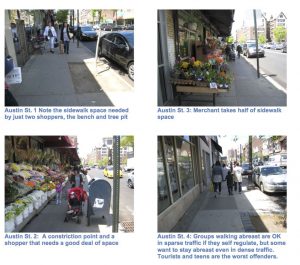
Impediments to a Good Pedestrian Experience. In many of these pedestrian traffic jams, walking is being constricted by such things as narrow sidewalks, stores bringing their merchandise stands out on the sidewalk, outdoor restaurant seating, newsstands, street and truck vendors and their customer crowds, street performers, street tree pits, planters, benches, construction sites, bus shelters and normal window shoppers. In too many instances, the possible pedestrian path on the sidewalk is only wide enough for one person. Lessons learned:

  • When these issues are not properly addressed they can make walking so difficult and unpleasant that they negatively impact a district’s image and increase avoidance of important portions of it.
  • Even very desirable amenities, e.g., street trees, planters, benches and bus shelters can cause problems simply because of the amount of sidewalk space they occupy. (See the Austin Street photos below). Also, shoppers with shopping bags, shopping carts and children in strollers/carriages will need more space than the average pedestrian. Americans are also getting more obese and consequently occupy a larger volume of space. Smaller communities certainly are not exempt from having such problems.

Downtowns that want to attract more pedestrians need to take these factors into consideration. Just setting the attraction of more pedestrians as a goal is acting with blinders on. As the astute Andy Manshel recently emailed me: “Our work is always all about balance.”


Austin Street in Forest Hills, NY (and in NYC) is a very strong and popular shopping corridor. It suffers from narrow sidewalks, sometimes even when pedestrian flows are relatively sparse. That problem rises to the point of being very detrimental during late afternoon and weekend pedestrian peaks.


Rules for the Sidewalk? Certain pedestrian behaviors, those that might be called pedestrian incivilities, too often also impede the smooth flow of pedestrians and make walking thoroughly unpleasant. Some of these incivilities are: raucous, drunken behaviors; walking against the flow of traffic; walking in groups of three or more lined up across the sidewalk; aggressive passing; stopping and standing in the middle of the sidewalk, especially in groups. Lessons learned:

  • There may be rules of the road for drivers, but apparently, there are no behavioral rules of the sidewalk for pedestrians.
  • There is a need for an accepted etiquette of pedestrian behavior, but its codification and acceptance will probably be very, very hard to accomplish. How could it be accomplished and by whom?
  • Pedestrian flows, I’ve been told by experts, are self-regulating. Who or what steps in when that self-regulation fails to work properly? Incivilities are good examples of such failures.
  • Individuals can find that self-regulation can become a very negative experience, full of uncertainties and possibly fears. It also can require a lot of hard work.
  • My observations suggest that tourists are more prone than New York residents to engage in pedestrian incivilities, though local teenagers are also frequent miscreants. If this is the case, how do the tourists impact on our ability to remediate this problem?
  • Districts with high levels of pedestrian incivilities should not try to develop levels of pedestrian traffic that increase the frequency and adverse consequences of such incivilities.

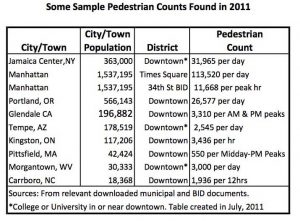
Pedestrian Traffic in Small Towns. Small and medium-sized downtowns will never have the consistently strong pedestrian flows found in our big, traditionally urban cities such as NYC, Chicago and Boston. (See the table below.) They just do not have the needed large daytime populations and the development densities that generate them. So, how much pedestrian traffic should they have? And how can that be determined? By their land use densities? By the needs of local merchants and those targeted for recruitment? By sidewalk capacities? By the number required for the district’s sidewalks to look active and interesting? Or are they so small that such a concern is simply irrelevant for them?

Who You Add Really Counts! Among the relatively smaller downtowns, I have come across some instances where local leaders have complained that their events have drawn either more people than they could handle properly or the kinds of folks they did not want (e.g., bikers, hot rodders, aggressive panhandlers, drug dealers). In several other small and medium-sized downtowns both merchants and residents have complained that a recent big influx of tourist traffic has changed the basic character of their district for the worse. Lesson learned: the composition of the increased pedestrian traffic can really matter; another reason more pedestrian traffic may not always be beneficial.

Pedestrian Traffic as a Locational Asset. Conventional wisdom has long held that strong pedestrian traffic should be one of a downtown’s most valuable locational assets. However, I have not been able to find any research supported metric that shows with any accuracy how many pedestrians passing by a location are needed to support any kind of retail, food or entertainment operation. Questions:

  • How is a retailer to know if the pedestrian count near a potential new location is a really sufficient for its store to prosper there? Apparently, from their sales records, many retail chains do know, though in fairly broad terms, that their stores do better in locations with relatively high pedestrian counts. Yet, there is no evidence that they know of a threshold of pedestrian activity that has to be exceeded, much less how many passing pedestrians are needed to support a square foot of leased space or $1,000 of store sales.
  • How, then, is a downtown EDO to determine what level of pedestrian activity its prime retail-prone spaces need to attract and sustain desired retail tenants?

My recent look at the 34th Street District had an admittedly small sample to study, but it did indicate that some of the district’s most desirable retailers probably valued being closer to other retailers of similar caliber more than proximity to larger pedestrian flows (2). Question: how important is pedestrian traffic in retail locational decisions compared to other factors? Which other retailers are nearby, the characteristics of available spaces, including their size, rent and lease terms, may be more important.

One of the unexplored and untested gospels about healthy downtowns is the pedestrian strolling, window-shopping and browsing scenario for retail success. According to this lore, downtowns are healthy and retailers successful when downtown visitors can leisurely stroll along its sidewalks, window-shop and then browse inside the shops. It is one of the reasons why downtown retail locations are supposedly advantageous. However, today, this scenario often breaks down:

  • In many smaller downtowns and Main Streets, there just are not enough shops to warrant much strolling and the shops are not apt to change their merchandise frequently enough to warrant much window shopping or browsing. My field experiences in such towns suggest that store visits are overwhelmingly need driven to merchants that are locally well known and these merchants are identified destinations before the shopping trips are initiated. Question: In these downtowns/Main Streets, can more resident-driven pedestrian traffic really make all that much difference for retailers?
  • In really big downtowns with very high pedestrian traffic, it is sometimes hard to window shop because of frictions with passing pedestrians. At what level does high pedestrian traffic begin to significantly discourage window-shopping?
  • Today, before Americans go on a shopping trip, they overwhelmingly search on the Internet for the merchandise they want and the shops where it is sold. Consequently, the related residential shopping trips are now much more destination generated, less the result of strolling, browsing and exploring. With tourists, strolling and window-shopping behaviors are probably still significant. However, it may be asked if a lot of pedestrian traffic is still really an important factor for the retailers that are mainly attracting Internet-driven destination shoppers? The Internet is eroding what location, location, location has meant in our downtowns.

Is Simply More Really Better? In decades past, when downtowns were in decline or just starting to revive, getting higher levels of pedestrian traffic was a highly desired objective, even when there was little hope of achieving it. In more recent years, almost every downtown and Main Street revitalization strategy or plan I’ve seen has echoed this “more pedestrian activity is better” theme. Some of them, I wrote. One of my strongest arguments above has been that more is better only if a good pedestrian experience can be maintained or created. Many more of these revitalization plans and strategies should have addressed this issue of the quality of the pedestrian experience they provide – including some of mine. The objective downtown EDO’s should really adopt is attracting more visitors who will be happy because they so enjoyed walking on your downtown’s sidewalks and in its public spaces. I am even tempted to say that should be The First Commandment of Downtown Revitalization.

A Quick Look at the Times Square Bowtie

A brief look at Times Square is worthwhile because it demonstrates so forcefully a number of the points I have argued above.

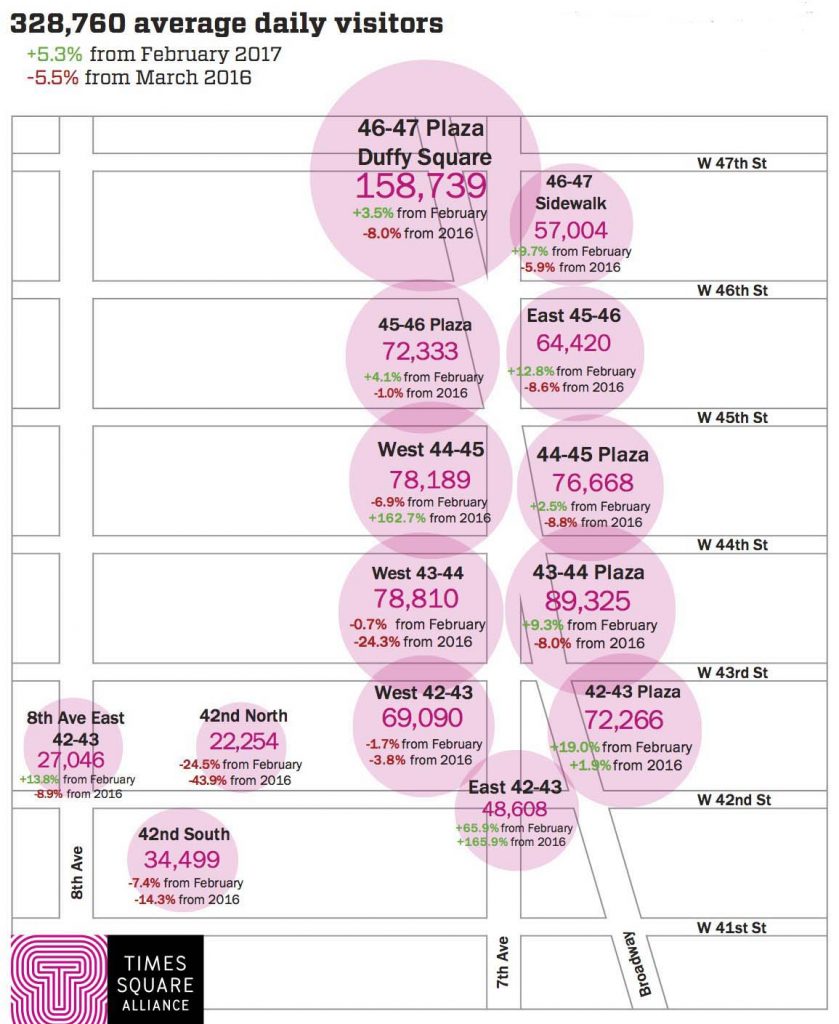
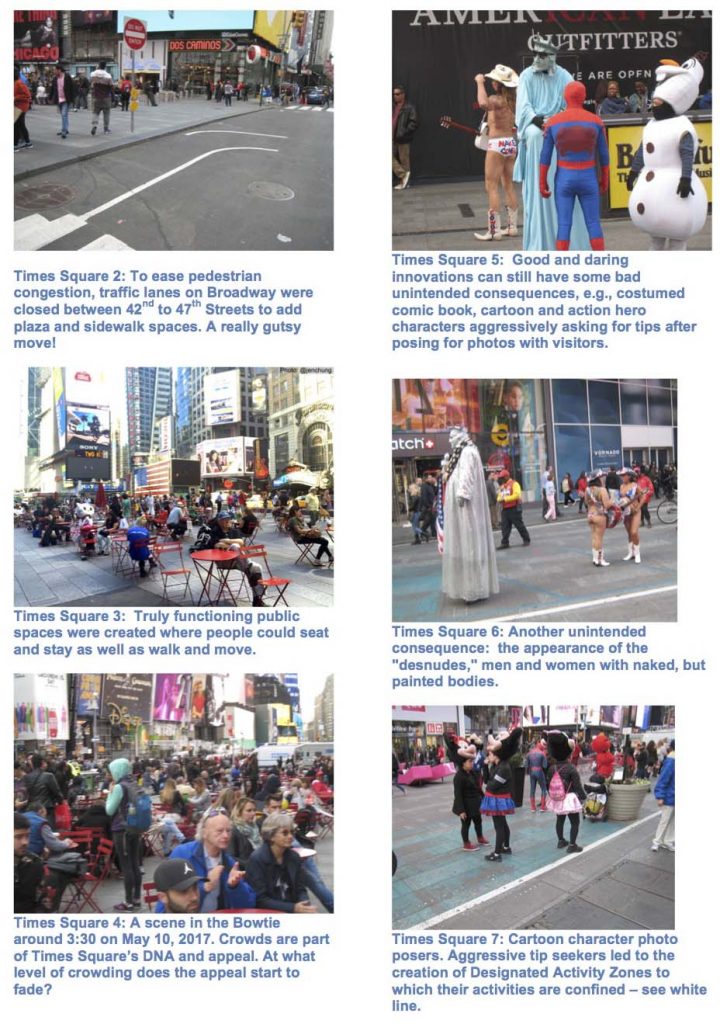
One of the most salient features of the new normal for our downtowns is that while being successful, they must face a range of relatively new problems. Nowhere is this more forcefully demonstrated than in Times Square, where very high pedestrian flows have been a growth and business recruitment asset as well as the cause of overcrowded sidewalks, frequently unhappy pedestrian experiences and possibly a disincentive for business attraction and retention.

The behavior of the Times Square Alliance (TSA) also demonstrates how important the collection of data on pedestrian traffic has become for some downtown district management organizations. In 2012, the TSA completed the installation of an automated counting system that “provides 24/7/365 data on the number of pedestrians who enter and pass through specific counting zones of the Times Square Bowtie (7th and Broadway between 42nd and 47th).” (3)

It’s Economic Rebirth. This world famous urban area, especially in the “Bowtie,” has experienced an enormous and impressive rebirth. In the latter part of the 20th Century, despite its large cluster of legitimate “Broadway” theaters, the many show-goers they brought in, and the hordes of tourists attracted by its signage and honky-tonk atmosphere, Times Square increasingly was known as a decaying place filled with of all sorts of porn establishments, lots of homeless and prostitutes and a high level of criminal activity. Today, that blight and most of the deviant behavior has disappeared – to the point that a few mavens long for some of its former edgy, honky tonk atmosphere to return. The area has attracted new office buildings with major corporate tenants and hotels. Major retail chains have opened, including: Loft, Forever 21, Gap, H&M, Uniqlo, Levi’s, American Eagle, Charles Tyrwhitt. The theaters have had record box office numbers in recent years. Overall, today, Times Square is a stronger than ever attraction for tourists.

Its retail rents are an important indicator of its resurgence and desirability as a retail location. In 2016, average asking rents in the Bowtie were $2,170 PSF, the second highest among all of Manhattan’s major retail corridors. Moreover, these rents grew by 150% between 2008 and 2016, the largest increase among those retail corridors. (4)

An Astonishing Level of Pedestrian Activity. The TSA’s counts for March 2017 showed that:

  • Over 300,000 pedestrians enter the Times Square Bowtie each day. That is equivalent to being the 64th largest city in the USA by population.
  • On the busiest days, Times Square pedestrian counts are as high as 480,000. That is equivalent to being the 35th largest city in the USA.
  • Times Square stays active in the evening: 66,000+ pedestrians enter the “Bowtie” between 7 pm and 1 am. (5)

Only a handful of commercial districts worldwide can rival these numbers.

The map below shows the March 2017 pedestrian counts broken down by the nine sidewalk and five plaza locations where they were observed. Within the core Bowtie area are six of the sidewalk locations and all five plazas. The plazas are more like public spaces, with places for people to sit and stay. They averaged 93,866 visitors per day, with a high of 158,739 and a low of 72,266. The average sidewalk counts in the Bowtie, that look at the more constantly moving pedestrians in smaller spaces, was about 30% lower than that of the plazas, 66,020, but still impressively strong. The sidewalk counts ranged from a high of 78,810 to a low of 48,608.

Times Square 1: Map from the Times Square Alliance shows pedestrian counts in March 2017 at different locations.

These High Levels of Pedestrian Traffic Are Not Problem Free. By the early 2000s, because of the negative experiences generated by Times Square’s very heavy pedestrian traffic, I and many, many other New Yorkers, avoided walking in the area as much as possible, only doing so when going to important business appointments or shows at one of its many theaters. The sidewalks were so packed that walking in the area was thoroughly unpleasant and too often irritating. A good tell of this was the fact that more and more people were leaving the sidewalks and taking to the streets. A TSA pedestrian count in 2006, for example, found that as many as 9,148 pedestrians a day were walking in the street on Broadway between 46th and 47th Streets despite high levels of vehicle traffic (6). It seems reasonable to assume that many of them felt it was safer, easier and/or faster to walk among the vehicles than in the dense flow of pedestrians!

A Very Gutsy Project to Rebalance the Situation. Broadway is an old and long street that predates Manhattan’s street grid and runs 13 miles through Manhattan, two miles through The Bronx and 18 miles through towns in Westchester. Because it cut diagonally across so many important north-south avenues it caused a lot of vehicular congestion. Its sidewalks in the Times Square Bowtie were also badly overcrowded. Around 2008, the Bloomberg Administration decided to take a very bold move on Broadway below Columbus Circle that basically banned it for vehicles or made it very unfriendly for drivers. At least half of its traffic lanes were closed and repurposed for bike riders and pedestrians. Between 33rd and 35th Streets near Herald Square and in the Times Square Bowtie between 42nd and 47th Streets, Broadway was completely closed to vehicle use. The resulting freed space in the Bowtie was used for more sidewalk space for pedestrians and for plazas with street furniture that visitors could use. (See photos above Times Square 2-4)These renovations took about six years to complete, finally concluding just before New Years Eve in 2016. They reportedly added about 100,000 SF of pedestrian space that reduced pedestrian congestion and added 50% more space for events and concessions (8). Reportedly, 65% of NYC residents felt the plazas made the experience of being in Times Square better. Pedestrian traffic in the street bed also was said to have been reduced, even while overall pedestrian traffic reportedly increased.

New “Old” Problems Emerged. Unintended consequences are perhaps the devil of downtown revitalization — they certainly bedeviled Times Square’s new plazas. Before the area’s revival, it was known for its porn-oriented businesses. They left, but around 2002 the Nude Cowboy (who was not completely nude) appeared, who sang and posed for photos for tips. Over the years, especially after the creation of the plazas, other buskers came in along with cartoon, comic book and action hero costumed people who posed for photos with visitors for tips. They were joined by the “desnudas,” women who were nude, but had costumes painted on them. (See photos Times Square 5-7). By 2015, as the numbers of these tip seekers increased and as complaints rose about their nudity and aggressive, perhaps illegal, treatment of visitors rose to a crescendo, a significant political movement emerged to tear up the plazas. The NYPD seemed to be in the lead. Noted urbanists, such as Jan Gehl, rushed to the plazas defense, arguing that better stewardship could keep them both vibrant and orderly.

One outcome was the creation within the plazas of Designated Activity Zones to which the tip seekers were confined. You can see the white boundary line of one of these zones in photos Times Square 6 and 7. I have not seen any study of the zone’s impacts. My own field observations on three visits over the last year are that the behavior of the tip seekers has become less aggressive or problematic. My hunch is that a lot of them know that if their behavior again becomes an issue, then they will soon be gone.

Impact On Business Recruitment and Retention. In a lot of ways, the somewhat edgy behavior of the tip seekers is consistent with Times Square’s edgy honky-tonk behavior of decades past. Furthermore, one might reasonably argue that, today, edginess along with its humongous colorful signs and dense crowds remain as fundamental pillars to the area’s image and attractiveness to tourists. But, how consistent are they with the needs of local business recruitment and retention efforts?

Around the time, in 2015, when the plazas were being called into question, an article appeared in the New York Times that was titled “Times Square’s Crushing Success Raises Questions About Its Future.” (9) The article asks: “With all this going for it, why are so many landlords, office tenants and theater owners worried about the future of Times Square?” Its answer is very noteworthy because it was made well after steps had been taken to significantly reduce pedestrian congestion in the area: “The same reason that retailers and advertisers lust after a Times Square location is the same reason that others now find it unbearable: the crowds.” (The emphasis added is mine).

Office workers were said to complain about navigating “thick and sometimes unyielding knots of tourists in various hot spots.” Some business people said the area was too congested for New Yorkers to do business. Office workers found it hard to get lunch in restaurants so crowded with tourists. Major corporate tenants were trying to solve crowded streets problem by opening cafeterias and gyms within their office buildings. Others had their executives conduct business east of the district.

A lawyer in a large white shoe law firm that left Times Square noted: “Everyone agreed, it’s awful there. People would go well out of their way to avoid Times Square.” (10)

Also noteworthy is the fact that local businesses that basically deal with the tourists, i.e., those in the hospitality and retail sectors, are not negatively impacted by the crowding.

The Impacts of the Plazas. The plazas have increased pedestrian traffic, but whether or not they have substantially improved the pedestrian experience remains unknown. My personal experiences suggest the improvements, if any, are marginal. My suspicion is that tourists are much more likely to put up with the area’s poor pedestrian experience because it is, in a sense, what they came to have and they know they do not have to endure it on any repeated basis – they can go back home. We New Yorkers, on the other hand, are usually in a rush and we will avoid the area’s congested pedestrian flows whenever and however we can.

The leaders of the TSA are pros and apparently fully aware of the situation. As one of them stated to the Times: “Our concern is that the public realm is so unpleasant that we may at some point hit a tipping point, where companies won’t take space in Times Square. We’re not there yet, but the data is telling us we could get there.” (11)


ACKNOWLEDGEMENT

This book has had a great impact on my interest and understanding of urban pedestrian behavior: Urban Space for Pedestrians by Boris Pushkarev and Jeffrey Zupan (MIT Press 1975). My understanding is that Jeff and his RPA crew are doing an update to it. I am eager to see the results and recommend that anyone interested in downtown revitalization should be as well.

ENDNOTES

1- Winnie Hu, “New York’s Sidewalks Are So Packed, Pedestrians Are Taking to the Streets.” The New York Times. June 30, 2016.   http://nyti.ms/29dy7m3

2- See: https://www.ndavidmilder.com/2017/04/34th-street-a-fabled-shopping-district-and-window-on-the-future-of-downtown-retailing

3- From the Times Square Alliance (TSA) website: http://www.timessquarenyc.org/do-business-here/market-facts/pedestrian-counts/index.aspx#.WQda-lPyvjA

4- Real Estate Board of New York (REBNY) Retail Report 2016

5- From the Times Square Alliance (TSA) website: http://www.timessquarenyc.org/do-business-here/market-facts/pedestrian-counts/index.aspx#.WQda-lPyvjA

6- See: The TSA’s 2006 Summer Pedestrian Counts, Wednesday, July 16 available on its website.

7- See: http://www.timessquarenyc.org/live-work/times-square-transformation/faq/index.aspx#.WRMVWFPyvjB

8- See: https://en.wikipedia.org/wiki/Times_Square

9- Charles V Bagli, “ Times Square’s Crushing Success Raises Questions About Its Future.” New York Times, Jan. 26, 2015. http://nyti.ms/1DcL5o6

10- Ibid.

11- Ibid.

Posted in BIDs, Business Recruitment, Central Social Districts, Crime, Downtown Niches, Downtown Redevelopment, downtown retailing, Economci Development, EDOs, Entertainment, Entertainment niche, Informal entertainment venues, New Normal, Office Development, Pedestrian traffic, Planning and Strategies, Public Spaces, retail chains |

The New Normal For Our Downtowns Cheat Sheet

Posted on February 1, 2017 by DANTH

By N. David Milder

Since 2008, I have been writing about the New Normal for our downtowns. Recently, I have been asked on several occasions if I had a relatively brief summary article. I didn’t, so it seemed the time to write this one.

Downtowns Are Now Expected To Succeed

Success stories abound everywhere you look. Not every downtown has made it, but many have, and many more are well on their way. Today, laggard downtowns really stand out.

Downtowns Are The Place To Be

Today, lots and lots of people seem to want to be downtown, not to flee or avoid it. They are easily attracting people to visit, work and, especially, live. Importantly, this is increasingly happening organically. That’s a significant paradigm shift from a few decades ago.

In fact, downtowns have become so popular that many are now facing problems of high pedestrian congestion and how to get all these people in and out of the downtown quickly, comfortably and affordably via mass transit, vehicles, bikes and on foot. Success does not always mean the end of all problems; sometimes it brings along its own set of new ones.

The Negative Impacts of the Fear Of Crime And Actual Crime Rates Have Diminished Significantly

Downtown streets at night are less likely to be empty and fear-inducing.

In most large cities, crime and the fear of crime have fallen so significantly that they have fallen out of sight as an issue. There are several strategies that appear to be effective. However, drug use and drug trade induced crime has increased dramatically in many smaller and more rural communities.

Our Ability To Revitalize Downtowns Has Vastly Improved Since The 1980s

We may not be able to solve every problem, but we have a lot of real knowledge about how to revitalize and manage downtowns. Moreover, we now have in many places the professionally staffed organizations to use that knowledge, e.g., BIDs, SIDs, Main Street organizations.

Downtown Housing    

Most downtown leaders and experts would agree that the development of significant amounts of market rate housing has been the most important force in successful downtown revitalization efforts. Housing placed in walkable urban contexts, especially near downtown workplaces, has sparked large district revivals. Housing near commuter rail and subway stations also have helped power suburban downtown and neighborhood district revivals away from the urban core.

Mixed use housing in downtown Cranford, NJ

Since the Great Recession, new condo and coop projects have been eclipsed by new rental projects in many downtowns as a result of changing consumer preferences and the impacts of “deliberate consumer” behaviors.

In many medium-sized downtowns, retail has become a less viable component for mixed-use projects because of the reduced demand for retail space and the retail chains’ greater preference for proven locations.

Market rate downtown housing seems more and more to be only for the affluent and very wealthy. As a result, projects with “micro-units” are being built to provide an affordable solution.

Will downtowns stop being everyone’s neighborhood? In the 1970s and 1980s, many feared downtowns were destined to house only our poorest, most disadvantaged residents. Now, will they be ghettos of the wealthy? Should policies be put in place to assure economic diversity in our downtowns?

Nevertheless, the value and viability of downtown housing as a growth engine continues.

Deliberate Consumers

These consumers display much more deliberation about their expenditures than their pre-2008 counterparts, are much more liable to be concerned about needs than wants and tend to focus on a product’s price, quality and/or value. Many have come to expect steep discounts.

They include the vast majority of middle income households, especially those whose incomes have not increased meaningfully for many, many years. Also, this behavior pattern is seen even in customers of luxury markets, where about 30% of the sales are “off-price.” Economic recovery seems to have increased consumer expenditures somewhat, but the cautious consumer decision-making seems to have continued on in full force.

These consumers are everywhere, careful, want their money’s worth, and are here to stay.

E-commerce  

Though more than 90% of all retail sales are still in traditional brick and mortar stores, e-retail sales for specific lines of GAFO merchandise have passed 25% to 50%. If current trends hold, they will pass those levels in several other merchandise lines within a few years. But, e-retailing’s biggest impact comes through how it has changed consumer behavior. Most Americans now make an online product and store search before shopping in traditional shops. They browse less inside shops and more often go directly to the merchandise they want and then leave after a purchase. They use smartphones inside stores to find competitive prices online. Some pay with their phones.

It is highly unlikely that brick and mortar shops will disappear. The vast majority of Americans still prefer shopping in them to shopping online. Even online born retailers – e.g., Amazon, Warby Parker — are also opening brick and mortar stores because they see potential benefits resulting from customers being able to use both channels together.

Nonetheless, traditional retailers have to change their business formulae to better integrate the internet into their brick and mortar operations. This probably means that their legacy stores will become less important in the initial stages of the retail sales transaction process, though often more important in the later stages. They will have to take on new functions like pick up points for online orders, storage for quick local deliveries of online purchases or the venues for special attention and pampering for customers filtered out by retailers for making significant online purchases and how they navigated the store’s website.

Retailing In Various Types Of Downtowns  

The emergence of deliberate consumers, the growing power and influence of e-commerce and the prior building of too much of retail space have combined to create large upheavals in the retail industry. Retailers are looking for fewer and smaller new spaces in very low risk locations where other retailers are doing really well.

Different kinds of downtowns have been impacted in different ways and to varying extents by the Great Recession. Here are some examples:

  • Districts with large luxury markets came through the Great Recession the least scathed and recovered the fastest. Their wealthy shoppers had the best recovery to pre-recession spending levels. Their luxury retail chains benefited from a growing global luxury market and were consequently financially better able to absorb any sales downturn in the US market
  • Very small towns with populations less than about 2,500, were among the least hurt downtowns because they had few if any national chain stores. Their retail prospects improved as the incomes of their deliberate consumers recovered
  • Many towns in the 15,000 to 35,000 population range have seen their malls badly falter or completely fail as their anchor department stores (e.g., Sears, Kmart, JCPenny) and specialty retail chain tenants closed.
  • These retail failures have created an opportunity for many small GAFO merchants to open and do well. The e-retailers and the local mass market merchants like Walmart, Target and Best Buy did not capture all of the market share that the closing department stores and specialty retailers had disgorged. The mass market retailers are typically also ignoring that disgorged share for the small retailers to capture by not increasing their presence in these towns, .
  • GAFO retailers in towns in the 2,500 to 15,000 population range also seemed to benefit from these closings. Their local trade area residents previously typically outshopped for GAFO merchandise in the struggling/closed malls
  • As many commercial districts in The Bronx, NY, have shown, moderate income ethnic downtowns and neighborhoods are attracting retailers under the new normal to the degree that they can accommodate the often very large space needs of the value oriented and off-price retailers, e.g., Target, Best Buy, Marshall’s and TJ Maxx. Sometimes this means the “factory store” or “outlet” formats of some very highly regarded chains such as GAP, Banana Republic, Ann Taylor and Nine West. Fitting the large format value retailers into these downtowns so as to retain their walkability and scale is a critical urban design issue. Unfortunately, too often the project solutions have been damaging or half-thought through.
  • Many downtowns in affluent suburban communities with large numbers of well-regarded specialty retailers, have seen many of them close. Among them were chains such as Chico’s, Coach, Eileen Fisher, Gap, Talbot’s and Ann Taylor. In many instances, the closed stores had under average sales for their chains. This made them vulnerable when their brand encountered strong sales headwinds nationally. In some instances, the stores’ subpar sales were due to more cautious spending by local shoppers. In others, the chain’s merchandise did not mesh with local lifestyles. For example, one expert has noted that Chico’s shoppers nationally had basically “aged out.” In any case, these downtowns are now faced with an unusually large number of vacancies of relatively large spaces that are located in highly desirable locations. They need a strategy to fill those space that will also maintain the strength and attractiveness of the downtown. A viable strategy for maintaining the downtown’s strength may have to look at non-retail uses, as well as subdividing large spaces.

Office Functions and Development  

How firms now use office space has drastically changed, influenced by practices at successful high tech firms. With that change, many firms, large and small, are now looking for open spaces for “hot desks.” They have few if any private offices and are configured to stimulate worker interaction and cooperation. They are also using less office space per worker, because the workers are spending more time telecommuting from home or being out with clients.

Consequently, overall demand for office space is being constrained, while on the supply side many of the older downtown buildings are badly out of date and unmarketable. New or adaptively rebuilt downtown office buildings are needed that are configured for the no-office, hot-desk, interactive work environment. Many of the dated office building are either being torn down or converted into residential buildings.

Here and there, usually organically, but sometimes according to a plan, downtown office spaces are being used to stimulate new businesses. This trend is manifested in business incubators, co-worker spaces and buildings geared for start ups. Given the steady growth of the nation’s contingent workforce, many downtowns – be they urban or rural — may find significant economic growth if they can attract and nurture local contingent workers. However, to do that will likely require the presence of several kinds of county or regional level support programs.

Central Social Districts  

Since antiquity, successful communities have had vibrant central meeting places that bring residents together and facilitate their interactions, such as the Greek agoras and the Roman forums. Our downtowns long have had venues that performed these central meeting place functions, e.g., churches, parks and public spaces, museums, theaters, arenas, stadiums, multi-unit housing, etc. They are all essential elements of the downtown’s Central Social District (CSD).

Greatly strengthened CSDs have been another important factor associated with the emergence of strong and popular downtowns. In an increasing number of downtowns, their CSD functions have become more important than their traditional CBD functions, e.g., retail and office based activities. Today, for most downtowns, be they large or small, their revitalization strategies must focus on strengthening and growing their CSD’s elements.

The housing element has been discussed above; here are some comments about other important CSD elements:

Formal Entertainment Venues. These include such venues as museums, PACs, concert halls, stadiums, and arenas. They often are held in great esteem within their communities and especially among the local social, business and political elites. However, they also tend to be relatively expensive to build, maintain and operate. Many are venues for types of arts events that have suffered significantly decreased attendance in recent years. There have been a substantial number of failures among these venues and a much larger number that struggle financially each year because their true costs for each admission cannot be sustained by their ticket prices. They consequently need to constantly ask for lots of donations and grants to remain solvent. Too often, it is not a sustainable business model.

Many of them are seriously underutilized: closed during the days and only “lit” some of the evenings. Most performance venues in medium-sized downtowns probably will have under 80 events a year. They can have positive impacts on local eateries and watering holes to the degree that they are active. Their impacts on retail, if any, have an overwhelmingly indirect and contingent route – through the new residents they might attract. Conversely, dark cultural centers can actually be detrimental to a downtown’s sense of vitality.

Ticket prices for these venues are usually relatively expensive – far above the price of local movie tickets, for example – so a substantial portion of middle income households are discouraged from attending their events.

There is little doubt that formal entertainment venues can be wonderful assets for a community. However, they demand a lot of resources and management expertise. Before a downtown decides to build one of these venues, local leaders must realistically assess whether they have the resources and management skills to not only build it, but also to maintain it and to run its programs without continued financial stress well into the future.

Restaurants. Restaurants are particularly important for downtowns not only because they are places where people can obtain needed nourishment, but also because they are places where folks go to have fun, be entertained and, most importantly, enjoy the company of other people. They are the essential driver of downtown vitality.

The growth of strong downtown restaurant niches and clusters has been another strong characteristic of successful downtowns of all sizes. They help bring downtowns alive after dark. Even though independent merchants are unlikely to be open during dinner hours and thus benefit from the restaurants’ customer traffic, they do benefit from the restaurant patrons’ lunchtime visits and their improved image of the district. Retail chains, with longer operating hours, are more likely to benefit directly from the restaurants’ customer traffic.

In small and medium sized communities, restaurants are relatively easy to start-up because of the relatively small market share they have to win to be viable as well as their districts’ comparatively low rents and labor costs.

The consumer market for restaurant fare is enormous: households in America spend relatively similar amounts for eating out as they do for meals prepared at home.

Any community that wants to build a strong CSD should first focus on strengthening its restaurant niche through recruitment and start-up assistance.

Movie Theaters. Though they have passed the digital projection/distribution divide that threatened to put many of them out of business, downtown movie theaters remain vulnerable. They are still threatened by home and electronic device movie watching – that is how most movies now are viewed. More importantly, they are vulnerable to some influential Hollywood execs who, because theaters provide such a small slice of their overall revenues, want same day release of new films through the theater and purely electronic distribution channels. Goodbye first run theaters.

Cinemart Theater in Forest Hills, NY,, its restaurant’s outdoor dining, with Eddie’s Ice Cream shop in background

For most downtowns and neighborhood commercial districts, cinemas are important parts of their CSDs. They have fewer user frictions than many other kinds of entertainment venues. They have comparatively reasonable prices; are open afternoons and evenings almost every day, and present frequent showings through the day. They also occupy large spaces, usually in highly visible locations. Failed cinemas are hard to redevelop and can be terrible eyesores.

When they get in trouble, there is usually not a lot of time available to save them. Savvy downtown EDOs should have an action plan ready to go, should their cinema face closure. In dealing with the digital divide many communities used new tools such as community based businesses and crowdfunding to save their theaters. These tools can be used readily by other downtowns should the need arise.

Parks and Public Spaces. These are not just green or open urban spaces where people can retreat for quiet relaxation. They are also places that are great for that most fundamental of entertainments, people-watching.

Bryant Park, once a festering venue for drug use and drug sale is now an exemplar engine of economic growth

Great parks and public spaces also usually have infrastructures and equipment that allow guests, at little or no cost, to engage in a range of leisure behaviors. Among them are a pond for sailing model boats; a boules court; a ping pong table; chess and checkers tables; a carrousel and an ice rink. The resulting activities constitute performances that other people-watching visitors can observe and enjoy.

Ice skating rink in Central Park Plaza in Valparaiso, IN.

Great parks and public spaces also often have performance spaces for events such as movies, plays, dance recitals, concerts, lectures, etc. The smart ones use temporary stages, so the same spaces can be used for multiple purposes over the year. For many small and medium-sized communities, this is the most cost effective venue they can have for entertainment and arts performances. But public space programming is not (at least initially) self-generating and government or some other entity must have the capacity to book and produce public events.

DANTH, Inc.’s research has shown that well-activated parks and public spaces are usually much cheaper to build, maintain and operate than any of the formal entertainment venues. Most communities already have them in key locations. Even where they are absent, the cost of a new build is generally far less that of a new enclosed venue. They have, by far, a lower ratio of operating costs per visitor/user. They also have the fewest user frictions. Access is free. Use of their infrastructure and equipment is either free or very affordably priced. They are open all day and often well into the evenings almost all year. No one has to make an appointment to use them or buy a ticket in advance of their visit. Visitors can stay 10 minutes or several hours.

Furthermore, successful parks and public spaces have a proven ability to increase values for properties from which they can be seen – even those 480 to 800 feet high and about 0.25 miles away. They also have a proven ability to improve adjacent property values to levels equaling the costs of initial construction or later renovation.

Downtowns of all sizes can have such successful parks and public spaces.

Downtowns that want to strengthen their CSD functions should make sure, early on, that they have an attractive, well activated park or public space. They can be very popular and produce the best bang for the buck of any type of downtown entertainment venue.

One note of caution. The success of a park or public space has far less to do with how beautiful it is – though it definitely should be attractive – than with how it is programmed by its infrastructure, equipment and events and the people it attracts. Unfortunately, this is not widely recognized.

Posted in Central Social Districts, Crime, Deliberate Consumer, Downtown Niches, Downtown Redevelopment, downtown retailing, E commerce, Economci Development, Entertainment, Entertainment niche, fear of crime, Formal entertainment venues, Informal entertainment venues, multichannel retailing, New Normal, Planning and Strategies, Public Spaces, retail chains, Trends |

The Challenges Facing Suburban Downtowns With Trophy Retailers Under the New Normal©

Posted on October 31, 2016 by DANTH

By N. David Milder

Introduction    

This article is a follow up to:

  • “Some Key Aspects of the New Normal for Downtowns: some emerging challenges” which can be found at: https://www.ndavidmilder.com/2013/12/some-key-aspects-of-the-new-normal-for-downtowns-some-emerging-challenges
  • “The Changes in the Retail Industry That Are Impacting Our Downtowns” which can be found at: https://www.ndavidmilder.com/2016/09/the-changes-in-the-retail-industry-that-are-impacting-our-downtowns
  • “How Smaller Rural Downtowns Are Faring Under the New Normal’s New Retailing“ which can be found at: https://www.ndavidmilder.com/2016/10/how-smaller-rural-downtowns-are-faring-under-the-new-normals-new-retailing
  • “Downtown Retailing in Smaller Rural Regional Centers Under the New Normal” which can be found at: https://www.ndavidmilder.com/2016/10/downtown-retailing-in-smaller-rural-regional-centers-under-the-new-normal

Following the path of the last article, it also will explore how the changes in the nation’s retailing are manifesting themselves in different types of downtowns. The changes this article will look at again are:

  • The emergence of the deliberate consumer
  • Reduced demand for retail spaces
  • The growing strength of e-commerce
  • The continued growth of a broadly defined “value” category of retailers
  • The decline of traditional department stores and traditional specialty retailers
  • The uneven opportunities for small merchants

This time the focus will be on suburban downtowns that have the kind of prestigious retail chains that many downtown leaders, in both the suburbs and cities, very often crave or covet: Gap, Talbots, Starbucks, Victoria’s Secret, Williams Sonoma, etc. I will focus attention on a few of these downtowns that I know well, because I have visited them and/or previously done research about them. Between 1994 and 2000, I did several projects for the Englewood EDC and worked closely with its director, Peter Beronio. I’ve done one small assignment for Westfield’s Main Street program but, I researched in-depth the downtown’s retailing for two assignments I did for the neighboring town of Cranford. I’ve continued to visit Westfield over the years, because I found it to be so successful and interesting. For eight straight years I visited Wellesley, MA, about four times a year as my daughters attended college in the area. I last visited in 2008 and have tried to keep pace with its retail mix since then online. I will then compare these downtowns to downtown Morristown. In contrast, that district depends on successful smaller retailers whose prospects are enhanced by the downtown’s strong Central Social District assets. All four downtowns are among my favorites because of their scale, walkability and attractive establishments that provide food and drink.

The trophy retail downtowns, to varying degrees, are now being wounded by the very retailers that have previously made them strong: the traditional specialty retail chains. The strength and character of the demand for local retail space consequently has changed very significantly – not only do the landlords in these downtowns need to find different tenants, but they also must provide different kinds of spaces to accommodate them. The changing strength and presence of the major retail chains are also altering the array of problems local independent merchants have to face.

I suggest that many of the conclusions and observations I make below should be treated as hypotheses, since I cannot claim that they are based on a rigorous, wide reaching, systematic research effort. However, I hope that the discussion below convinces readers that I have done enough number crunching, field visits, personal interviews and analytical thinking to warrant my observations and conclusions being deemed worthy of serious attention and consideration.

Many of the old rules of the retail game are still in effect. Bad urban design and the lack of appropriate spaces can still thwart downtown retail health and growth. Also, the dynamics of constructive economic destruction can still mean that when some retailers falter in a market, others have the opportunity to enter and compete for that lost market share. When conditions change, downtowns need to develop appropriate adaptive responses – this is the biggest challenge now facing downtowns of this ilk.

Some Background on These Communities

Wellesley, MA. On my first trip to Wellesley in the early 1980s, as I walked along Central Street, I was first grabbed by a very attractive aroma that I traced to one of George Howell’s Coffee Connection locations. Inside, they were roasting coffees that smelled delicious and tasting them proved that they were. Howell is one of the best coffee bean selectors and roasters in the nation. He later sold his chain to Starbucks and his Wellesley location is today a Starbucks. Also, noted chef Ming Tsai has his Blue Ginger restaurant in this downtown.

demog-data-for-3-dts

After that terrific cup of coffee, I then quickly noticed that the downtown had an attractive scale, was very walkable and was filled with a mix of very attractive independent retailers, small regional chains and highly coveted national chains. I had never seen before so many prestigious retail chains in one suburban downtown.

Wellesley is most definitely a college town, but not a normal one, because it is also a very wealthy residential suburb of Boston and adjacent to a number of other wealthy suburbs. As can be seen in the above table, the average household income in Wellesley is about $237,462; for Wellesley and its abutting towns, the average household income is $188,239. These numbers are substantially higher than those for Westfield and Englewood, that, in turn, are also well above those for most other suburban communities. This affluence is reflected in the median value of owner-occupied homes in Wellesley, $914,000.

Wellesley College with its 2,344 students, has a definite impact on this downtown’s eateries and drinking establishments. The campus is within very easy walking distance of the downtown’s commercial core. While the research results I’ve reviewed recently suggest that college students nationally have significantly less discretionary funds available to them than they did in years past because of much higher costs for tuition, board and fees, my strong guess is that this is far less the case for Wellesley College students. For one thing, their costs for tuition, room, board and fees total $61,088 per year and only affluent households can afford those expenditures. While many of the students will get financial assistance, many of them will still come from households that have above average household incomes. Babson College, known for its entrepreneurship education, with about 3,000 students, is also in this town. It costs about $62,440/yr for a boarding student to attend. Additionally, within an easy walk of the downtown core is the Dana Hall School with its 356 female students in grades 9-12. Its annual costs are $40,116 for day students and $53,211 for boarding students.

Wellesley College provides many cultural-entertainment facilities: a movie theater, legitimate theater and art museum.

The strange thing is that so few of the retailers seem to focus on the students. Most of the apparel shops, for example, have been those that target an older demographic. The students seem more likely to shop in malls in Natick and Chestnut Hill.


wcs-entrance-gate

Entrance to the Wellesley College Campus on Central Street, downtown Wellesley.

talbots-wellesley-2015

On Central Street in downtown Wellesley, this is one of the largest Talbot’s stores I’ve ever been to.

According to the Census Bureau’s On-the-Map dataset, Wellesley has a significant number of people working there, with 16,813 having fulltime jobs. The presence of this many college students and employees means that there is a significant local daytime population for merchants to tap.

Total annual retail sales in Wellesley are fairly robust, about $432 million. The Natick Mall is 5.5 miles away, The Shops at Chestnut Hill are 7.7 miles away. Both remain powerful, with impressive lists of high quality retail tenants. They are among the small percentage of malls that are doing really well under the new normal and in sharp contrast to the retail malls in Rutland, VT, and Scottsbluff, NE, that I discussed in my last article.

There is a downtown merchants association, but the development of this district does not appear to have been impacted by any EDO or revitalization strategy. That speaks loudly about the strength of the community’s economic development related assets and healthy market forces.

Englewood, NJ. Of these three communities, Englewood is the one I know best having done many assignments there from 1994 to 2000.

Englewood is the most diverse of the three communities. About 45% of its population is white only. In comparison, both Westfield and Wellesley are over 85% white only.

englewood-trade-area

Englewood has a fairly high average household income, $115,679, and its trade area’s is $131,256. Its most affluent shoppers do not reside in the city, but in other parts of its trade area. However, its median income, at $73,249, is just 1.6% higher than that of the state. This points out that a lot of people, mostly of color, with relatively modest incomes, live near the downtown. However, Englewood also has had as residents some very successful people of color, such as Dizzy Gillespie, Eddie Murphy, George Benson, Nancy Wilson and Patrick Ewing.

This income divide was reflected for many years in how the downtown worked. An active railroad track ran through the heart of the downtown and “the other side of the tracks” along Palisade Avenue (the primary retail corridor) was a very meaningful term. The east side had many successful boutique shops and restaurants that successfully attracted upscale shoppers living up the hill in Englewood as well as from Tenafly, Alpine, Closter, Haworth, etc., (see the above map). The city has long had a sizeable daytime workforce, recently totaling about 14,708 fulltime jobs, but it’s eateries and merchants can also easily tap the 8,437 workers employed in major corporate offices located nearby on Rte 9W in Englewood Cliffs.

The west side of the downtown, however, was falling into increasing decline. Armory Street became the scene of much drug use and sale as well as prostitution.

palct-entrance

Entrance to Palisade Court in downtown Englewood

gpusachilplce2

Group USA and The Children’s Place on West Palisade Avenue. Both are now gone.

Around 1991, the city brought in Treeco, a local developer and land owner, to build an in-downtown shopping center, Palisade Court (see photo above). It was and is anchored by a large (now 60,000 SF) supermarket. While that center was successful, it failed to help revitalize the shops just steps away on West Palisade Avenue, because it was so inward looking. However, by 1996, a surge of new, highly desirable retail chains began to appear on East Palisade Avenue, e.g., Ann Taylor, Nine West and Starbucks. Within a few years the problems on Armory Street were cleared. Soon thereafter Group USA opened in its own new building on West Palisade, bringing in Mikasa with it. Group USA also brought in The Children’s Place, when Mikasa left (see photo above). Treeco, too, was actively recruiting quality new retailers and developing a substantial number of housing units. It would bring in Victoria’s Secret and New York & Company. By 2000, downtown Englewood was the success story of downtown revitalization in New Jersey, and leaders in many other communities wanted to emulate its achievements. It’s success was noted frequently in the media, including several articles in The New York Times.

The city of Englewood has very strong total retail sales, over $1 billion a year. A lot of that comes from its 11 major automobile dealerships, with most of them selling high value brands — such as Mercedes Benz, Lexus, Infiniti, Porche and Audi. They are strong regional draws. However, Englewood’s retailers potentially must contend with powerful malls: the Shops at Riverside is 4.3 miles away, the Outlets at Bergen Town Center is 6.1 miles away and the Garden State Plaza is 7.3 miles away. All of these malls were upgraded in recent years.

During its most successful years of downtown revitalization, Englewood had an extremely effective economic development team that included its mayor, the city manage, its community services director, its planner and the president of the city council. They were able to get the sustained support of most city council members and to develop consensus among these key decision makers about the strategy to pursue and the projects to build. Today, that team and the consensus about strategy and projects appear to be gone.

This downtown has the Bergen PAC, which was formally the John Harms Center. It draws a considerable audience to its many events. The downtown has no movie theater. Its restaurants have been strong, but now seem to be in flux. It also lacks a well-activated and popular public space.

The downtown’s retail revitalization has greatly benefited from having a capable developer, Treeco, and a very savvy commercial broker, the Greco Realty Group LLC, located in the city.

Westfield, NJ. I initially visited this downtown around 1995 or 1996 to do a small assignment for its Main Street program. I was then impressed, because I found another of George Howell’s Coffee Connections there. Ever since, when I think of one of these two towns, I inevitably also think of the other. A year or two later, I had to take an in-depth look at Westfield’s retailers as I researched for a retail revitalization strategy DANTH was developing for the Cranford Downtown Management Corporation. By then Starbucks had replaced the Coffee Connection, and the downtown had a growing number of important retail chains. The presence of a real department store, Lord & Taylor, had long given this downtown a key recruitment asset. Some of those retailers were regional chains that fell victim of the dot.com economic downturn, but they were soon replaced by a trend of more and more high quality specialty retail chains.

gap-westfield

The Gap in downtown Westfield. This chain is harder and harder to find in suburban downtowns – photo from Google Maps

By around 2007, when I again had to study downtown Westfield’s retailers. Its cluster of highly regarded national retail chains reminded me of a lifestyle mall, but one without a common ownership.

Westfield long has had lovely homes and great schools. Recently, it acquired a direct commuter rail connection to Manhattan. Consequently, it is an even more highly desirable residential community than ever before. It’s population is well educated – 66.4% have a B.A. degree or higher. The average household income is $187,669/yr, and the average for Westfield and it surrounding communities together is about $152,000/yr. Westfield’s median household income is $138,165, so a substantial majority are probably in the $100,000+ bracket. That affluence is reflected in the median value of owner occupied residences in Westfield, $653,900.

anntaylorwestfield

Ann Taylor in downtown Westfield. In the 1990s, this chain stood out for its interest in suburban downtown locations. Today, it looks very closely at such locations.

One thing that downtown leaders elsewhere should take away from this discussion of Wellesley, Englewood and Westfield is that if they want to attract “trophy retailers,” they better have an awful lot of households with incomes above $100,000/year – over $200,000 would be better still.

Total annual retail sales in Westfield is the lowest of the three communities being looked at in this article, at $262,436,000/yr. Of course, over a quarter of a billion dollars in sales is far from shabby in anyone’s book. The nearest major mall, the very powerful Short Hills Mall, is about 8.9 miles, or about an 18-20 minute drive, away. There also is a substantial amount of retail strung out along the nearby Rte 22 corridor, but those retailers are not of the kind likely to compete with the ones in downtown Westfield – those in the Short Hills Mall are. On the positive side, the distance between downtown Westfield and Short Hills means that some retail chains could consider having stores in both locations. That is not the case, for instance, with Maplewood and Morristown; both have been basically shunned by major retail chains because of their proximity to Short Hills. I think that factor helps explain why Westfield attracted so many of the highly coveted specialty retail chains.

Of the three communities, Westfield has the fewest people working in the community, 9,281.

This downtown has a movie theater. It lacks a well- activated and popular downtown public space. It does have about 50 restaurants, and many are highly rated and been around for a long time. Its inventory of fast food restaurants includes a lot of today’s most popular with Millennials: e.g., Panera Bread, Chipotle, and Five Guys.

papyrus-westfield

Papyrus is in all three of the downtowns under discussion.

Downtown Westfield probably has the smallest daytime population of the three communities. It has really depended on the repute of its large cluster of high quality retail chains to generate daytime customer traffic. The rents close to the strongest of these popular retail chains will be significantly higher than spaces farther away from them. Independent merchants are thus caught between wanting to be close to these strong retail attractions and having to pay the higher rents to do so.

Westfield also has benefited from having an effective local commercial brokerage community and a well-run, nationally recognized Main Street program that also manages a SID.

What Happened

retail-chains-in-three-downtowns

As was explained earlier in this series of articles, specialty retail chains have been facing increasing competitive pressures since the end of the Great Recession. A good number have gone bankrupt. Many others are struggling, closing many stores and trying to establish a more effective online presence. Consequently, it is not surprising that these three downtown have seen the flight of many of their prized national retail chains, though to significantly varying degrees. This flight has posed a number of challenges, some old, others new. Most importantly, it poses the challenge of formulating an effective strategic response.

The Extent of Retail Chain Closings. The above table lists the major retail chains I could identify that are now present in each of these downtowns as well as those that have left in recent years:

  • Englewood, NJ: A total of 19 major retail chains were at one time located in Englewood since 2008. Eleven, 58%, have left. Seven of the 11 sold apparel. Eight of them remain.
  • Westfield, NJ. This downtown attracted a total of 34 major retail chains, of which 14, or 41%, closed. Nine of the 14 sold apparel of one kind or another. That still leaves the downtown with an impressive array of 20 national retailers that includes: Ann Taylor, Banana Republic, GAP, Lord & Taylor, Urban Outfitters, Victoria’s Secret, Williams Sonoma and Trader Joe’s.
  • Wellesley, MA. Of the 17 retail chains that I was able to identify as having a downtown Wellesley location during this time period, five, or 29%, closed. Of the five, three sold apparel of some sort. 12 of the retail chains remain downtown. However, a local newspaper article provided information that suggests that in this downtown, the small independents and small chains may have been the worst hit by the new normal’s tougher environment for retailers. For example, Kaps, a four-location menswear chain, closed down. A good number independents also reportedly closed or moved to new locations that had lower rents and good proximity to the customer traffic generated by the Natick Mall.

Why They Closed. First, in absolute numbers, the more national chains a downtown had, the more it was likely to lose them: Westfield 14 of 34; Englewood 11 of 19, and Wellesley 5 of 17.

Also, in these three downtowns, the percentage of retail chain closures seems to be associated with the affluence of their potential customers. Wellesley and its surrounding towns have the most affluence, and that downtown has the lowest percentage of retail chain closures. Englewood and its trade area have the lowest household incomes of the three communities (though averaging over $100,000), and the highest percentage of chain closures. Might other downtowns, with even less affluent trade areas face even more retail chain closures? The sample size of three is admittedly miniscule, but this finding, when added to other pieces, begins to paint a picture worthy of serious consideration, if not of certain acceptance.

Tony Schilling, of Relocation Realty, is a very savvy commercial broker based in downtown Westfield. He has helped put many major retail chains in New Jersey downtowns, including several in downtown Westfield. He has been involved in the selection of 30 Chico’s store locations. He reports that the chains in downtown Westfield told him that, since the Great Recession, they saw a serious drop in customer traffic and spending. This, of course, is consistent with the Great Recession induced emergence of deliberate consumers, whose geographic presence and intensity diminishes as incomes rise.

Tony also pointed out that the situation for retail chains in downtown Englewood was probably worsened by the strengthening of the nearby malls. They not only may have taken away customers, but they also could take away retailers. For example, Gymboree closed in Englewood and opened in a nearby mall. While many malls are failing, and more are struggling, others in the best locations are adapting to the new conditions and doing quite well. The malls that these three downtowns compete with fall into that category.

Also, a few years ago, a top level executive managing the retail related business of a major national real estate brokerage firm, told me that the sales of the national retail chains in downtown Westfield were not as high as their stores in successful retail malls and that this was also true of most other suburban downtowns where they are located. This, unfortunately, means that these downtown chain stores are liable to be on the chopping block should their corporate masters face very rough waters.

A few downtown managers I’ve communicated with recently tried to explain away the closing of a retail chain in their district by stating it was a corporate problem. In my opinion, that avoids some important truths. As can be seen in the above table, few of the store closings were the result of a corporate bankruptcy. What usually has happened is that the parent corporation finds itself in serious trouble and, in trying to right itself, decides to close its poorest performing stores. The performance of that store may have something to do with the chain’s corporate strategy – e.g., its products are targeted for a market segment that is aging out, becoming fewer in number and buying less. It also could be that the demographics of the store’s trade area or its daytime popualtion have changed and have fewer of the kind of customers that a retailer is focused on. It’s essential that downtown leaders know what’s what on this score and not flippantly ascribe retail chain closures to just corporate problems.

According to Tony, many of the retail chains in downtown Westfield report that they and local independents are being badly hurt by the growth of e-commerce. Some of these chains, e.g., Chico’s, are trying to create a stronger online presence. If that is their strategy for the future, then their return to downtown locations is not likely to any significant extent. Such a return would also probably be based on significant use of a “click to brick” strategy where shoppers order online and pickup their purchase in a downtown store. In turn, that probably would reduce the retailers space requirement. Theoretically, if their sales transactions are so online driven, it could also reduce their need for prime geographic locations.

Some Important Fallouts of These Closures. Obviously, when retail chains close, vacancies are created. If a good number of these closings cluster in time and geography, the problem can be very serious indeed. Another problematic aspect of such a situation is that, unless another chain with a large space requirement can be found, it probably will be too large and its rent will be too high for most independents to lease.

Moreover, according to Tony Schilling, the retail chains that are now looking for new downtown locations want much smaller spaces than years ago: 1,800 SF to 2,500 SF instead of 5,000 SF to 7,500 SF. This creates a serious problem for landlords of the larger spaces that will need to be divided, with the smaller spaces being leased separately. This all jives with reports on the national level that retail chains are looking for smaller spaces, and I find it enlightening to see what that means on a local level. For downtown Westfield, and its landlords it also may mean that a significant amount of today’s retail space will have to be converted to other uses.

Because the major retail chains are such important traffic generators, when their numbers are greatly reduced that makes the downtown a less viable location for the remaining chains as well as for small merchants. That appears to have happened in Englewood according to the owner of a small retail chain with a store in that downtown, and Tony Schilling says it also has happened in Westfield. I think downtown Wellesley has been better able to absorb its closures shock, with the least reduction in daytime customer visits, because it had fewer closures and the district has so many other assets going for it.

The entry of major retail chains into a downtown usually is associated with a significant rise in retail rents. Tony Schilling reports that, at least in downtown Westfield, the reverse can also occur. According to him, retail rents there are now about 20% lower than they were before the Great Recession and the ensuing flight of many retail chains.

For small merchants, the situation is a two edged sword: they may find they are paying lower rents, but the major retail chains are pulling fewer shoppers into the downtown.

How Can Such Downtowns Successfully Adapt to the New Retail Conditions?

In my opinion, this is now a key question for downtown Englewood and downtown Westfield. The following are some broad strategic options they might consider.

  1. Keep going after traditional chains. If downtown leaders do nothing, this is their default strategy, which now is metaphorically akin to continually butting their heads against a stone wall.
  2. Go after emerging and growing chains or those that like smaller cities. One of the most interesting things I have recently observed in my research and travels through NY, NJ, MA, VT and CT is the number of small chains that have recently opened downtown stores. Some of them that opened in Westfield and Englewood are listed in the above table at the very bottom. Additionally, there are many retail chains that feel quite comfortable in cities with populations of 15,000 to 35,000, such as Maurice’s and Francesca’s, though they often tend to prefer shopping center locations over those in downtowns.
  3. Develop strong retail niches. Back in the early 1990s, downtown Englewood had a very strong niche of women’s apparel boutiques clustered closely together on North Dean Street and West Palisade Avenue. Its success helped convince the national chains about the viability of locations in downtown Englewood. Today, after many of its national apparel chains have closed, a rejuvenated women’s apparel niche has emerged, primarily in the same Dean Street and West Palisade area. It now has 24 boutiques, five of which belong to small chains. Savvy local commercial brokers are recruiting to this niche. A niche marketing program run by the Englewood EDC would probably have a high ROI. Other downtowns should consciously try to develop such niches. They can attract considerable customer traffic that helps keep the downtown active, retail sales flowing, property values strong and town tax revenues from declining.
  4. Economic gardening to seed and nurture high quality small independent retailers. This is an approach that the vast majority of downtown EDOs run quickly away from, because it is very tough to execute and hard to get a meaningful ROI. However, over the recent years, as I’ve tried to wrestle with how downtowns in rural and suburban areas can leverage growing contingent worker workforces, I’ve become convinced that they need to tap some meaningful economic gardening capability, whether it is in-house or in another organization. Perhaps a very focused problem-solving approach would make them more effective and easier to operate. For example, of the 24 boutiques in Englewood’s women’s apparel niche, less than one-third had any meaningful internet presence. In general, many non-Millennial retailers still need to become more agile on the Internet and able to use the social media effectively. A program to help them could have considerable impact.
  5. Develop a “quality of life” retail recruitment program. I hope to write an article about this soon. On my recent trip to VT, I found two retailers who had moved to the Rutland area because they liked its quality of life and then opened women’s apparel stores in its downtown. Years back, I met the former road manager of Pink Floyd, who had opened a housewares store in downtown Woodstock and then a restaurant in downtown Rutland. Around then, I also met in Rutland three people born and raised in the NYC metro area, but now lived in Vermont, while having successful telecommunications enabled careers managing an investment fund, being a computer graphics specialist and being a business consultant. I’ve read about a chef who went to meet his new in-laws to be, then living in a retirement community west of Phoenix, and he liked the area so much that he then decided to stay and open a restaurant there. I’ve also read about creatives living in Brooklyn, NY, who started to summer in the Catskill Mountains and then opened hotels, restaurants and shops up there. As Phil Burgess, president of the Annapolis Institute, has noted, lots of folks once they pass 50 years of age “reboot” their lives and careers. I am confident that rebooters are also moving to our suburbs that offer a high quality of life. Some may also want to open a shop or a restaurant.
  6. Accept the potential economic value of “pamper niches” and leverage them.  DANTH,Inc has found that pamper niches composed of hair and nail salons, spas, martial arts studios, yoga and Pilates studios, and gyms were important components of the street level business mixes in such diverse places as downtown Beverly Hills, CA and Bayonne, NJ. They attracted lot of patrons with money to spend and their shops do not create pedestrian discontinuities. Too many downtown leaders still have rather snobbish attitudes towards operations in this niche. The reality is that, in many downtowns, pamper niche operations are filling storefronts vacated by retailers. Sometimes, it’s better to try to leverage them than opposing them.
  7. Go after the value retailers as downtown Rutland did, but be sure to take care of key urban design issues. Some retailers are doing quite well these days. They are the “off-pricers” such as TJ Maxx and its sister brands, Ross Dresses, Stein Mart and Century 21 department stores. Downtown Rutland showed that having them and big box retailers can produce significant positive benefits for small merchants. However, that positive impact could have been far greater, if the Rutland Plaza project has been designed to be better integrated into the downtown core. That would have allowed local merchants to win a lot more cross-shopping from the Plaza’s patrons, while maintaining the downtown’s walkability.
  8. Reduce the strategic emphasis on retail. Instead develop and strengthen central social district (CSD) entities. In my 40 years of trying to help downtowns revitalize, I cannot count how often local political and community leaders wanted, more than anything else, strong retail to appear in the form of new department stores and/or a cluster of national chain stores. However, the truth of the matter was that few of these downtowns ever before had the type of retail they were aspiring to. Perhaps, in their “Golden Age,” they had had a small local department store and some well-known and well-regarded independent operators, that socio-economic forces had recently weakened, but very, very few had a branch of a major national department store chain or scads of national specialty retail chain stores. The latter did not even exist to any large degree during those hallowed golden years. This suggests that a vibrant, popular and economically healthy downtown does not equate with just an overwhelmingly strong retail base, but that a number of other factors may be as or even more important to a downtown’s success. Indeed, it even can be argued that, especially today, the health of a downtown’s retailing is more and more dependent on the strength of these other factors. Today, in downtowns across the nation and in communities of all sizes, CSD functions are increasingly important to their sense of vibrancy, economic well-being and municipal tax revenues. CSD functions facilitate people coming downtown to have enjoyable experiences with their friends and relatives or with new people that they meet there. Entities that perform CSD functions are wide ranging: e.g., vibrant and popular public spaces, libraries, churches, senior centers, community centers, restaurants, watering holes, hotels, entertainment and cultural venues, downtown residential units, etc. See: https://www.ndavidmilder.com/2016/02/central-social-districts

Downtown Morristown.  This district is a great example of a strong CSD and its importance. Although the town has annual retail sales around $520 million, it has not attracted anywhere near the number of prestigious national retail chains that have located in Englewood, Wellesley and Westfield. For years a former department store stood vacant. In the early 1990s, there was a strong feeling among community leaders that the downtown was in decline. Making matters worse was the fact that this downtown was surrounded by a very large amount of competing retail. The very powerful Short Hills Mall is close enough that any chain located there cannot be located in Morristown. Back in 2010, I came up with a very long list of specialty retail chains and noted their presence and distance from downtown Morristown. Everyone one of them was within a distance that would mean a new Morristown location would cannibalize sales from their nearby existing store.

Today, this downtown is vibrant, attractive and often cited as a model for suburban downtown revitalization. Morristown does not have a large population, about 18,500, and its median household income, around $76,000,is only slightly above that of the state. However, its primary trade area had a population in 2010 of roughly 99,000 and a median household income near $122,000. Its total trade area’s population was over 220,000, with income levels similar to that of the primary trade area. About 61% of the primary trade area’s households have incomes of $100,000+. Almost 60% of the trade area’s residents have a B.A, degree or higher. An even stronger retail development asset is downtown Morristown’s daytime population. There are about 23,000 fulltime jobs in Morristown. Most impressively, the downtown has attracted 1,500+ new market rate residential units It also has 77 eateries and watering holes with combined  sales of $79 million+/yr. Its Community Theater has about 230 performances annually with a reported attendance of 200,000. Its 10 screen cinema has an attendance estimated at 360,000/yr. The district’s three major hotels have an estimated 196,000 hotel guest days/yr. The Morristown Green is the venue for many major events that attract crowds of people downtown. DANTH’s estimates that the downtown spending potential of nearby office workers, new residents and high school students totals over $132.9 million/yr and that the hotel guests probably add another $9 million just for their restaurant expenditures.

Since so many of the specialty retail chains in Englewood, Wellesley and Westfield sold apparel, it’s interesting to look at the size and composition of downtown Morristown’s apparel niche. It has 23 stores in a broadly defined apparel niche that includes women’s clothing, but also menswear, 2 bridal shops, uniform and tuxedo shops, three national chains and three small regional chains. This diversity makes it less vulnerable to industry and national economic vicissitudes. Two of the national retailers, Athleta and Jos. A. Bank, are also found in one or more of the three other downtowns under discussion. However, the Century 21 department store in downtown Morristown is of special interest because it is a high end “off-price” operation. This is one of the kinds of retailing that is now doing well nationally. Century 21 also shows that such a large store can be inserted into a downtown without disrupting its walkability or attractiveness, if the appropriately sized space already exists – or can be developed.

© Unauthorized use is prohibited. Excerpts may be used, but only if expressed permission has been obtained from the author, N. David Milder.

Posted in Business Recruitment, Captive Markets, Central Social Districts, Deliberate Consumer, Downtown Merchants, Downtown Niches, downtown retailing, E commerce, Economci Development, EDOs, Entertainment niche, Formal entertainment venues, Informal entertainment venues, movie theaters, multichannel retailing, New Normal, Pedestrian traffic, Planning and Strategies, Public Spaces, retail chains, Small Merchants |

Post navigation

← Older posts
Newer posts →

Recent Posts

  • Now is the Time for Many Downtowns to Grow Older Adult Member Communities
  • How downtown multifunctionality is packaged is a key to its success
  • “How Our Downtowns’ Three Most Important User Groups Can Help Their Sustained Recoveries”
  • The Cockamamie Conclusions andAssumptions of the Downtown Doom Loop Analysis
  • More Visitors, Not the 100% Return of Office Workers, Are the Key to the Full Recovery of Our Downtowns

Labels

  • 15 minute neighborhoods (2)
  • automated cars (4)
  • backdoor retailing (5)
  • BIDs (27)
  • Business Recruitment (29)
  • Captive Markets (10)
  • Central Social Districts (38)
  • Central Social Functions (6)
  • Change Agents (24)
  • clean sidewalks (2)
  • clean streets (2)
  • commercial nodes (11)
  • Contingent workers (4)
  • convenience (6)
  • Creative Class (31)
  • Crime (8)
  • CSDs (7)
  • DANTH (13)
  • Deliberate Consumer (13)
  • Downtown Garages (4)
  • Downtown Merchants (30)
  • Downtown Niches (64)
  • Downtown Redevelopment (70)
  • downtown retailing (66)
  • Downtown Visitors (5)
  • driverless cars (4)
  • E commerce (27)
  • Economci Development (54)
  • Economic Development (8)
  • EDOs (27)
  • Entertainment (44)
  • Entertainment niche (35)
  • Entrepreneurship (14)
  • fear of crime (9)
  • Financial tools (5)
  • Formal entertainment venues (28)
  • Formats Facades Signs (6)
  • Functional Diversity (2)
  • Housing (11)
  • Informal entertainment venues (26)
  • Innovations (33)
  • Jamaica Center (3)
  • Jobs (7)
  • Leakages/gaps (7)
  • Live-Work (6)
  • Living donor (1)
  • Luxury retail (7)
  • Market research (7)
  • movie theaters (23)
  • Moving People (3)
  • multichannel retailing (20)
  • Multifunctionality (2)
  • New Normal (50)
  • Office Development (11)
  • Older Adults (1)
  • Pamper Niche (9)
  • Parking (5)
  • Parks (3)
  • Parksmand public spaces (6)
  • Pedestrian traffic (19)
  • Planning and Strategies (52)
  • Public Spaces (25)
  • Remote work (4)
  • Remote working (2)
  • retail chains (30)
  • self-driving cars (4)
  • Seniors (1)
  • Small Merchants (36)
  • Small Town Entrepreneurial Environments (8)
  • Small Towns (36)
  • Social Media (3)
  • Sprawl (3)
  • Suburban Downtowns (21)
  • Superstar downtown (2)
  • technology (11)
  • teenagers (4)
  • The Arts (28)
  • time pressure (5)
  • Tourism (10)
  • Trends (50)
  • Uncategorized (34)
  • Up for Grabs shoppers (2)

Links

  • CCED
  • Planetizen

BACK TO TOP

83-85 116th Street, Ste 3D
Kew Gardens, NY  11418
Phone: (718) 805-9507
[email protected]

Copyright © ndavidmilder.com