N. David Milder at DANTH, Inc.

Downtown Revitalization Specialist

Main menu

Skip to content
  • Home
  • About NDM
  • News
  • Downtown Curmudgeon
  • Reports
    • Long Island City (pdf)
    • Manhattan
    • Meredith (pdf)
    • Morristown (pdf)
    • Peoria (pdf)
    • Sherwood, WI (pdf)
  • Downtown Revitalization
  • Contact

Category Archives: Informal entertainment venues

Post navigation

← Older posts
Newer posts →

SOME THOUGHTS ON HOW TO STRENGTHEN DOWNTOWN PUBLIC SPACES IN OUR SMALLER COMMUNITIES

Posted on May 15, 2018 by DANTH

By N. David Milder

Introduction

For about 10 years now, I have been advocating in my blog, presentations at conferences and recommendations to clients that vibrant parks and public spaces are more critical than ever to the success of downtowns in our smaller communities. However, more often than I’d like, I’ve had some pushback from folks who argue one or more of the following points:

  1. They already have a public space, and nobody uses it. It’s deader than a doornail, more of a town liability than an asset.
  2. They’re a small town and their market area has a small population, so their downtown does not attract a lot of visitors who might use a public space.
  3. Their municipalities have limited finances, so it is extremely difficult to build a new public space or to significantly improve an existing one. Insufficient financial resources also mean that it is problematic to properly maintain existing public spaces or to provide the staff needed to facilitate the use of potential attractions, e.g., ping pong tables, boules courts, etc.

This article is premised on the belief that there are solutions to all of the above problems and that by incorporating knowledge of them into the designs and management of small-town public spaces, these spaces can be turned into successful and important downtown assets.

Setting Viable Aspirations for Use Levels

At the outset, it is essential to establish realistic expectations. These small-town spaces will never have the visitation levels of major urban public spaces where, for example, Bryant Park in New York can attract over six million visits annually and its neighbor, Times Square, draws over 300,000 pedestrians per day. On the other hand, if meaningfully activated, on days when they are not serving as the venues for events, the small-town parks and public spaces still can attract a significant number of visitors. Annual visitation levels for these small-town venues of 100,000+ are certainly possible and counts as high as 300,000/year have been achieved (1).

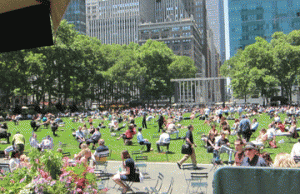
Town Green on a summer midweek afternoon, Guilford, CT

At most points in time during the weekday the small-town public spaces may have very few to no users, but this also even happens in large urban parks that still appear well activated, e.g., the Overlook section of Forest Park here in Kew Gardens, NY. However, at several times during the day — my observations suggest lunchtime, after school, and possibly 7:00 a.m. to 9:00 a.m. are the most likely times — a successful small-town public space can have a good chance of attracting platoons of users, some of whom are there with different subgroups, while others are alone. Altogether they may number no more than five or six people at a specific point in time, though their numbers on occasion can be substantially higher, e.g., 50 to 60.

Visitors Attract More Visitors. The presence of one small group of visitors helps attract other visitors, who may come at a later point in time. The existing visitors help validate in the eyes of passersby that the park has something worthwhile to see or do, encouraging them to visit as well. (This assumes the visitors’ behaviors are orderly).

To my knowledge, there, unfortunately, are no studies that show how many users a public space needs to project an image of being active, popular and worthy of a visit. But, my sense is that potential visitors make their own subjective judgments about visiting a park based substantially on who they see there and what they are doing.

Small town and market area sparse populations do not have to mean dead, inert and underutilized parks and public spaces if, on non-event days, those spaces attract several platoons of visitors at several times of the day.

Too Often, Public Spaces in Smaller Communities Focus on Just One of Three Necessary Functions

My field observations have led me to conclude that these venues can perform three important and essential functions:

  • Provide visitors with a green refuge for resting in peace and quiet.
  • Provide infrastructure assets and programs that stimulate visitors to engage in activities (i.e., to “perform”), many of which also will entertain people watchers visiting the venue. Some examples of such assets are ping pong tables, boules courts, model boat ponds, “reading rooms,” carrousel rides, ice rinks, chess tables, swings, spray pads, square dances, dance contests, etc.
  • To present events visitors can attend such as movies, plays, concerts, lectures, dance recitals, etc. Event attendees are almost always passive audiences (2).

The Pocket Park in downtown Washington Borough, NJ. This 4,000 SF park is the location for the town’s Farmers Market and several other events, but it has little appropriate seating or shade and no opportunities for visitors to engage in any activities. Its sole function is to serve as a location for events.

A Primary Focus on Events Limits a Public Space’s Potential Magnetism. One of the major problems of underutilized small-town public spaces is that their design and operation are focused on their being an events venue (see photo above). Such a narrow focus, of course, means that the space was probably easier to design. Operational costs are also probably minimized since the venue’s events are probably produced and funded by non-municipal organizations. Programming is offloaded. However, the number of their probable events means that the venue will be inactive on the vast majority of days in any year. For example, if the venue had a relatively robust schedule of events on fifty days, it still would have no events and be inactive on 84% of the days in a year.

The Critical Need for Appropriate Seating and Shade. Another major problem with many of the underutilized spaces is that they fail to provide the prime requisite for adequately performing the green refuge function: adequate seating and shade. If these spaces are to be sticky and keep visitors for any meaningful length of time, there must be comfortable seating for them. Tables and chairs, of course, also encourage visitors to eat their lunches and snacks in the public space. Food consumption and sale is a key to having a successful public space, no matter the size of the downtown or the community.

Too many of the small-town public spaces I’ve visited in the past 10 years lack such seating in adequately shaded areas. Even some of my favorites such as Mitchell Park in Greenport, NY and Central Park Plaza in Valparaiso, IN. (Happily, the situation in Valparaiso was corrected in the park’s second phase of development). On hot days, that can strongly discourage visits from anyone who is not a sun worshiper. What has been most surprising, is that even some well-known designers of public spaces have been among those failing to include anything approaching adequate shade in some of their project designs.

People Need Reasons to Visit Public Spaces on Non-Event Days. Those that provide infrastructure assets and programs that stimulate visitors to engage in activities give people the strongest reasons to visit. They substantially widen the variety of things visitors can do. Many of these attractions are there all day and every day, and they are not scheduled. These attractions also allow visitors to be active participants in the venue’s activities, rather than being just passive audience members. However, public spaces in smaller communities often lack such attractions. They have event programming, but not what may be called infrastructure programming. If a ping pong tables or chess tables were there, visitors might be stimulated to use them. Most often such attractions are not there reportedly because of a lack of financial resources to cover the costs of creating such attractions as well as the costs of the staff that would be needed to operate them, e.g., a carousel, an ice rink, a reading room, a bocce court. However, I suspect that the designers of these public spaces and/or the people who now manage them never considered providing such attractions and were unaware of their power and importance. Rectifying this situation may be the best way to strengthen downtown public spaces in our smaller communities.

A Good Location is Necessary, but Insufficient for Success, and, Importantly, a Location Can Be Improved

The location of a public space is extremely important for a number of reasons. Its visibility to downtown visitors drawn by its other attractions – retailers, eateries, services, government offices, entertainment venues, etc. — will influence how many visitors it will attract. Also, as Olmsted proved long ago about Central Park, and as more recent researchers have proved about other successful parks, parks can have positive impacts on real estate values on proximate properties and impact the desirability of commercial spaces. Where a park is located will determine what it can potentially impact. Far too many small and medium-sized downtowns have located public spaces where they are invisible to most downtown users and where they have a low potential for having significant positive economic impacts. Instead, they should be located, if possible, in what otherwise would be considered as worthy development sites, those that already benefit from significant flows of pedestrian and vehicle traffic and are proximate to other downtown assets.

The Center Street Alley in downtown Rutland, VT is a troubled public space because it is surrounded by buildings and has no visibility from surrounding streets.


 In downtown Downers Grove, IL, Fishel Park, and Its Veterans Memorial Bandstand are not visible from Main Street.

Very importantly, a public space’s location also will determine the pool of people who are its most likely users. In urban areas that pool is most easily defined by:

  • The people who live, work and study with a five-minute walk of the venue (about ¼ of a mile.
  • Those who visit this area to shop or complete medical or business chores or are staying overnight in its hotels.
  • Those who are walking or driving by the public space’s location.

In suburban and rural areas, whether we like it or not, the auto plays a much larger role in personal trips than walking. Based on my field observations, I would suggest that in suburban and rural small downtowns, the most likely users of their public spaces are to be found within a five-minute drive of the venue. Within that travel shed, I hypothesize that the propensity to visit the venue has the following hierarchy:

  1. Those who are within an easy five-minute walk, say .25 miles.
  2. Those with a doable ten-minute walk, say .50 miles.
  3. Finally, those who are more than .50 miles from the venue, but within a five-minute drive of the public space.

Learning from Bryant Park. This park in Manhattan has been widely acclaimed for its successful revitalization and popularity after decades of crime induced decline. Though it is located in the largest and strongest CBD in the USA, it’s history is relevant to all public spaces, be they in small rural towns or in large, dense urban areas.  It demonstrates a number of very important points related to activating public spaces.

Its Location Gives It Great Visibility and Access to a Huge Pool of Potential Visitors. The blocks surrounding this park are densely filled with high rise office buildings and a large number have ground floor storefronts. Its surrounding streets are jammed with cars and buses. The park’s management estimates that, on an average weekday, about 250,000 people walk by on the sidewalks of the four streets that surround the park; a significant number are probably tourists.

About 78,000 people are employed within a 5-minute walk just from the park’s 42nd Street and Avenue of the Americas entrance. Also, there are 29 hotels within 0.2 miles of the park. Times Square is within a three-minute walk, while the Grand Central Terminal, Macy’s and Rockefeller Center are both within roughly six-minute walks. This means that the park does not have to bring people into the area and its management can completely focus on the essential task of capturing users from the vast number of people who already are in the area.

A Strong Location Provides a Pool of Essential Potential Users, but the Park’s “Products” Are What Gets Them to Actually Make Visits. Bryant Park’s strong location is what gives Bryant Park access to a very large number of potential users, but it alone could not assure its success. Consider that the flow of pedestrian traffic near the park during its troubled days was probably lower than today’s, but still relatively very strong when compared to downtown locations in other cities. What turned the tide was not the new and renovated office buildings and hotels that have appeared since 1992 — they came after the park became a success– but what was happening inside the park, the new “products” it offered and how they were “packaged.” That’s what drew all the visitors into the park and encouraged them to stay. A superb location was not enough by itself, but it is still damned important.

A Location’s Pool of Potential Users Can Be Made Larger. Back in the 1950s and 1960s, before Bryant Park entered its period of steep decline, the area surrounding it was relatively healthy and successful. The park’s decline made the leasing of office and retail spaces proximate to it far more difficult. Pedestrians intentionally walked on the other sides of the streets from the park or avoided the entire area. The park’s resurgence rectified that situation. Pedestrians returned in abundance to its surrounding sidewalks. New office building and hotel projects wanted to not only be located close to it, but to claim the park’s name in their addresses. For example, the Bank of America Tower proudly proclaims its address to be One Bryant Park. However, the overall success of the commercial spaces near the park as well as the increasing strength of the Midtown CBD also had their own positive impacts on the size and composition of the park’s user pool (3).

The implications of this point can be very important for the success of small-town public spaces – redevelopment and the recruitment of residents, businesses, and nonprofits near these venues can significantly strengthen their pools of potential visitors.

Likely Pools of Potential Users in Smaller Towns.

As with Bryant Park, these pools will most likely be defined by the people who live, work, study and visit within a surrounding area, but that area will be more car trip defined than the densely urban Bryant Park’s. These pools will obviously also have far fewer potential visitors than Bryant Park’s, but then their expected user levels are also far lower.

Residents. Many smaller towns have sparse residential development in their downtown/Main Street areas, though more and more are rightly trying to correct that situation. For example, I did a deep dive into successful public spaces in three smaller communities a few years ago (see the above table). Based on my observations and discussions with local officials, I concluded that none had a significant number of downtown residents, though Somerville was developing a substantial number of new units. This means that most residents probably live beyond an easy walking distance (0.25 miles) of any downtown public space or even a doable walking distance of 0.50 miles. Another challenge is posed by the fact that most adult residents who are in the workforce will be at their employment locations during the daytimes on all five weekdays. For example, here are the percentages of working residents whose jobs are located out of town in three smaller communities:

  • Valparaiso IN, population 32,000: 64.4%
  • Somerville, NJ, population 12,100: 93.6%
  • Greenport, NY, population 2,200: 80.3%.

Events held in a downtown public space on weekends are likely to attract the most adult residents because they are then most likely to be in-town and have free leisure time.

The types of residents who are most likely to remain in town on weekdays are retired seniors (the fastest growing age cohort in rural areas), school children, and at-home parents with pre-school children. Well designed and managed public spaces in smaller communities would do well to offer attractions that appeal to each of these demographic groups, who are likely to visit them at different times of the day.

As Andy Manshel argues so forcefully, in his upcoming book “What Works: Placemaking in Bryant Park. Revitalizing Cities, Towns and Public Spaces,( Rutgers University Press, Spring 2019),” finding successful attractions is largely a matter of trial and error, with much tweaking and recalibration, though greenery, suitable seating and easy access to food and drink are essentials. Below are some ideas about attractions that might be aimed at seniors, school-age children and parents with preschool children. They are offered as some possibilities that might be tried and tested while recognizing that there are probably many other possibilities that might be discovered by talking to members of these three potential park-user market segments:

  • Seniors: exercise paths for walkers, bicyclists and bird watchers; exercise classes; chess/checkers tables; a “reading room”; a putting green. Seniors are likely to appear in the morning and midday hours.
  • School-Age Children: playground equipment; bike paths; skateboard areas; soccer/football/baseball field; basketball courts; outdoor hockey rinks; summer camps; after-school supervised activity programs. School children are likely to appear after 3:00 p.m.

Childcare program in Memorial Park, Maplewood, NJ
  • Parents with Preschool Children: They have a long-demonstrated the need to get out of the house and socialize with their peers. For example, in Maplewood, NJ, and Englewood, NJ, they have turned tea shops and coffee houses into places for them to congregate. In NYC, this often happens in its parks, where the parents’ young children can also be safely entertained. For example, on any nice day just take a walk around any of the playground areas in Manhattan’s Central Park (where there may be nannies instead of moms) or in Forest Park here in Queens. Appropriate seating, amply shaded, and clean accessible toilets encourage the emergence of such social clustering. These parents usually will show up from late morning to late afternoon.

Given that the numbers of potential daytime residential users are likely to be relatively moderate, a downtown public space would do well to cultivate a structured corps of potential repeat users. This can be encouraged if downtown development officials take “location enhancement” steps such as, but not limited to, these:

  • Develop a community center in or adjacent to the public space that has daytime programs for seniors, kids after school and for parents with preschool children.
  • Locate senior housing within a very short walk of the public space that does not entail a need to cross a street. The attractions in the public space can also serve as a development incentive for such projects.
  • Invite any nonprofit that provides after-school programs for kids to use the public space.
  • Invite nonprofits that have summer day camp programs to use the public space.
  • If the public space has the needed playing fields, invite youth sports leagues to play on them.
  • Attract a coffee shop or tea house that can attract parents with preschool children to a location adjacent to the public space.

It is also helpful to avoid a kind of downtown revitalization snobbery. Chains like McDonald’s and Starbucks are often scorned by downtown activists, but in smaller downtowns, they are regularly strong magnets that attract the available daytime residential population segments. For example:

  • In Gering, NE, the downtown’s McDonald’s is its strongest customer traffic generator. It reported having consistent waves of seniors who are customers in the mid-morning and school children without adult supervision coming in after 3:00 p.m.
  • In Englewood, NJ, the downtown manager reported, back in the early 2000s, that the downtown’s Starbucks attracted a consistent group of moms with pre-school children in the early afternoons.

Encouraging their opening near a smaller town downtown public space should not be dismissed out-of-hand. Of course, independents that can perform the same functions should be also courted.


The Critical Downtown Workforce. Development density in smaller community downtowns is almost always the result of the agglomeration of businesses. This means that their downtown’s critical daytime population has a lot of people who work in or near the downtown. A very interesting research project done by Ryan and Jin of communities in Wisconsin shows just how significant are the numbers of workers who are located within acceptable walking distances and easy driving times of the centers of small downtowns (4). The above table provides Ryan-Jin data on four groups of smaller towns categorized by ranges of population size: 1,000 to 2,500; 2,500 to 5,000; 5,000 to 10,000, and 10,000 to 25,000. The top four rows of data show the number of towns in each category, the number of people employed within 0.25 miles of the downtown’s center, the number of people employed within 0.25 miles, 0.50 miles and 1-mile of the downtowns’ centers.

Morristown, NJ, has more people who work there than live there. Many visit The Green at lunchtime.

In a seminal article, Larry Houstoun’s analysis of data from the first ICSC study of office workers showed that they basically averaged trips that lasted 9-minutes to and from their lunchtime destinations (5). That trip time included time spent getting out of their buildings and then the time needed to walk from their building to their destination (and vice versa).  To bring the Ryan and Jin data more, if not fully, in line with Houstoun’s findings, I have translated those data into downtown employees who have an easy walk to its center, those who have a doable walk to its center, and those who are located beyond a doable walk, but still within an easy drive of the center. I have included the “easy drive” category because my projects in many suburban and rural communities – e.g., Englewood, NJ, Gering, NE, Sherwood, WI –have shown that their downtowns attract a lot of people who are within a 5-minute drive of their downtowns during weekdays.

Even the 143 towns with populations between 1,000 and 2,500 have significant daytime workforces averaging:

  • 400, who are within easy walks of any public space located near the center of their downtowns.
  • 354 who are within a doable 5 to 10-minute walk of such a public space
  • 406 who are beyond a 10-minute walk, but within a 5-minute drive of such a space (and who probably need another four or five minutes to get to and from their cars)

Among these smallest towns, the average workforce pool of potential users totals 1,160. The larger small towns, of course, have larger workforce pools of potential users.

Even though they are likely to be very proximate to the public space, converting them into actual visitors is very challenging simply because most of the time they are in the vicinity, they are busy working. Overwhelmingly, they are most likely to visit during their lunch breaks in the 11:30 a.m. to 1:30 p.m. time period. They will need to eat their lunches on their visits – indeed, if the public space is an attractive place to eat lunch, it will attract more of their visits, so they can eat there. This means that for the small town public spaces to capture significant amounts of workforce visits, it should have:

  • Quality food vendors in or adjacent to the space. They may be restaurants that do take out, fast food eateries, delis, food trucks, food carts, or kiosks. Whatever they are, they need to provide quality products at affordable prices. A public space in a good location will either have such food vendors nearby or be able to recruit them. But a public space poorly located in a fringe or low traffic area will neither have them nor be able to recruit them.
  • Movable seating and tables in the space where the workers can enjoyably and comfortably eat their lunches.

The workforce users of the public space can be critical pump primers for attracting additional users. Other downtown visitors, seeing them in the public space, may also be lured into visiting it and perhaps also easting their lunches there.

Tourism. Yes, tourism can provide some small town public spaces with a significant number of visitors. For example, Greenport, NY, only has a total of 2,200 year-round residents, who have relatively modest annual incomes. and a daytime downtown workforce of 399, but its Mitchell Park attracts over 300,000 visitors annually.  – day trippers from the county and beyond, second homeowners, overnight visitors at its hotels, B&Bs and marina as well as travelers passing through to use its ferries to get to Shelter Island, the Hamptons and the casinos in CT (6). Public space managers in small communities with a strong tourist flow should definitely think about ways to attract them.

That said, care should be taken to assure that the attractions the park/public space offers to attract tourists do not conflict with the attitudes and preferences of local residents. Strong, attractive parks/public spaces are usually important cornerstones of a community’s Central Social District. Nothing should be done to jeopardize that role. Indeed, strong park attractions aimed at local residents probably will also please many tourists.

Still, most smaller rural and suburban communities that I’ve visited do not have significant tourist flows, though their leaders may want to attract more out-of-towners. The focus then should be on local residents and folks who have jobs located in the community. If that is done well, then out-of-town visitors also may be attracted.

Strategically Important: Attractions That Do Not Require Much, if Any, Staff to Function

As Andrew Dane and I have written, there is a large financial toolbox available that small town leaders can use to create attractive public spaces (7). In these smaller towns, substantial financial support from the municipality definitely will be needed and essential for winning outside funding and the use of such important financial tools as tax increment financing. It probably will also be necessary to assure proper maintenance, though responsibility for programming may be given to a non-profit organization.

Recent reports suggest that parks and public spaces are now attracting increased support from philanthropic organizations and wealthy private donors (8). In Valparaiso, IN, for example, a local family recently contributed $3 million for the construction of Phase II of the downtown’s Grand Central Plaza Park.

Strategically, I would argue that the most pivotal challenge for smaller town public spaces is how to create and maintain attractions that stimulate visitors to engage in various types of activities, e.g. eating lunch or a snack, play chess or ping pong, birdwatch, ride a swing, read a magazine or book, etc. The opportunities to engage in such activities are essential if more visitors are to be attracted on non-event days.

For those concerned about how to finance the creation of these attractions and the staff then needed to operate them, there are several possible responses. First, select attractions that are relatively affordable to create and that do not require a lot of staff time, if any, to be operational. Moveable seating and tables, so visitors can eat lunches and snacks, need not be expensive to create and require no staff time to supervise.  The same for climbing rocks, adult or children’s swings and chess tables. Spray pads, popular across the nation, may need a little staff time to turn them on and off. (See photos below). These examples are not exhaustive. There are other possibilities.

Some attractions that small town parks and public spaces can have that are relatively affordable to create and do not require much staff, if any, to operate: climbing racks; spray pad; adult swings and chess/checkers tables.

Other attractions may be more expensive to implement and require staff to operate, e.g., a carousel or ice rink. Their operational costs can be covered by sponsorships and user fees. It probably will take some time to attract sponsors and meaningful numbers of users.

Finally, if paying for needed staff is a problem, then perhaps volunteers can be mobilized. Of course, the reliability of volunteers can be a problem. Involving civic groups – e.g., garden clubs, chess clubs, birdwatching groups — to provide them may be one way to alleviate the situation.

ENDNOTES

1) N. David Milder. “Three Informal Entertainment Venues in Smaller Communities: Bryant Park Series, Article 4.”  The Downtown Curmudgeon Blog. https://www.ndavidmilder.com/2014/12/draft-121414-three-informal-entertainment-venues-in-smaller-communities-bryant-park-4

2) N. David Milder.  “Bryant Park: The Quintessential Downtown Informal Entertainment Venue – Part 1.” Downtown Curmudgeon Blog. August 19, 2014. https://www.ndavidmilder.com/2014/08/bryant-park-the-quintessential-downtown-informal-entertainment-venue-part-1

3) For more about Bryant Park’s location see: https://www.ndavidmilder.com/2014/08/bryant-park-the-quintessential-downtown-informal-entertainment-venue-part-1 .

4) Bill Ryan and Jangik Jin. “Employment in Wisconsin’s Downtowns.” Center for Community & Economic Development. University of Wisconsin – Extension. Staff Paper, October 20, 2011. https://cced.ces.uwex.edu/files/2014/12/Downtown_Employment_Analysis112111.pdf

5) Lawrence O. Houstoun. “NINE MINUTES TO RETAIL: The Workplace-Marketplace.” Urban Land, December 1989, pp 25-29.

6) See endnote 1.

7) N. David Milder and Andrew Dane. “Some More Thoughts on the Economic Revitalization of Small Town Downtowns: Financial Tools.” Economic Development Journal of Canada, November 2014.  http://tinyurl.com/qcbnefh

8)  Alyssa Ochs. “Many Things: The Surprising Appeal of Funding Community Parks.” Inside Philanthropy. May 3, 2018. https://www.insidephilanthropy.com/home/2018/5/9/many-things-the-surprising-appeal-of-funding-community-parks


Posted in Central Social Districts, Economci Development, Entertainment, Entertainment niche, Informal entertainment venues, Parksmand public spaces, Planning and Strategies, Public Spaces |

Some Downtown Equity Issues

Posted on March 17, 2018 by DANTH

Part 2 of the A Closer Look at Some Strategic Challenges Generated by the New Normal for Our Downtowns Series of Articles

By N. David Milder

Introduction.

There are a number of issues that involve questions about who will visit, live, work and play in our downtowns and how all stakeholders – be they those who live, work and play there or those who own properties and businesses – can share in their successes. The term “equity” seems to fit all of these issues. Their emergence has been relatively recent, and their full dimensions are probably yet to be grasped. As a result, most are not on the radar screens of many downtown leaders, save in those cities where the problems have already become very acute and/or nationally visible, e.g., affordable housing in San Francisco and the entire Bay region.

The core equity issues are essentially about what our values and preferences are and how they will be applied to many of the component parts of these successful downtowns. Decades ago, at their nadir, downtowns had a different set of users and, often, different stakeholders. Strong concerns about equity were not really salient since there were so few goodies to distribute and so few people who wanted either a psychological or legal stake in these districts. These days, that has all changed. The equity issues are generated by downtown and community successes, sometimes huge ones, not their failures!

Way back when, it may have been from one of Jane Jacobs’s books, I learned two axioms about downtowns that have stayed with me ever since:

  • A downtown needs its community’s residents to take psychological ownership of it. It must become “my downtown” in their guts. When that happens, they will not only use it, but also politically defend it, and support efforts to improve it. Psychologically, they become stakeholders.
  • A downtown should be everyone’s place. It should have attractions suitable for large swathes of the community. It also should be the community’s central gathering place. Anyone acting in an orderly manner should be welcome.

During the decades when downtowns were in decline, it seemed as if few people within their communities wanted to take psychological possession of them. Today’s successful downtowns show a marked ability to attract many more people, many of whom are affluent and well-educated, to live, work and play in them. In some, where the median price of a residential unit exceeds $1m and where the price of a ticket to a show or ballgame can exceed $1,000 in secondary markets, many local residents may wonder what’s there in the downtown for them?

Who Can Afford to Live Downtown?

Downtown experts agree that more residents in the downtown and in neighborhoods within reasonable walking distances of it have been the strongest engine for downtown revitalization. Yet, more housing in those places is proving to be a double-edged sword and concerns about middle income and “workforce housing” are popping up across the nation. The situation in San Francisco has attracted a lot of national attention and demonstrates many aspects of this problem. Nearby Silicon Valley has had a famed economic success and many of its relatively well-paid workers seek housing in San Francisco. For example, Google-owned buses haul hordes of them to and fro daily. The result has been a very expensive housing market in the entire Bay area. It’s become very difficult for these relatively affluent workers to find affordable housing and those pressures are also impacting other types of workers. One response is to accept smaller and/or unusual types of dwellings. Here’s a recent headline in the New York Times: “Dorm Living for Professionals Comes to San Francisco” (1). The article goes on to detail that: “In search of reasonable rent, the middle-class backbone of San Francisco — maître d’s, teachers, bookstore managers, lounge musicians, copywriters and merchandise planners — are engaging in an unusual experiment in communal living: They are moving into dorms.”

Dorms and other “co-living” arrangements are just one solution path San Franciscans have followed to cope with their region’s skyrocketing housing costs. For example, Business Insider even headlined that: “A 23-year-old Google employee lives in a truck in the company’s parking lot and saves 90% of his income” (2).

A Cargo Container Converted into a Small House in San Franciso. 

The Tiny House movement has even penetrated the San Francisco area as evidenced by the photo above taken from an article in Business Insider (3). In this instance, a cargo shipping container was converted into the wee home. Some more affluent San Franciscans have spent $1m+ to purchase and renovate “earthquake shacks,” or are living on boats in the bay. Still others are squeezing together with a large number of roommates into an apartment or house (4).

High housing costs are not confined to San Francisco.  As can be seen in the above table, in all 10 of these highly successful major cities, the ratio of median home prices to median household incomes exceed the 5.1 level deemed to indicate serious unaffordability.

An important question: are the housing costs in smaller communities than our major cities also skyrocketing and having adverse impacts?  Probably yes, if they are located in a region, such as the San Francisco Bay Area, where the whole area is thriving economically. For example, the communities where the Jobs, Zuckerbergs, Pages, and Ellisons live are small and hyper expensive. In less economically robust regions, one might expect a more complicated picture. My hypothesis is that higher housing prices are an inevitable result of a downtown and its community becoming successful, desirable places to live, work and play. So, where that has happened, the prices will very likely be higher. For instance, in districts that have recently experienced a significant revitalization that was propelled by mix-use, residential anchored projects. This has happened in a number of suburban communities around our major cities, especially those served by commuter rail. Otherwise, in smaller towns and cities, housing prices probably have not skyrocketed. For some smaller towns, their lower housing costs when combined with strong quality-of-life assets,  and decent broadband and transportation access, might give them a meaningful competitive edge in attracting new residents and businesses.

“Micro-living,” i.e. living in units of 300 to 400 SF or less is a growing phenomenon in cities across the globe where their economic success has pushed housing prices well beyond what middle-income and even upper-middle-income persons/households can afford. In the U.S. they can be found in many of our largest cities — e.g., Boston, Chicago, and NYC – but especially in cities such as Atlanta, Cincinnati, Denver, Pittsburgh, Seattle, St. Louis and Washington D.C., where the share of single person households exceeds 40%.  The mini apartments also are not unusual in Tokyo and many European cities (5).

To provide some perspective on these 300 SF to 400 SF units, consider that in the recent past many of their occupants would have rented studio apartments. Their average size in NYC, San Francisco, and Oakland are 550, SF 514 SF and 531 SF respectively. The micro-living units are 20%+ to 40%+ smaller than the studios. Also, consider that in the 20 most populous metro areas there is a distinct trend toward smaller units – though all still average above 854 SF (see the above table). The decreases in size have been smallest is in the metro area that have very high costs and low costs and highest in the high cost and moderate cost markets.

The small units, such as those in dorm or co-living buildings, often have desirable social/communal advantages that attract their inhabitants. Whether a true equity issue exists for these residents under these conditions depends on whether the inhabitants really want to live in such units or are occupying them because they are the best of the bad options available to them.

This discussion would also be more informed if there was some research establishing that humans need abodes that have XYZ square feet of living space. My memory says that HUD somewhere at some time established that dwellings were overcrowded if a unit’s occupants have less than 188 SF each. I have not found any research that supports a number like that. Moreover, it is highly probable that the personal space needs vary culturally. For example, NYC subways certainly get crowded, but I doubt that their riders would accpt either the level of crowdedness found in the Tokyo subways or their use of car packers to assure that the subway cars are maximally stuffed with riders. Moreover, there are many people in neighborhoods in the Borough of Queens in NYC, such Kew Gardens, Forest Hills, Bayside, who use the l far more expensive Long Island Rail Road rather than experiencing the crowded subways.

Many San Franciscans and residents of other high price communities have responded to the housing equity issue with their feet. A recent report notes that: “San Francisco lost more residents than any other city in the US in the last quarter of 2017…. San Francisco lost net 15,489 residents; about 24% more than the next-highest loser on the list, New York City” (6). This behavior pattern probably results in area firms losing a lot of talented employees. Of course, very high housing prices probably will also dissuade a significant number of talented people from taking jobs located in a community.

Tourists and Tight Housing Markets. City leaders, their economic development officials and local business operators often brag about how many tourists and second homeowners they have and all the revenues and jobs that means for their local economies. However, the residents of many of these communities may tell a different story. They may note that the retail developed for tourist shoppers really does not provide the types of merchandise and services they need or want and often creates seasonal traffic nightmares on local streets. In many communities, large and small, tourists also have impacted negatively on the housing market from the perspective of the needs of local residents.

Moses Gates, in a study by Regional Plan Association (RPA), noted that: “54,764 apartments in New York City … are vacant, according to the 2014 Housing and Vacancy Survey – but not really. These are apartments used for ‘seasonal, occasional, or recreational use’ – i.e., pieds-à-terre or second homes” (7). He went on to state that:

“We also need to better leverage our housing inventory, especially in places where land is scarce and building new homes is difficult. One way to do that is through policies like a tax surcharge on second homes in the New York City (or a pied-à-terre tax) designed to get mostly unused apartments back on the housing market.”

It should also be noted that strong suspicions have been raised about many of these pieds-à-terre in some of our biggest and most tourist-popular cities  (e.g., NYC, Miami, etc.) being money-laundering operations for their wealthy and unknown foreign owners.

Many of these units are vacant for most of the year. They thus do not contribute the pedestrian traffic to the sidewalks below nor the expenditures in the city’s shops, restaurants and entertainment venues that one might reasonably expect – nor the sales taxes on those expenditures.

Are these second homeowners to be treated differently from a downtown’s normal stakeholders? Laws probably protect them in many ways, but I am certain that many local residents would say there is something unjust stirring here that must be fixed.

Airbnb has seemed to be looking for trouble in a host of cities, quickly getting into conflict with city governments because of its alleged flaunting of local laws and putative negative impacts on the availability of affordable housing. As a recent study published in the APA Journal noted, Airbnb had been criticized for enabling:

“…tourism accommodations to penetrate residential neighborhoods, which creates conflicts between visitors and residents, ­ displacing permanent accommodations in high-demand cities and exacerbating affordability pressures for low-income groups (8).

Governments, at all levels, have for decades often mounted programs to cope with the affordable housing issue, though they almost always targeted low-income and impoverished households. Also, the units produced by those programs usually were placed in poor neighborhoods or in those very out of the way, e.g. Far Rockaway here in NYC. The downtown housing equity issue differs in that the targeted population is middle or even upper-middle-income households and that the units produced for them should be at least within a very reasonable travel time of the downtown. It would also probably be a good idea to have representatives of these residents and their employers extensively involved in the development of the needed housing units.

Downtown Success Encourages Landlords to Ask Independent Retailers for Unaffordable Rents

This problem is made more complicated by the fact that to properly understand it one must break it down analytically into three constituent parts: fairness to the merchants, impacts on vacancies, and the impacts of the loss of popular, able merchants. In many discussions of the affordable retail rent problem, things get murky as attention quickly shifts from one of these sub-issues to another. My objective here is not to provide definitive solutions, but to help illuminate the problem and to suggest some solution paths that may be worth exploring.

The Problem Is Not New.  Unaffordable retail rents are an issue that long predates the Great Recession. For example, back in the late 1970s, when I surveyed street-level merchants in Charlotte’s CBD about how they were impacted by an off-street, internal shopping network that was created by overstreet bridges connecting a number of new buildings, they replied that it took traffic from the sidewalks and led to hard to afford rent increases. In the two districts I managed, I never met a small merchant who did not have something negative to say about their rent increases.

Generally, when downtowns or neighborhoods become observably successful, they not only attract retail chains, but also tend to attract many other types of businesses, such as personal, professional and financial service operations. A very high percentage of these operations can afford higher retail rents than the average independent retailer. Some, such as the banks, are willing and able to spend a lot more on rents than even the well-heeled retail chains. As one observer noted: “Banks frequently overpay by 15% to 20% or more on average for real estate compared to other retailers for comparable space. Over 10 or 20 years we’re talking a lot of money!” (9).

I put together the above table for an article I wrote back in 2010. It shows how much space a merchant could afford to lease if 15% of his or her annual sales were devoted to paying rent (10). The 15% figure makes the analysis somewhat conservative, as a more accurate number would the 8% to 12% range for downtown merchants and about 10% for restaurants. Small merchants just cannot afford a whole lot of space in any successful district unless they have very significant annual sales.

Small retailers have not been the only group impacted on. Jeremiah Moss, in his book Vanishing New York, describes how bohemian artistic live-work areas, such as the East Village, were erased by major retail chains coming in.

Why Do Landlords Ask for Unreasonable Rents? Landlords are not necessarily being venal or thoughtless if they sign these higher paying tenants when they appear on their doorsteps. They are simply responding rationally to proven market demand. Of course, even then, they must decide, perhaps just implicitly, that these non-retail uses will ultimately generate more value than if a current small retail tenant was retained. However, one might ask if they considered how that tenant might affect nearby businesses and buildings or if they just considered their own bottom lines. Obviously, another important question is if considering the impacts of a potential tenant on the district should be obligatory in some way, shape or form? This problem would ease if a landlord or an accomplished EDO owned a lot of downtown properties with retail tenants and managed them like a mall, but that is an unlikely outcome.

Here are some other patterns that I have found in the ways landlords establish their rent increases

  • Some increases are based on a reasonably accurate assessment of local rising property values and dominant asking rents. Both of these may already reflect the district’s growing success. These landlords tend to avoid asking for the highest rents. Among them, are a number of experienced professionals who see the landlord function as having strong stewardship aspects and consider what is good not only for their properties but also for those that are near them. I fear that they are a dying breed. How instead can we develop more of them?
  • Some small landlords I’ve spoken to simply could not explain the reasons for their very high rent increases, save to say they were products of their best judgments. Among those that I have met, many were new to the U.S. and new to local property and retail markets. A number of them would stubbornly maintain unreasonable asking rents for a year or more. These landlords do not typically care who their tenant is as long as they pay the asked for rent. Here the high rents and vacancies are being sustained by landlord ignorance and management ineptitude. Newness to the area is another factor.
  • Other increases are based on hopes, often wishful, that a national chain or other higher paying tenants can be attracted that will pay much higher rents and have a better credit rating than those of the current independent retail tenant. An analysis of the local retail market is either perfunctorily done or simply missing.  An example of this is Wong Kee, located in Manhattan’s Chinatown. It recently “succumbed to a new landlord and rising rents.”  It was in Chinatown for nearly 30 years. Its lease was not renewed. by the landlord.  The landlord wants to build a pharmacy in its place, though there are already several pharmacies nearby (11). This type of landlord needs to learn what is really feasible from a business recruitment perspective.
  • A few other landlords – usually those unfamiliar with the downtown, retailing or even property ownership – will ask for very large increases because they paid way too much for their newly purchased building. Their huge rent increases are what they need to financially stay whole. This may be because their bank loan agreement probably stipulated a formula for determining what the rents should be. There was little room for them to consider local market factors, even if they wanted to — and too many didn’t care anyway. According to Jerimiah Moss, banks will devalue a property if it has a small business tenant but increase it for a retail chain tenant. “There’s benefit to waiting for chain stores. If you are a hedge fund manager running a portfolio you leave it empty and take a write-off” (12). In other words, such landlords have tax incentives that encourage them to demand very high rents and tolerate long-term vacancies. They also seem absolutely oblivious about how a vibrant district will increase their local property values and bottom lines.

The Fairness Issue. Local residents and civic leaders may feel that some of the merchants facing unaffordable rent increases are being unfairly treated. This issue is implicitly present in most usages of the phrase “unaffordable rents” where unaffordable is really seen as a synonym for unfair.  Should such an equivalence be accepted? Moreover, why should any government entity or nonprofit help those facing unaffordable rents? Market forces are freely at work and, to quote Barzini in the Godfather, “After all, we are not a bunch of communists.”  I would argue that it is not the unfairness of the unaffordable rents that justifies remedial action, but their most important impacts: long-term and multiple vacancies and the loss of many popular, high-quality merchants.

Vacancies. First, let’s establish that a certain level of vacancies is necessary for a downtown to work correctly and prevent ossification. Downtowns need some churn to recruit new, attractive merchants and to get rid of the dregs. I think it’s generally accepted that a vacancy rate below 5% suppresses the desired level of churn while one above around 10% can have bad effects on the district. Many consultants, downtown leaders and, perhaps more frequently, elected officials, believe that vacancies can be an unattractive creeping plague. However, the real problem about vacancies may not be the emptiness of the storefront, but the absence of an accomplish operator to occupy it. Let me anticipate those who will claim that a cluster of empty storefronts is visually an eyesore for the district, diminishes its walkability and a puts a blemish on its reputation, by asking: Is the district really any better when the vacancies are filled by unpopular, inept operations? Bad operators can repel customers and downtown visitors even more than empty storefronts.

It is also important to realize that any valid explanation of today’s retail vacancies must take a multi-causal approach that includes far more cautious consumer behavior, the rise of Millennials who prefer experiences over things, significantly reduced demand by retail chains in terms of both the number and size of their new locations, and affordable rents. The reduced retail demand is especially relevant because many of the landlords that were pushing out independents were doing so in hopes of recruiting the very chains that were hardest hit by reduced consumer favor and demand, such as the apparel specialty retailers.

It is also important to consider that reducing landlord asking rents is not the only way of reducing vacancies. As Andy Manshel reminded me, good results can be achieved by “animating vacant storefronts with temporary art or high-quality other pop up uses.” He also suggested that vacancies could be taxed, motivating landlords to sign leases.

Generally, it can be reasonably argued that concern about vacancies is a misunderstanding of the essential core problem.

The Loss of Popular, High-Quality Merchants. That core problem is not the emptiness of the vacancies, but that ill-informed landlord rent increases can result in the closings of independent merchants who are well-loved in the community. They are real losses for their customers, nearby business owners, and their district. Additionally, it usually is very hard to replace them.

However, it must be understood, that by definition, about half of a downtown’s merchants will be below average in their performance, including their ability to satisfy local customers. Are the potential closings of poorly performing, unpopular merchants the type of losses that are worthy of preventive actions by an EDO or municipal interventions? Some, who are ideologically committed to small businesses, may say yes, believing every small firm by definition is worth retaining or saving. Yet, many savvy downtown managers and civic leaders see a prime result of their revitalization efforts being the replacement of their poor-quality merchants, not necessarily with bigger operators or chains, but with higher quality operations.

Who Should Receive Help? One might cogently argue that the harm done to the public and/or district that would result from the closing of a popular and able merchant might justify an EDO or municipal intervention, but how much sway should the “fairness” of the rent increase have? For example, should an unpopular or incompetent merchant who gets an unaffordable rent increase be helped? That would imply that the fairness issue carries the day. Or will assistance only go to merchants who are able and/or popular? Is the fairness issue unrelated to the issue of the merchant’s value to the community or district? I would suggest that the fairness issue only becomes relevant when the merchant’s community value criterion is satisfied.

My observations suggest that the merchant’s value to the community is very likely to be considered when one specific business favored by an important segment of the community announces that it will soon need to move or close – whatever the cause, e.g., poor sales, increased competition, workforce problems, high operating costs (including costs of space) etc.  In contrast, because of the sheer number of businesses involved, municipal attempts to remediate unaffordable rents cannot logistically evaluate each of the benefiting firms and it would probably be a political nightmare to do so anyway. As a result, the fairness issue seems to prevail when municipal actions are taken. For example, here in NYC, the City Council has passed a bill that reduces the Commercial Rent Tax that businesses have to pay if they are located in Manhattan below 96th Street, pay $250,000+ annually in rent, and that have annual revenues under $5m (13).

In several large cities across the nation — NYC being one of them — proposals also have appeared for rent control laws that cover properties with retail uses.

What Kind of Programs Do We Need to Cope with the Unaffordable Rents Problem?  Municipal actions tend to treat quality merchants and underachievers in the same way, probably out of necessity. Moreover, both the retail rent control and merchant tax abatements seem to be rather shotgun approaches aimed at helping broad classes of small merchants.  The key actors, whose behaviors need to be altered, are the landlords, not the merchants. The retail rent control approach carries with it great potential dangers and certain resistance from the entire real estate community. Yes, the tax abatement helps some worthy merchants, but it also helps make the unaffordable rent increases more bearable. In that way, it implies the increases are justified.

Downtown EDOs may be in a far better position to mount more effective programs to influence landlord behavior. Many of the landlords are probably on their boards and many others have engaged in their programs. Anyone who wants to educate or convince landlords has to have won their esteem, trust, and confidence. The goal of such an educational effort cannot unrealistically be to convince large numbers of landlords. Instead, it should be, to convince a savvy few among them who can lead by example and thereby also exert some market pressures for others to follow.

Probably the best solution to the affordable retail rents problem is to help able merchants buy the spaces they need to do business. They might do this alone or as a group. Buying a single storefront space is unlikely unless it is from some kind of retail coop or condo. In many suburban towns and cities with populations under around 100,000, I’ve encountered retailers who own the entire buildings in which their stores are located. In big, high rent districts with stores located in big expensive buildings that is not likely

It might be possible for buildings that have multiple storefronts to lease, that a partnership of some kind might buy either the entire building if it is cheap enough or just the retail spaces in the larger more expensive buildings. These groups of retailer property buyers most likely will not emerge organically from the merchants themselves. Probably, they will need the catalytic interventions of teams lead by the downtown EDO that has strong active support from the municipal government and a civic-minded developer.

Local governments can do a lot to assist the development of the retailer-owned co-op or condo buildings:

  • Provide low-cost land or a low-cost building.
  • PILOTS just as developers are ordinarily given.
  • Other abatements such as on NYC Commercial Rent Taxes.

The EDO might also help the buyers connect to financial organizations that will provide them with loans that have reasonable terms.

If helping able retailers purchase their spaces is not viable, here are some other actions that might be tried to assist these merchants. Their effectiveness is far from assured. To influence landlords, local governments might consider:

  • Using zoning and tax incentives to reduce spaces so that they are smaller than what chain stores would want, perhaps around 1,500 SF to 2,000 SF. Landlord blowback can be expected. Also, quality independent merchants might find such spaces too small and a few chains now might still find them suitable.
  • Use zoning to limit where chain stores can go. This has been done for personal service operations and big boxes. Various legal and political problems can be expected. Landlord blowback can be expected.
  • Use their own legislative powers to change its tax code to erase any incentives for landlords to demand higher rents and tolerate long vacancies. Also, vacancies might be taxed as if they were occupied.
  • Use their external political influence to change the state’s tax code to erase any incentives for landlords to demand higher rents and tolerate long vacancies

If the retailer space purchasing option is not viable, to influence landlords, downtown EDOs might consider:

  • Creating either a formula that landlords can use to calculate an appropriate affordable rent for their retail spaces or to identify the steps in an analytical process that can help landlords make a well-reasoned decision about rent increases.
  • Educating landlords about the importance of taking into consideration district benefits and harms in their recruitment decisions.
  • Make a special effort that targets landlords new to the district, retailing or property ownership.
  • Jawbone banks about the value of small merchants to properties and downtown.
  • Issue a brief annual report that identifies the most “recruitable” types of businesses to the district and the types of spaces they will want.
  • Publicly praise and disseminate information about what landlords who are effectively dealing with the rent increase issue are doing.

To help high value, threatened merchants, downtown EDOs should assist them to:

  • Find new locations. Deft use of the Internet can help many independent retailers thrive in locations previously deemed less than optimum.
  • Find financing for the move.
  • Publicize their new location to let current and potential customers know where they now are.

Who Can Play Downtown?

As Central Social District (CSD) functions and venues have become of growing importance to the vibrancy and success of our downtowns, this basic question has become correspondingly important.

A few years ago, I put together the above table to demonstrate the user frictions that five specific CSD venues and two types of CSD venues have here in NYC. The specific venues were Bryant Park, Lincoln Center (LCPA), Madison Square Garden (MSG), The Museum of Modern Art, and The Metropolitan Museum of Art. The types of venues were movie theaters and Broadway theaters. The user frictions I looked at were:

  • When the venues were open.
  • Their admission fees.
  • Whether the user’s schedule could drive a visit or does the user have to conform to what is available on the venue’s schedule of performances.
  • Can the venue be used for visits that last 45 minutes or less? Lots of downtown visitors have holes in their schedules of that length and districts that have venues that can entertainingly plug those holes will be much stronger than those that cannot.

From the perspective of when the venues are open for people to use them, hands down Bryant Park has the most hours open, followed by the movie theaters. LCPA and MSG are basically closed during most days, while the two museums are closed 5 nights a week. If you work or go to school, these results mean that some venues are much harder to use than others.

Another key friction is how much it costs to be admitted to these venues and here is where many downtown users are simply priced out. Again, Bryant Park followed by movie theaters are the most affordable – and in many instances by gargantuan amounts of dollars:

  • Bryant Park is free to enter and the fees for using some of its attractions, such as riding the carousel or ice skating, are reasonable. It and other parks in the city cost the least to use.
  • At the time I did the research, my check of cinemas in Manhattan showed the average price for a ticket was about $13. Nationally, at the time it was about $8. I would argue that movie house ticket prices should be the benchmark of affordability because so many people still go to the movies.
  • MoMA and the Metropolitan Museum of Art rank next in lowest general admission prices. The Met “asks” for a $25 donation; MoMA requires it. The Met request is based on the deal the city made when giving land for the museum that gives NYC residents free admission. Residents can pay what they want or nothing at all. A $25 fee/donation to these museums would be 1.9 times more than the average cost of a movie ticket in Manhattan.
  • The prices at Lincoln Center are pricey. An average ticket to the opera costs $156. That’s 12 times more than going to a movie and taking a four-member family could cost a real bundle. If you want to accept alpine, nose-bleed seats you can get a ticket to a NY Philharmonic concert for about $29. But prices go up to about $112/concert if you are a subscriber to a series. That’s 8.6 times more than a movie ticket. Tickets to the opera and philharmonic concerts can be even higher than those cited if they are purchased on the secondary market and there is strong demand for them. But, given that their audiences have weakened in recent years, the markups are not as large as for Broadway shows or Madison Square Garden events. Perhaps in recognition of its high admission prices as well as its mission to serve a broad public, the Philharmonic does give a lot of free concerts on the LCPA’s campus as well as in the boroughs outside Manhattan. It also has a significant educational program in NYC’s schools.
  • In 2013, the average price for a ticket to a Broadway show was $98.64. Back in 1955, for her birthday, I took my girlfriend to see Mr. Wonderful on Broadway. We had dinner before at a steakhouse, Gallagher’s and to get to and from I hired a limo. It was a very memorable evening. The whole thing cost under $70, with the fifth-row center seats costing about $8.50 each. Adjusting for inflation, the price of those tickets would be $73.91 in 2013 dollars, substantially less than the actual $98.64. The difference is probably substantially accounted for by higher costs, such as for labor, talent, marketing, and equipment, etc. The biggest problems with today’s Broadway theater ticket prices is that so many of the tickets are bought by dealers who then resell them at substantial markups and that some hot plays are asking for $500 a ticket. Paying $1,000+ per ticket for hot shows.in the secondary market is far from uncommon.
  • The average ticket to a Knicks game at Madison Square Garden, in 2013, cost $125, while a ticket to a Rangers was $78. A ticket to a Billy Joel concert at the Garden could range from from $64 to $124. However, here too, a significant percentage of the tickets are captured by dealers in the secondary market and prices for a very popular game or concert can go above $1,000. Joe Six-Pack fans are unlikely to have the financial resources to attend with any regularity the basketball and hockey games of their favorite teams. Their attendance is more likely confined to special occasions for which they either plan early and save or are gifted. For these fans, downtown sports bars may be one way to deliver the more affordable TV access to these games in an arena-like, fan-filled setting.

Parks, other public spaces, and movie theaters are entertainment venues that help make a downtown everyone’s neighborhood. They are the most easily accessible and the least expensive to visit. Consequently, they provide reasons for most of a community’s population to take psychological possession of their downtown. Where they are absent or weak, the downtown will be lacking very important support mechanisms. On the other hand, attendance at the events of many high culture performing arts venues, popular concerts, and professional sports events can only be afforded by those with above-average amounts of discretionary dollars to spend. These folks, too, are assets for their downtowns, assets that downtown leaders only dreamed of attracting in years past.

The Impact of Tourism. The table above was generated from data published online by the Broadway League. It shows just how much the attendance at Broadway shows is dominated by out-of-towners. Just 22% of the ticket holders are NYC residents. Another 18% come from the surrounding suburbs. Most, 61%, are tourists, with about 46% coming from other parts of the USA and about 15% from other countries.

Strong tourism can have important impacts on a local economy. For example, here in NYC, we have about 60 million tourist visitors annually and their direct spending in 2016 amounted to about $64.8 billion (14). About 6.45 billion went to firms in the recreation and entertainment industries. Without tourist expenditures for Broadway tickets, the relatively high ticket prices probably would not have been reached or maintained. One may wonder if a lower flow of tourists would have resulted in lower Broadway theater ticket prices that would have attracted more buyers from NYC residents and from folks in the surrounding suburbs.

As is happening in many entertainment niches (defined to include cultural/arts venues) across the nation, tourism now accounts for very high percentages of the attendance at many of NYC’s major entertainment venues. This is particularly true for our most prestigious museums, where tourists account for 75% or more of their attendance (see table above). These institutions aspire to be and are world-class venues. That means that though they are located in NYC, for New Yorkers, they are no longer just theirs. Some psychological adjustments may be needed. As I write this I remember many years ago, when my neighbors and shopkeepers in Paris warned me in the late spring, that soon “your Americans and the Germans would come” and Paris would not be the same until the fall. They were absolutely right. The buildings, the Seine, the Metro, the museums were all the same, but Paris in the summer was very different. My French friends explained that they felt during the summertime as if their beloved city is taken over by foreigners. It’s really not theirs during those months. Things may have changed in Paris since my student days there, but that sense of tourists taking over is one I’ve encountered in several other communities here in the USA

Tourism can be boon for many downtowns, but it also often is a two-edged sword, that brings a number of problems with it. Some of these problems are obvious, such as how tourism can impact housing and retail, while others may be quite subtle, such as residents psychologically feeling dispossessed in their own communities.   Part of the New Normal, as more and more downtowns become adept at attracting tourists, will also be the emergence of these problems.


ENDNOTES


1. Nellie Bowles. “Dorm Living for Professionals Comes to San Francisco.” New York Times. March 4, 2018. Retrieved from:  https://www.nytimes.com/2018/03/04/technology/dorm-living-grown-ups-san-francisco.html?

2. “Employee lives in truck in parking lot.” “Business Insider. October 2015. http://www.businessinsider.com/google-employee-lives-in-truck-in-parking-lot-2015-10

3. See: http://www.businessinsider.com/american-suburbs-dying-photos-2017-10#in-lieu-of-traditional-housing-some-millennials-are-turning-shipping-containers-sailboats-and-vans-into-homes-59

4. Melia Robinson. “All the crazy things happening in San Francisco because of its out-of-control housing prices.” March 6, 2018. http://www.businessinsider.com/why-people-are-leaving-san-francisco-2018-3

5. Wendy Koch, “Mini-apartments are the next big thing in U.S. cities,” USA TODAY, August 1, 2013. http://www.usatoday.com/story/news/nation/2013/07/30/tiny-apartments-apodments-catch-on-us-cities/2580179/

6. Prachi Bhardwaj. “San Francisco is losing more residents than any other city in the US, creating a shortage of U-Hauls that puts a rental at $2,000 just to move to Las Vegas” BI. March 5, 2015. http://www.businessinsider.com/san-francisco-bay-area-residents-moving-away-increase-u-haul-rental-prices-2018-3.

7. Moses Gates. “How a pied-à-terre tax could help solve New York City’s housing crisis.” City & State New York. Aug. 30, 2017. https://www.cityandstateny.com/articles/opinion/pied-a-terre-tax-could-help-solve-new-york-city-housing-crisis.html

8. Nicole Gurran and Peter Phibbs. “When Tourists Move In: How Should Urban Planners Respond to Airbnb?” Journal of the American Planning Association. January 2017. 2017https://www.tandfonline.com/doi/full/10.1080/01944363.2016.1249011)

9. Richard Pilla. “Why banks overpay for real estate” BAI Oct 6, 2015 https://www.bai.org/banking-strategies/article-detail/why-banks-overpay-for-real-estate

10. N. David Milder. “As we leave the recession, affordable downtown retail rents are a revitalization imperative.” Downtown Idea Exchange. May 2010.  https://www.downtowndevelopment.com/perspectives/dixperspectives050110.pdf

11. “Wong Kee Vanished.” http://vanishingnewyork.blogspot.com/2018/03/wong-kee.html Retrieved on March 14, 2018.

12. Quoted in Edward Helmore. “New York’s vanishing shops and storefronts: ‘It’s not Amazon, it’s rent.’” The Guardian. Dec 24, 2017. https://www.theguardian.com/business/2017/dec/24/new-york-retail-shops-amazon-rent?CMP=share_btn_link

13. Sarah Maslin Nir. “Tax Break Could Help Small Shops Survive Manhattan’s Rising Rents.” New York Times. Nov. 28, 2017. https://www.nytimes.com/2017/11/28/nyregion/rent-tax-manhattan-local-shops.html

14. Tourism Economics. “The Economic Impact of Tourism in New York.” https://www.governor.ny.gov/sites/governor.ny.gov/files/atoms/files/NYS_Tourism_Impact_2016.pdf

Posted in Central Social Districts, Creative Class, Downtown Redevelopment, Economci Development, EDOs, Entertainment niche, Formal entertainment venues, Housing, Informal entertainment venues, Luxury retail, movie theaters, New Normal, Parksmand public spaces, Planning and Strategies, The Arts, Tourism, Trends | Tagged Housing |

Some of the Impacts of the Emerging Retail Paradigm on Downtowns

Posted on March 11, 2018 by DANTH

Part 1 of the A Closer Look at Some Strategic Challenges Generated by the New Normal for Our Downtowns Series of Articles

By N. David Milder

Introduction

As I have been arguing for about 10 years now, our downtowns, no matter their size or geographic location, will be facing a set of challenges and opportunities for the foreseeable future that are quite different from those that downtowns faced from the 1960s through the mid-2000s (1). Even as more and more downtowns are attaining great popularity and economic vibrancy, in many crucial respects they will be facing multi-faceted uncertainty and very strong forces that are ushering in significant changes. This situation will not be surprising to those who understand that downtown revitalization is a never-ending process, that even today’s successes do not vitiate the need to prepare for tomorrow’s inevitable new challenges.

Many of those changes will be behavioral, manifested in what visitors/users do downtown and the motivations for their visits. Perhaps even more disruptive – and often in positive ways – will be the changes in the ways downtown spaces, be they retail, office, residential, parking, roadways or parks will be used, and the physical changes needed to facilitate those use changes.

My observations suggest that many downtowners, who understandably are happily focused on their district’s success, are not preparing to deal with these challenges, often even though they may have already emerged in their districts. The objective of this article is to help make downtowners and their EDOs’ leaders become more aware of some of these emerging strategic challenges, so they can begin to take effective actions to respond to them.

We are seeing important changes in the ways that we shop and how we work, how retailers use their brick and mortar spaces and companies use office spaces. In a decade or two, we also will be interfacing with automobiles in entirely new ways and in anticipation of that fact, some steps should be taken either in the near future or right now. The New Normal for our Downtowns promises many large benefits, but also a lot of change and uncertainty.

The Impacts

The retail industry’s operational paradigm is undergoing a disruptive shift in a process that probably will not be completed for another decade. Today, its ultimate characteristics remain uncertain (2). Many downtown stakeholders and EDO leaders are aware of this situation and feel they cannot do much about it – after all, they think, that’s the job of the retailers. For them, the most salient characteristics of the changing retail paradigm are the reduced demand for retail spaces and the difficulty of recruiting retailers to fill vacant storefronts.  However, contrary to what many of them believe, downtowners can indeed take steps to enhance the retail shopper’s downtown experiences by attracting and strengthening their downtown’s Central Social District venues, as I have written about in many previous articles (3). In a future article, I will explore the need to better connect what is happening inside downtown shops with what is happening immediately outside on downtown streets and public spaces. Below I want to focus on a number of other issues that are integrally related to the state of today’s retailing that I think downtowners need to be more aware of and prepared to act upon.

The Decline of Strolling and Browsing Shoppers and Multi-Purpose Trips. Among downtown experts, if you peel away the layers of their understanding of how downtowns optimally work, you soon get to the notions of strolling/browsing shoppers and multi-purpose visits. The competitive advantage downtowns have long had over other types of commercial districts was their ability to enable visitors, on the same visit, to easily walk to a large number of different kinds of destinations, e.g., retailer, eatery, doctor, cinema, concert hall, public park, library, bank, real estate broker, government offices, rail or bus terminal, etc. While, retail destinations were just one type among many, in years past successful downtown retailers would be attracting a lot of users and accounting for a significant portion of their district’s pedestrian traffic. The importance of having a multi-functional downtown that sparks lots of multi-purpose trips is evidenced by the very successful malls (such as the Easton Town Center in Columbus, OH) that are designed to be multi-functional – they have residential, office, personal services, and strong entertainment components – and enable their visitors to have multi-purpose trips.

In the optimal downtown, visitors brought in for whatever reason would stroll down its streets, passing shop windows that might catch their eye and draw them inside. Once in the shop, they would browse through its aisles looking at its merchandise, often buying merchandise impulsively or unplanned.

The Internet, combined with many people leading time-pressured lives, has significantly disrupted shopper behavior so that the numbers of strolling/browsing shoppers and multi-purpose visits have meaningfully diminished. Research has shown that for several years now, “(q)quick trips make up more than half of all shopping trips” (4). Many shoppers, after first doing online searches, then make targeted, quick in-quick out visits to brick and mortar shops. They don’t stroll down the streets as much but travel straight to their retail destinations. Once inside the store, they go directly to the merchandise they previously researched online. They spend less time in the stores, do far less in-store browsing and make fewer impulse purchases. Others are “click and collect” shoppers who make their purchases online and visit the shop just to pick up their merchandise.

Americans’ concerns about convenience are understandable, given the time pressures so many of them face. Downtowns that do not try to make themselves appropriately convenient – there are right and wrong ways of doing it – are negligent in their development of an effective district customer service program.

These quick in and out shoppers are not new, but the Internet has stimulated their numbers to really burgeon – and that poses a number of problems for downtowns:

  • They are anathema to a lot of downtowners – they are not languorous strollers or browsers. Moreover, they likely to use cars and want to park in front of their destination stores. Retailers relying strongly on this market segment are likely to want drive throughs, curb cuts, etc. On the other hand, they have also helped induce retailers to adopt smaller store formats and “click and collect” programs.
  • They probably are producing a significant reduction in pedestrian trips, most visible and felt in downtowns that have significant, but not huge pedestrian flows of thousands per hour. That means the vast majority of them.
  • How can those trips be replaced? Having and maintaining a robust flow of pedestrians is more important than maintaining any specific kind of economic use. In most instances, stronger public spaces and other Central Social District venues are probably the most effective and viable responses – they are what drives most discretionary downtown visits these days.
  • The quick in and out shoppers also probably reduce the number of multi-purpose trips and the ability of downtown retailers to attract customers who will also visit other types businesses in the district. How can that be remedied? Again, stronger public spaces and other Central Social District venues are probably the most effective and viable responses.
  • These shoppers, while in their quick in and out shopping behavior mode, are likely immune to the magnetism of the quality experiential retail environments that are increasingly seen by retail experts as the secret sauce for brick and mortar stores to have a healthy flow of customer traffic. However, they can switch their shopping behavior mode at a later time.
  • While I haven’t seen any research on this, I strongly suspect that designated places near these shops for Uber, Lyft and taxis drop-offs and pick-ups would also probably appeal to these customers. Of course, customer accommodations such as these will not be easy to provide, in no small measure because they would be contrary to the way many downtown leaders want their districts to operate.
  • That said, downtown retailers probably cannot afford to write-off shoppers in a quick in and out behavioral mode. They probably represent too many sales dollars.
  • Moreover, a shopper may engage in the quick in and out behavior mode on one day and then prefer being in a languorous experiential shopping environment on an another. Target’s plans for its new stores tries to offer features that appeal to people in both the convenience and experiential shopping modes (5). Ticking shoppers off on their convenience-oriented trip may dissuade them from visiting the shop when they want the experiential retail setting. When, back in 2012, I last visited Rodeo Drive in Beverly Hills, it had short-term parking spots dedicated to shoppers picking up merchandise. Other districts may want to follow suit.
  • Because the Internet has in a very real sense increased the number of shopping trips that have a specific retail store destination in mind, it can be argued that some retailers may be satisfied with locations that traditionally have been considered less than top rank, e.g., on a side street. Moreover, at such locations, it may be easier to provide the short-term parking and drop-off/pick-up spots for on-demand car services than at the downtown’s 100% corner.

The Need to Repurpose Significant Amounts of Retail Space as Demand Declines.  The need of downtown landlords to find new uses for their vacant former retail storefronts is a growing trend and found in all kinds of downtowns. Given that so many downtown properties, especially those that are not in our largest cities, will not be owned by professional real estate companies, there is a strong probability that many local landlords will need help to identify viable new uses for their long-vacant retail spaces and perhaps, then, to attract appropriate tenants. In a very basic way, the repurposing of vacant retail stores has become an essential element of viable business recruitment strategies. The problems are that too many downtown EDOs don’t have a recruitment program and that too many have failed to see that many of their stakeholder landlords need help if they are to repurpose their problematic properties.

The reasons why so much retail space now needs to be repurposed are simple and well-known:

  • The US has far more retail space than we really need.
  • Retail chains have finally wised-up and are now opening far, far fewer stores. Those that they do open are about 25% smaller than those they opened a decade ago.
  • The Great Recession forced a great number of small independent retailers to close, mostly because their customers’ incomes had been reduced and/or threatened. Their closure rate was not greater than that of larger retailers, but their very large absolute numbers – 91% of all retail enterprises have fewer than 20 employees — created the public’s impression that they were hurt far more than other retailers (6).
  • Post-recession, successfully revitalizing downtowns, be they large or small, encountered vacancies caused by landlords asking for unaffordable rents from their small independent retail tenants.

Today, high numbers of retail vacancies in our largest, densest and most expensive downtowns are not uncommon. For example, in Q3 of 2017, Manhattan’s economy was doing quite well, but its 12 major submarket areas had an “availability rate” of retail space” – a.k.a. the vacancy rate – that averaged 18%, with a low of 7% and a high of 32% (). This strongly suggests that the landlords are asking for unreasonable rents, or much of this vacant retail space is outdated, or these spaces lack sufficient market support. The spaces that are outdated or lack market support probably should be repurposed.

Since the Great Recession, my discussions with suburban downtown managers and my own field observations have indicated that a lot of former retail spaces are being repurposed organically by market forces and rented to personal and professional services operations as well as eateries. In recent years, their storefront vacancy rates have fallen to more acceptable levels, but many suburban downtown leaders worry about maintaining a sense of vibrancy with a reduced retail drawing power. I have long argued that many of the operations in personal services pamper niches can keep store windows interesting and customer traffic levels significant. However, many of these suburban downtowns may want to bring in more Central Social District type operations such as craftspeople, childcare locations, senior centers to fill their storefronts.

Tellingly, at the Illinois Institute of Rural Affair’s (IIRA) 2018 annual conference, one of the featured presentations focused on: “opportunities for communities to create vibrant downtowns by repurposing former retail stores as entertainment, service or civic destinations which better meet the needs of today’s residents” (8). My impression is that many downtown leaders in larger towns also need assistance in properly repurposing their vacant retail spaces. This IIRA presentation also hits on essential points that leaders in downtowns of all sizes need to strongly consider: the repurposing of retail vacancies should not be just to fill an empty space but seen as an important opportunity to increase the district’s vibrancy and economic well-being as well as to improve the quality-of-life available to the people in the community.

The Reconfiguration of Retail Spaces as Their Mix of Functions Change.  There are a number of functions that can be part of a retail transaction process and that can be done in a brick and mortar downtown store:  e.g., sales, distribution, online order fulfillment, showrooming, customer service and relationship building, inventory storage, connections to the store’s other marketing/sales channels. A lot of the effort going into finding a new retail paradigm is really about determining which of these functions should be present and how they should be carried out. The decisions retailers make about these two issues are important because they probably will have large impacts on the type and amounts of brick and mortar spaces they will need. They also could have impacts on adjacent streets and sidewalks, e.g., if a retailer’s location generates a huge increase in truck traffic because it serves as an online order fulfillment center.

The photo below shows one of the interesting combinations of functions and partnerships that can occur.

Amazon package delivery lockers outside a 7-Eleven in Forest Hills, NY

 To accommodate “click and collect” shoppers, online retail giant Amazon has placed a set of package delivery lockers outside a 7-Eleven in a NYC neighborhood. This serves Amazon’s distribution needs while providing the convenience store chain with revenues from what was a dead space. Any reputable convenience store chain’s location is a potential site for such lockers.

Another example of a retailer’s interesting selection of functions is Bonobos, the online-birthed men’s clothing merchant. As of January 2018, it had opened 48 brick and mortar stores in major shopping locations around the country. While it carries lots of samples of its clothing, so customers can try them on, it has none in stock that customers can take with them after making a purchase. Their purchases are delivered to them from another central location. This retailer does not need a lot of on-site space for either storing merchandise or fulfilling orders. Many online-birthed retailers are adopting this “buy and send” approach in their brick and mortar shops.

Nordstrom has a pilot store, dubbed Nordstrom Local, that is very adventurous. It is small, only 3,000 SF, and targets upscale shoppers who can afford to participate in Nordstrom’s Trunk Club that specializes in designer clothing and providing highly personalized services. The customer interacts with stylists rather than salespeople. The only clothing in the store are those pieces that have been selected by the stylists and their customers for tying on. Customers are further pampered with coffee, juice and nail bars. Outside, space has been provided to accommodate curbside pickups. The stylists use an app to help customers select the clothing they will try on when they next visit. (9). It would not be surprising if Nordstrom soon uses artificial intelligence to let customers see what clothing items in various colors and sizes would look like on them, before selecting them for an actual try on.

The Nordstrom Local store on Melrose Place in West Hollywood. (Photo by Christina House / Los Angeles Times)

The online luxury retailer Moda Operandi offers another interesting example of how retailers may use brick and mortar locations, one that is similar in many respects to Nordstrom Local. Moda started online, but later opened a brick and mortar location on 64th Street, steps away from, though not on Madison Avenue. It is not among, yet very close to Mad Ave’s cluster of designer stores and amidst a large dense cluster of very wealthy residents. It is not a traditional store — it does not want to attract shoppers who are walking nearby. It is indifferent to pedestrian flows. It is an “appointment showroom,” where the retailer identifies the customers who will be asked if they want appointments. Those asked are filtered from Moda’s online customers who have made frequent and significant purchases. Moda knows from those purchases and their website navigation a lot about the customer’s preferences. On their appointments, Moda is able to show them a wide range of merchandise specifically selected to match their tastes. This all occurs in a very attractive, private, face-a-face setting. Moda probably sells a lot more merchandise, while the customer gets loads of privacy, recognition, and pampering as well as selections matching their preferences. Using e-commerce transactions to identify/qualify shoppers for personalized, pampering attention in brick and mortar stores may be one of tomorrow’s successful retail strategies (10).

Moda Operandi and Nordstrom Local have very strong personal service-based experiential strategies. Both are looking to have relatively small size physical presences in very well-to-do commercial districts, but that will have very high sales volumes per square foot of space. The retailing activity in their locations also is more invisible than customarily thought necessary for retail establishments. Their operational models rely on their ability to leverage pre-existing relationships – Moda through its online sales and Nordstrom through its Trunk Club – to identify customers to target for intense pampering and relationship building.

Nordstrom Local and Moda are changing the definition of what is a good downtown location for luxury retailers. Though they may be located in a downtown or neighborhood commercial district, strong pedestrian flows and strolling shoppers are irrelevant to their operational model. These locations are valued instead because they are convenient for wealthy customers to access and then receive their pampering. Also, there is a low probability their shoppers will arrive by bus or rail, travel modes that many of these shoppers consider completely déclassé.

What happens to districts like Rodeo Drive, Madison Avenue, Michigan Avenue, Newbury Street, etc. if a significant proportion of their major luxury retailers adopt a lot of the approach used by Moda Operandi and Nordstrom Local? For example, what will be the effects on who is walking on their sidewalks and the local demand for retail space. Will their retailing also become more invisible? Will they, too, have a greater need for stronger Central Social District venues to keep their sidewalks energized?

AmazonGo in Seattle. Photo by Kyle Johnson for the New York Times

The current temple for quick in – quick out shoppers is AmazonGo. Its opening in 2018 in Seattle grabbed a lot of media attention. Though relatively small, 1,800 SF, this convenience store broke new ground because its whole shopping experience uniquely involves several technologies. Check-out is automatic, not requiring a stop at a cashier or register. Shoppers need an Amazon account and the store’s app on their smartphones to enter. That allows their movements to be tracked as they move through the store and take items. When they leave the store, their account is automatically charged for the items they selected and left with.

Other large retailers, such as Home Depot and Walmart, have had self-check-outs for years, but they required the shopper to scan purchased items and then to make a credit card transaction. It took the cashier out of the equation but made the shopper do more to complete the transaction.Most shoppers did not use it. At AmazonGo the scanning and payments are automatic, the shopper needs to do nothing. Also, all customers must use the system. For years, big box stores and supermarkets have faced a lot of consumer blowback about their inconveniences – they are so large it takes a lot of time to get about and find items, checkout lines are too long, etc. Self-checkout was intended to make the shopping trip more convenient (11).

 AmazonGo is small enough to easily fit into the vast majority of our downtowns, any of them that can attract a reputable convenience store chain. Lockers for Amazon’s click and collect shoppers could easily be added on to them. The success of these stores will only reinforce convenience shopping. Of course, if you think about it, Amazon’s whole business model is based on appealing to the convenienceand value-oriented shopper.

A certainty: changes are coming to retailers near you!!! 

An uncertainty: what those changes will be.

Endnotes

 1. See for example: “The New Normal for Downtown Retailing.” Downtown Curmudgeon. Oct 29, 2009  https://www.ndavidmilder.com/2009/10/the-new-normal-for-downtown-retailing-i-introduction

2. See: N. David Milder. “Retail at the End of 2017: Apocalypse or Evolving Paradigm Shift”. .” Downtown Curmudgeon. Dec. 3, 2017. https://www.ndavidmilder.com/2017/12/retail-at-the-end-of-2017-apocalypse-or-evolving-paradigm-shift

3. See: N. David Milder. “The New Normal For Our Downtowns Cheat Sheet.” February 1, 2017. https://www.ndavidmilder.com/2017/02/the-new-normal-for-our-downtowns-cheat-sheet

4. IRI: Quick Trips Make Up More Than Half of All Shopping Trips” Convenience Store News.07/31/2017 https://csnews.com/iri-quick-trips-make-more-half-all-shopping-trips

5. Corrine Ruff. “Target’s ‘next gen’ store caters to 2 types of customers”. Retail Dive.  Nov. 13,2017.  https://www.retaildive.com/news/targets-next-gen-store-caters-to-2-types-of-customers/510740/

6. N.David Milder. “Nationally, How Small Retailers Were Impacted by the Great Recession.” Downtown Curmudgeon Blog. https://www.ndavidmilder.com/2017/01/nationally-how-small-retailers-were-impacted-by-the-great-recession

7. Cushman & Wakefield, MarketBeat Manhattan Retail Q3 2017

8. See conference program.

9. Ronald D. White. “Nordstrom’s newest store aims for a personal touch — and no clothing racks”. Los Angeles times. Oct. 6, 2017.  http://www.latimes.com/business/la-fi-nordstrom-local-20171006-story.html

10. A lot of this information is taken from my article on Madison Ave luxury shopping district https://www.ndavidmilder.com/2017/01/a-large-luxury-urban-retail-district-under-the-new-normal 

11. Jake Bullinger.” Amazon’s Checkout-Free Store Makes Shopping Feel Like Shoplifting.” The Atlantic , Jan. 24, 2018. https://www.theatlantic.com/business/archive/2018/01/amazon-go-store-checkouts-seattle/551357/

Posted in Central Social Districts, convenience, Downtown Merchants, downtown retailing, E commerce, Economci Development, EDOs, Entertainment, Formal entertainment venues, Informal entertainment venues, Luxury retail, New Normal, Pamper Niche, Pedestrian traffic, Planning and Strategies, retail chains, Small Merchants, Small Towns, time pressure, Uncategorized |

SOME THOUGHTS ON THE PERPLEXITIES OF DOWNTOWN PEDESTRIAN ACTIVITY

Posted on May 13, 2017 by DANTH

By N. David Milder

Introduction

Over the past 15 to 20 years, pedestrian activity has become an essential element in our understanding of how successful downtowns and Main Street districts work. Such activity has qualitative and quantitative aspects. The well deserved and growing attention that downtown “walkability” has garnered reflects the qualitative concerns of those active in downtown revitalization about the physical and social conditions that encourage pedestrian activity. It is also a de facto acknowledgement of the importance of such activity. However, in my opinion, a lot of important issues are being generated by pedestrian activity that are not being acknowledged, much less being resolved. They could benefit from conceptually and methodologically rigorous quantitative analyses. Moreover, such analyses needs to look at not just pedestrian activity in isolation, but also how it relates to other economic and social behaviors and attitudes. In this article, I’ll take a stab at outlining some of these issues.

How Much Pedestrian Activity Should Your Downtown Have?

It might be reasonably argued that this is one of the most basic questions that should be addressed by any downtown revitalization plan or strategy. Below are some observations and ruminations about pedestrian flows I’ve been accumulating over several years. They stimulated me to look more closely into this question and to realize how complex the task of answering it might be.

The Importance of the Quality of the Pedestrian’s Experience. Many years ago, before the NYPD instituted corrals for the event, I took my nine-year old daughter to Times Square on New Years Eve. It was a ghastly mistake! A strong surge in the crowd sent people flying into us and my daughter went to the ground. I thankfully was able to get her in my arms before she was trampled by the crowd. Lesson learned: a lot of people close together on foot can be very, very dangerous. At what point does pedestrian density become dangerous? Is there some metric about how much space a pedestrian needs to be safe and to feel comfortable and unstressed?

I have long avoided many streets in Midtown Manhattan at certain times of the day, e.g., lunchtimes and during the evening rush, and especially at certain times of the year, e.g., most of December and St Patrick’s Day, because the sidewalks are so crowded, sometimes also with raucous people, that:

  • I have to walk in the street and then take care that I’m not run over by passing vehicles or
  • Staying on sidewalks, I strongly fear bumping into other people or being bumped into far more often than I’d like by unpleasant people. Walking then becomes a very labored, fearful and thoroughly unpleasant experience. Lesson learned: overly crowded pedestrian traffic is inducing me to dislike walking in these areas so I avoid them, much as New Yorkers avoided Bryant Park back when it was known as a crime ridden and dangerous place. I suspect I am far from alone in having this reaction. As Yogi Berra famously said, “no one goes there anymore—it’s too crowded.”

How many downtowns are inducing avoidance behavior and having their images tarnished by too much pedestrian traffic congestion? My suspicion is that it is happening far more often than their leaders and stakeholders either realize or would want. In turn, this raises the question of at what point does the density of pedestrians begin to significantly make walking an irritating, joyless labor and an inducement for avoidance behavior? How much pedestrian traffic is too much pedestrian traffic?

A headline in a 2016 article in the New York Times blared: “New York’s Sidewalks Are So Packed, Pedestrians Are Taking to the Streets.” (1) Such behavior is a good indicator of a malfunctioning pedestrian environment, but it is not a good measure of the extent of the underlying problem. Many, many other pedestrians are staying on the sidewalks, but are far from happy about the situation they are in.

While this happening in Manhattan on 5th Avenue in and near Rockefeller Center, in the Times Square Bowtie, along Broadway and elsewhere in Lower Manhattan, around Macy’s and near Penn Station is perhaps to be expected, I have been in similar pedestrian traffic jams, though less frequently, on the sidewalks of: Austin Street in Forest Hills, NY; Main Street in Flushing, NY, Jamaica Avenue in Queens; Fordham Road in The Bronx, Main Street in East Hampton, NY, Michigan Avenue in Chicago, Newberry Street in Boston and Ocean Drive in Miami Beach.

Impediments to a Good Pedestrian Experience. In many of these pedestrian traffic jams, walking is being constricted by such things as narrow sidewalks, stores bringing their merchandise stands out on the sidewalk, outdoor restaurant seating, newsstands, street and truck vendors and their customer crowds, street performers, street tree pits, planters, benches, construction sites, bus shelters and normal window shoppers. In too many instances, the possible pedestrian path on the sidewalk is only wide enough for one person. Lessons learned:

  • When these issues are not properly addressed they can make walking so difficult and unpleasant that they negatively impact a district’s image and increase avoidance of important portions of it.
  • Even very desirable amenities, e.g., street trees, planters, benches and bus shelters can cause problems simply because of the amount of sidewalk space they occupy. (See the Austin Street photos below). Also, shoppers with shopping bags, shopping carts and children in strollers/carriages will need more space than the average pedestrian. Americans are also getting more obese and consequently occupy a larger volume of space. Smaller communities certainly are not exempt from having such problems.

Downtowns that want to attract more pedestrians need to take these factors into consideration. Just setting the attraction of more pedestrians as a goal is acting with blinders on. As the astute Andy Manshel recently emailed me: “Our work is always all about balance.”


Austin Street in Forest Hills, NY (and in NYC) is a very strong and popular shopping corridor. It suffers from narrow sidewalks, sometimes even when pedestrian flows are relatively sparse. That problem rises to the point of being very detrimental during late afternoon and weekend pedestrian peaks.


Rules for the Sidewalk? Certain pedestrian behaviors, those that might be called pedestrian incivilities, too often also impede the smooth flow of pedestrians and make walking thoroughly unpleasant. Some of these incivilities are: raucous, drunken behaviors; walking against the flow of traffic; walking in groups of three or more lined up across the sidewalk; aggressive passing; stopping and standing in the middle of the sidewalk, especially in groups. Lessons learned:

  • There may be rules of the road for drivers, but apparently, there are no behavioral rules of the sidewalk for pedestrians.
  • There is a need for an accepted etiquette of pedestrian behavior, but its codification and acceptance will probably be very, very hard to accomplish. How could it be accomplished and by whom?
  • Pedestrian flows, I’ve been told by experts, are self-regulating. Who or what steps in when that self-regulation fails to work properly? Incivilities are good examples of such failures.
  • Individuals can find that self-regulation can become a very negative experience, full of uncertainties and possibly fears. It also can require a lot of hard work.
  • My observations suggest that tourists are more prone than New York residents to engage in pedestrian incivilities, though local teenagers are also frequent miscreants. If this is the case, how do the tourists impact on our ability to remediate this problem?
  • Districts with high levels of pedestrian incivilities should not try to develop levels of pedestrian traffic that increase the frequency and adverse consequences of such incivilities.

Pedestrian Traffic in Small Towns. Small and medium-sized downtowns will never have the consistently strong pedestrian flows found in our big, traditionally urban cities such as NYC, Chicago and Boston. (See the table below.) They just do not have the needed large daytime populations and the development densities that generate them. So, how much pedestrian traffic should they have? And how can that be determined? By their land use densities? By the needs of local merchants and those targeted for recruitment? By sidewalk capacities? By the number required for the district’s sidewalks to look active and interesting? Or are they so small that such a concern is simply irrelevant for them?

Who You Add Really Counts! Among the relatively smaller downtowns, I have come across some instances where local leaders have complained that their events have drawn either more people than they could handle properly or the kinds of folks they did not want (e.g., bikers, hot rodders, aggressive panhandlers, drug dealers). In several other small and medium-sized downtowns both merchants and residents have complained that a recent big influx of tourist traffic has changed the basic character of their district for the worse. Lesson learned: the composition of the increased pedestrian traffic can really matter; another reason more pedestrian traffic may not always be beneficial.

Pedestrian Traffic as a Locational Asset. Conventional wisdom has long held that strong pedestrian traffic should be one of a downtown’s most valuable locational assets. However, I have not been able to find any research supported metric that shows with any accuracy how many pedestrians passing by a location are needed to support any kind of retail, food or entertainment operation. Questions:

  • How is a retailer to know if the pedestrian count near a potential new location is a really sufficient for its store to prosper there? Apparently, from their sales records, many retail chains do know, though in fairly broad terms, that their stores do better in locations with relatively high pedestrian counts. Yet, there is no evidence that they know of a threshold of pedestrian activity that has to be exceeded, much less how many passing pedestrians are needed to support a square foot of leased space or $1,000 of store sales.
  • How, then, is a downtown EDO to determine what level of pedestrian activity its prime retail-prone spaces need to attract and sustain desired retail tenants?

My recent look at the 34th Street District had an admittedly small sample to study, but it did indicate that some of the district’s most desirable retailers probably valued being closer to other retailers of similar caliber more than proximity to larger pedestrian flows (2). Question: how important is pedestrian traffic in retail locational decisions compared to other factors? Which other retailers are nearby, the characteristics of available spaces, including their size, rent and lease terms, may be more important.

One of the unexplored and untested gospels about healthy downtowns is the pedestrian strolling, window-shopping and browsing scenario for retail success. According to this lore, downtowns are healthy and retailers successful when downtown visitors can leisurely stroll along its sidewalks, window-shop and then browse inside the shops. It is one of the reasons why downtown retail locations are supposedly advantageous. However, today, this scenario often breaks down:

  • In many smaller downtowns and Main Streets, there just are not enough shops to warrant much strolling and the shops are not apt to change their merchandise frequently enough to warrant much window shopping or browsing. My field experiences in such towns suggest that store visits are overwhelmingly need driven to merchants that are locally well known and these merchants are identified destinations before the shopping trips are initiated. Question: In these downtowns/Main Streets, can more resident-driven pedestrian traffic really make all that much difference for retailers?
  • In really big downtowns with very high pedestrian traffic, it is sometimes hard to window shop because of frictions with passing pedestrians. At what level does high pedestrian traffic begin to significantly discourage window-shopping?
  • Today, before Americans go on a shopping trip, they overwhelmingly search on the Internet for the merchandise they want and the shops where it is sold. Consequently, the related residential shopping trips are now much more destination generated, less the result of strolling, browsing and exploring. With tourists, strolling and window-shopping behaviors are probably still significant. However, it may be asked if a lot of pedestrian traffic is still really an important factor for the retailers that are mainly attracting Internet-driven destination shoppers? The Internet is eroding what location, location, location has meant in our downtowns.

Is Simply More Really Better? In decades past, when downtowns were in decline or just starting to revive, getting higher levels of pedestrian traffic was a highly desired objective, even when there was little hope of achieving it. In more recent years, almost every downtown and Main Street revitalization strategy or plan I’ve seen has echoed this “more pedestrian activity is better” theme. Some of them, I wrote. One of my strongest arguments above has been that more is better only if a good pedestrian experience can be maintained or created. Many more of these revitalization plans and strategies should have addressed this issue of the quality of the pedestrian experience they provide – including some of mine. The objective downtown EDO’s should really adopt is attracting more visitors who will be happy because they so enjoyed walking on your downtown’s sidewalks and in its public spaces. I am even tempted to say that should be The First Commandment of Downtown Revitalization.

A Quick Look at the Times Square Bowtie

A brief look at Times Square is worthwhile because it demonstrates so forcefully a number of the points I have argued above.

One of the most salient features of the new normal for our downtowns is that while being successful, they must face a range of relatively new problems. Nowhere is this more forcefully demonstrated than in Times Square, where very high pedestrian flows have been a growth and business recruitment asset as well as the cause of overcrowded sidewalks, frequently unhappy pedestrian experiences and possibly a disincentive for business attraction and retention.

The behavior of the Times Square Alliance (TSA) also demonstrates how important the collection of data on pedestrian traffic has become for some downtown district management organizations. In 2012, the TSA completed the installation of an automated counting system that “provides 24/7/365 data on the number of pedestrians who enter and pass through specific counting zones of the Times Square Bowtie (7th and Broadway between 42nd and 47th).” (3)

It’s Economic Rebirth. This world famous urban area, especially in the “Bowtie,” has experienced an enormous and impressive rebirth. In the latter part of the 20th Century, despite its large cluster of legitimate “Broadway” theaters, the many show-goers they brought in, and the hordes of tourists attracted by its signage and honky-tonk atmosphere, Times Square increasingly was known as a decaying place filled with of all sorts of porn establishments, lots of homeless and prostitutes and a high level of criminal activity. Today, that blight and most of the deviant behavior has disappeared – to the point that a few mavens long for some of its former edgy, honky tonk atmosphere to return. The area has attracted new office buildings with major corporate tenants and hotels. Major retail chains have opened, including: Loft, Forever 21, Gap, H&M, Uniqlo, Levi’s, American Eagle, Charles Tyrwhitt. The theaters have had record box office numbers in recent years. Overall, today, Times Square is a stronger than ever attraction for tourists.

Its retail rents are an important indicator of its resurgence and desirability as a retail location. In 2016, average asking rents in the Bowtie were $2,170 PSF, the second highest among all of Manhattan’s major retail corridors. Moreover, these rents grew by 150% between 2008 and 2016, the largest increase among those retail corridors. (4)

An Astonishing Level of Pedestrian Activity. The TSA’s counts for March 2017 showed that:

  • Over 300,000 pedestrians enter the Times Square Bowtie each day. That is equivalent to being the 64th largest city in the USA by population.
  • On the busiest days, Times Square pedestrian counts are as high as 480,000. That is equivalent to being the 35th largest city in the USA.
  • Times Square stays active in the evening: 66,000+ pedestrians enter the “Bowtie” between 7 pm and 1 am. (5)

Only a handful of commercial districts worldwide can rival these numbers.

The map below shows the March 2017 pedestrian counts broken down by the nine sidewalk and five plaza locations where they were observed. Within the core Bowtie area are six of the sidewalk locations and all five plazas. The plazas are more like public spaces, with places for people to sit and stay. They averaged 93,866 visitors per day, with a high of 158,739 and a low of 72,266. The average sidewalk counts in the Bowtie, that look at the more constantly moving pedestrians in smaller spaces, was about 30% lower than that of the plazas, 66,020, but still impressively strong. The sidewalk counts ranged from a high of 78,810 to a low of 48,608.

Times Square 1: Map from the Times Square Alliance shows pedestrian counts in March 2017 at different locations.

These High Levels of Pedestrian Traffic Are Not Problem Free. By the early 2000s, because of the negative experiences generated by Times Square’s very heavy pedestrian traffic, I and many, many other New Yorkers, avoided walking in the area as much as possible, only doing so when going to important business appointments or shows at one of its many theaters. The sidewalks were so packed that walking in the area was thoroughly unpleasant and too often irritating. A good tell of this was the fact that more and more people were leaving the sidewalks and taking to the streets. A TSA pedestrian count in 2006, for example, found that as many as 9,148 pedestrians a day were walking in the street on Broadway between 46th and 47th Streets despite high levels of vehicle traffic (6). It seems reasonable to assume that many of them felt it was safer, easier and/or faster to walk among the vehicles than in the dense flow of pedestrians!

A Very Gutsy Project to Rebalance the Situation. Broadway is an old and long street that predates Manhattan’s street grid and runs 13 miles through Manhattan, two miles through The Bronx and 18 miles through towns in Westchester. Because it cut diagonally across so many important north-south avenues it caused a lot of vehicular congestion. Its sidewalks in the Times Square Bowtie were also badly overcrowded. Around 2008, the Bloomberg Administration decided to take a very bold move on Broadway below Columbus Circle that basically banned it for vehicles or made it very unfriendly for drivers. At least half of its traffic lanes were closed and repurposed for bike riders and pedestrians. Between 33rd and 35th Streets near Herald Square and in the Times Square Bowtie between 42nd and 47th Streets, Broadway was completely closed to vehicle use. The resulting freed space in the Bowtie was used for more sidewalk space for pedestrians and for plazas with street furniture that visitors could use. (See photos above Times Square 2-4)These renovations took about six years to complete, finally concluding just before New Years Eve in 2016. They reportedly added about 100,000 SF of pedestrian space that reduced pedestrian congestion and added 50% more space for events and concessions (8). Reportedly, 65% of NYC residents felt the plazas made the experience of being in Times Square better. Pedestrian traffic in the street bed also was said to have been reduced, even while overall pedestrian traffic reportedly increased.

New “Old” Problems Emerged. Unintended consequences are perhaps the devil of downtown revitalization — they certainly bedeviled Times Square’s new plazas. Before the area’s revival, it was known for its porn-oriented businesses. They left, but around 2002 the Nude Cowboy (who was not completely nude) appeared, who sang and posed for photos for tips. Over the years, especially after the creation of the plazas, other buskers came in along with cartoon, comic book and action hero costumed people who posed for photos with visitors for tips. They were joined by the “desnudas,” women who were nude, but had costumes painted on them. (See photos Times Square 5-7). By 2015, as the numbers of these tip seekers increased and as complaints rose about their nudity and aggressive, perhaps illegal, treatment of visitors rose to a crescendo, a significant political movement emerged to tear up the plazas. The NYPD seemed to be in the lead. Noted urbanists, such as Jan Gehl, rushed to the plazas defense, arguing that better stewardship could keep them both vibrant and orderly.

One outcome was the creation within the plazas of Designated Activity Zones to which the tip seekers were confined. You can see the white boundary line of one of these zones in photos Times Square 6 and 7. I have not seen any study of the zone’s impacts. My own field observations on three visits over the last year are that the behavior of the tip seekers has become less aggressive or problematic. My hunch is that a lot of them know that if their behavior again becomes an issue, then they will soon be gone.

Impact On Business Recruitment and Retention. In a lot of ways, the somewhat edgy behavior of the tip seekers is consistent with Times Square’s edgy honky-tonk behavior of decades past. Furthermore, one might reasonably argue that, today, edginess along with its humongous colorful signs and dense crowds remain as fundamental pillars to the area’s image and attractiveness to tourists. But, how consistent are they with the needs of local business recruitment and retention efforts?

Around the time, in 2015, when the plazas were being called into question, an article appeared in the New York Times that was titled “Times Square’s Crushing Success Raises Questions About Its Future.” (9) The article asks: “With all this going for it, why are so many landlords, office tenants and theater owners worried about the future of Times Square?” Its answer is very noteworthy because it was made well after steps had been taken to significantly reduce pedestrian congestion in the area: “The same reason that retailers and advertisers lust after a Times Square location is the same reason that others now find it unbearable: the crowds.” (The emphasis added is mine).

Office workers were said to complain about navigating “thick and sometimes unyielding knots of tourists in various hot spots.” Some business people said the area was too congested for New Yorkers to do business. Office workers found it hard to get lunch in restaurants so crowded with tourists. Major corporate tenants were trying to solve crowded streets problem by opening cafeterias and gyms within their office buildings. Others had their executives conduct business east of the district.

A lawyer in a large white shoe law firm that left Times Square noted: “Everyone agreed, it’s awful there. People would go well out of their way to avoid Times Square.” (10)

Also noteworthy is the fact that local businesses that basically deal with the tourists, i.e., those in the hospitality and retail sectors, are not negatively impacted by the crowding.

The Impacts of the Plazas. The plazas have increased pedestrian traffic, but whether or not they have substantially improved the pedestrian experience remains unknown. My personal experiences suggest the improvements, if any, are marginal. My suspicion is that tourists are much more likely to put up with the area’s poor pedestrian experience because it is, in a sense, what they came to have and they know they do not have to endure it on any repeated basis – they can go back home. We New Yorkers, on the other hand, are usually in a rush and we will avoid the area’s congested pedestrian flows whenever and however we can.

The leaders of the TSA are pros and apparently fully aware of the situation. As one of them stated to the Times: “Our concern is that the public realm is so unpleasant that we may at some point hit a tipping point, where companies won’t take space in Times Square. We’re not there yet, but the data is telling us we could get there.” (11)


ACKNOWLEDGEMENT

This book has had a great impact on my interest and understanding of urban pedestrian behavior: Urban Space for Pedestrians by Boris Pushkarev and Jeffrey Zupan (MIT Press 1975). My understanding is that Jeff and his RPA crew are doing an update to it. I am eager to see the results and recommend that anyone interested in downtown revitalization should be as well.

ENDNOTES

1- Winnie Hu, “New York’s Sidewalks Are So Packed, Pedestrians Are Taking to the Streets.” The New York Times. June 30, 2016.   http://nyti.ms/29dy7m3

2- See: https://www.ndavidmilder.com/2017/04/34th-street-a-fabled-shopping-district-and-window-on-the-future-of-downtown-retailing

3- From the Times Square Alliance (TSA) website: http://www.timessquarenyc.org/do-business-here/market-facts/pedestrian-counts/index.aspx#.WQda-lPyvjA

4- Real Estate Board of New York (REBNY) Retail Report 2016

5- From the Times Square Alliance (TSA) website: http://www.timessquarenyc.org/do-business-here/market-facts/pedestrian-counts/index.aspx#.WQda-lPyvjA

6- See: The TSA’s 2006 Summer Pedestrian Counts, Wednesday, July 16 available on its website.

7- See: http://www.timessquarenyc.org/live-work/times-square-transformation/faq/index.aspx#.WRMVWFPyvjB

8- See: https://en.wikipedia.org/wiki/Times_Square

9- Charles V Bagli, “ Times Square’s Crushing Success Raises Questions About Its Future.” New York Times, Jan. 26, 2015. http://nyti.ms/1DcL5o6

10- Ibid.

11- Ibid.

Posted in BIDs, Business Recruitment, Central Social Districts, Crime, Downtown Niches, Downtown Redevelopment, downtown retailing, Economci Development, EDOs, Entertainment, Entertainment niche, Informal entertainment venues, New Normal, Office Development, Pedestrian traffic, Planning and Strategies, Public Spaces, retail chains |

The New Normal For Our Downtowns Cheat Sheet

Posted on February 1, 2017 by DANTH

By N. David Milder

Since 2008, I have been writing about the New Normal for our downtowns. Recently, I have been asked on several occasions if I had a relatively brief summary article. I didn’t, so it seemed the time to write this one.

Downtowns Are Now Expected To Succeed

Success stories abound everywhere you look. Not every downtown has made it, but many have, and many more are well on their way. Today, laggard downtowns really stand out.

Downtowns Are The Place To Be

Today, lots and lots of people seem to want to be downtown, not to flee or avoid it. They are easily attracting people to visit, work and, especially, live. Importantly, this is increasingly happening organically. That’s a significant paradigm shift from a few decades ago.

In fact, downtowns have become so popular that many are now facing problems of high pedestrian congestion and how to get all these people in and out of the downtown quickly, comfortably and affordably via mass transit, vehicles, bikes and on foot. Success does not always mean the end of all problems; sometimes it brings along its own set of new ones.

The Negative Impacts of the Fear Of Crime And Actual Crime Rates Have Diminished Significantly

Downtown streets at night are less likely to be empty and fear-inducing.

In most large cities, crime and the fear of crime have fallen so significantly that they have fallen out of sight as an issue. There are several strategies that appear to be effective. However, drug use and drug trade induced crime has increased dramatically in many smaller and more rural communities.

Our Ability To Revitalize Downtowns Has Vastly Improved Since The 1980s

We may not be able to solve every problem, but we have a lot of real knowledge about how to revitalize and manage downtowns. Moreover, we now have in many places the professionally staffed organizations to use that knowledge, e.g., BIDs, SIDs, Main Street organizations.

Downtown Housing    

Most downtown leaders and experts would agree that the development of significant amounts of market rate housing has been the most important force in successful downtown revitalization efforts. Housing placed in walkable urban contexts, especially near downtown workplaces, has sparked large district revivals. Housing near commuter rail and subway stations also have helped power suburban downtown and neighborhood district revivals away from the urban core.

Mixed use housing in downtown Cranford, NJ

Since the Great Recession, new condo and coop projects have been eclipsed by new rental projects in many downtowns as a result of changing consumer preferences and the impacts of “deliberate consumer” behaviors.

In many medium-sized downtowns, retail has become a less viable component for mixed-use projects because of the reduced demand for retail space and the retail chains’ greater preference for proven locations.

Market rate downtown housing seems more and more to be only for the affluent and very wealthy. As a result, projects with “micro-units” are being built to provide an affordable solution.

Will downtowns stop being everyone’s neighborhood? In the 1970s and 1980s, many feared downtowns were destined to house only our poorest, most disadvantaged residents. Now, will they be ghettos of the wealthy? Should policies be put in place to assure economic diversity in our downtowns?

Nevertheless, the value and viability of downtown housing as a growth engine continues.

Deliberate Consumers

These consumers display much more deliberation about their expenditures than their pre-2008 counterparts, are much more liable to be concerned about needs than wants and tend to focus on a product’s price, quality and/or value. Many have come to expect steep discounts.

They include the vast majority of middle income households, especially those whose incomes have not increased meaningfully for many, many years. Also, this behavior pattern is seen even in customers of luxury markets, where about 30% of the sales are “off-price.” Economic recovery seems to have increased consumer expenditures somewhat, but the cautious consumer decision-making seems to have continued on in full force.

These consumers are everywhere, careful, want their money’s worth, and are here to stay.

E-commerce  

Though more than 90% of all retail sales are still in traditional brick and mortar stores, e-retail sales for specific lines of GAFO merchandise have passed 25% to 50%. If current trends hold, they will pass those levels in several other merchandise lines within a few years. But, e-retailing’s biggest impact comes through how it has changed consumer behavior. Most Americans now make an online product and store search before shopping in traditional shops. They browse less inside shops and more often go directly to the merchandise they want and then leave after a purchase. They use smartphones inside stores to find competitive prices online. Some pay with their phones.

It is highly unlikely that brick and mortar shops will disappear. The vast majority of Americans still prefer shopping in them to shopping online. Even online born retailers – e.g., Amazon, Warby Parker — are also opening brick and mortar stores because they see potential benefits resulting from customers being able to use both channels together.

Nonetheless, traditional retailers have to change their business formulae to better integrate the internet into their brick and mortar operations. This probably means that their legacy stores will become less important in the initial stages of the retail sales transaction process, though often more important in the later stages. They will have to take on new functions like pick up points for online orders, storage for quick local deliveries of online purchases or the venues for special attention and pampering for customers filtered out by retailers for making significant online purchases and how they navigated the store’s website.

Retailing In Various Types Of Downtowns  

The emergence of deliberate consumers, the growing power and influence of e-commerce and the prior building of too much of retail space have combined to create large upheavals in the retail industry. Retailers are looking for fewer and smaller new spaces in very low risk locations where other retailers are doing really well.

Different kinds of downtowns have been impacted in different ways and to varying extents by the Great Recession. Here are some examples:

  • Districts with large luxury markets came through the Great Recession the least scathed and recovered the fastest. Their wealthy shoppers had the best recovery to pre-recession spending levels. Their luxury retail chains benefited from a growing global luxury market and were consequently financially better able to absorb any sales downturn in the US market
  • Very small towns with populations less than about 2,500, were among the least hurt downtowns because they had few if any national chain stores. Their retail prospects improved as the incomes of their deliberate consumers recovered
  • Many towns in the 15,000 to 35,000 population range have seen their malls badly falter or completely fail as their anchor department stores (e.g., Sears, Kmart, JCPenny) and specialty retail chain tenants closed.
  • These retail failures have created an opportunity for many small GAFO merchants to open and do well. The e-retailers and the local mass market merchants like Walmart, Target and Best Buy did not capture all of the market share that the closing department stores and specialty retailers had disgorged. The mass market retailers are typically also ignoring that disgorged share for the small retailers to capture by not increasing their presence in these towns, .
  • GAFO retailers in towns in the 2,500 to 15,000 population range also seemed to benefit from these closings. Their local trade area residents previously typically outshopped for GAFO merchandise in the struggling/closed malls
  • As many commercial districts in The Bronx, NY, have shown, moderate income ethnic downtowns and neighborhoods are attracting retailers under the new normal to the degree that they can accommodate the often very large space needs of the value oriented and off-price retailers, e.g., Target, Best Buy, Marshall’s and TJ Maxx. Sometimes this means the “factory store” or “outlet” formats of some very highly regarded chains such as GAP, Banana Republic, Ann Taylor and Nine West. Fitting the large format value retailers into these downtowns so as to retain their walkability and scale is a critical urban design issue. Unfortunately, too often the project solutions have been damaging or half-thought through.
  • Many downtowns in affluent suburban communities with large numbers of well-regarded specialty retailers, have seen many of them close. Among them were chains such as Chico’s, Coach, Eileen Fisher, Gap, Talbot’s and Ann Taylor. In many instances, the closed stores had under average sales for their chains. This made them vulnerable when their brand encountered strong sales headwinds nationally. In some instances, the stores’ subpar sales were due to more cautious spending by local shoppers. In others, the chain’s merchandise did not mesh with local lifestyles. For example, one expert has noted that Chico’s shoppers nationally had basically “aged out.” In any case, these downtowns are now faced with an unusually large number of vacancies of relatively large spaces that are located in highly desirable locations. They need a strategy to fill those space that will also maintain the strength and attractiveness of the downtown. A viable strategy for maintaining the downtown’s strength may have to look at non-retail uses, as well as subdividing large spaces.

Office Functions and Development  

How firms now use office space has drastically changed, influenced by practices at successful high tech firms. With that change, many firms, large and small, are now looking for open spaces for “hot desks.” They have few if any private offices and are configured to stimulate worker interaction and cooperation. They are also using less office space per worker, because the workers are spending more time telecommuting from home or being out with clients.

Consequently, overall demand for office space is being constrained, while on the supply side many of the older downtown buildings are badly out of date and unmarketable. New or adaptively rebuilt downtown office buildings are needed that are configured for the no-office, hot-desk, interactive work environment. Many of the dated office building are either being torn down or converted into residential buildings.

Here and there, usually organically, but sometimes according to a plan, downtown office spaces are being used to stimulate new businesses. This trend is manifested in business incubators, co-worker spaces and buildings geared for start ups. Given the steady growth of the nation’s contingent workforce, many downtowns – be they urban or rural — may find significant economic growth if they can attract and nurture local contingent workers. However, to do that will likely require the presence of several kinds of county or regional level support programs.

Central Social Districts  

Since antiquity, successful communities have had vibrant central meeting places that bring residents together and facilitate their interactions, such as the Greek agoras and the Roman forums. Our downtowns long have had venues that performed these central meeting place functions, e.g., churches, parks and public spaces, museums, theaters, arenas, stadiums, multi-unit housing, etc. They are all essential elements of the downtown’s Central Social District (CSD).

Greatly strengthened CSDs have been another important factor associated with the emergence of strong and popular downtowns. In an increasing number of downtowns, their CSD functions have become more important than their traditional CBD functions, e.g., retail and office based activities. Today, for most downtowns, be they large or small, their revitalization strategies must focus on strengthening and growing their CSD’s elements.

The housing element has been discussed above; here are some comments about other important CSD elements:

Formal Entertainment Venues. These include such venues as museums, PACs, concert halls, stadiums, and arenas. They often are held in great esteem within their communities and especially among the local social, business and political elites. However, they also tend to be relatively expensive to build, maintain and operate. Many are venues for types of arts events that have suffered significantly decreased attendance in recent years. There have been a substantial number of failures among these venues and a much larger number that struggle financially each year because their true costs for each admission cannot be sustained by their ticket prices. They consequently need to constantly ask for lots of donations and grants to remain solvent. Too often, it is not a sustainable business model.

Many of them are seriously underutilized: closed during the days and only “lit” some of the evenings. Most performance venues in medium-sized downtowns probably will have under 80 events a year. They can have positive impacts on local eateries and watering holes to the degree that they are active. Their impacts on retail, if any, have an overwhelmingly indirect and contingent route – through the new residents they might attract. Conversely, dark cultural centers can actually be detrimental to a downtown’s sense of vitality.

Ticket prices for these venues are usually relatively expensive – far above the price of local movie tickets, for example – so a substantial portion of middle income households are discouraged from attending their events.

There is little doubt that formal entertainment venues can be wonderful assets for a community. However, they demand a lot of resources and management expertise. Before a downtown decides to build one of these venues, local leaders must realistically assess whether they have the resources and management skills to not only build it, but also to maintain it and to run its programs without continued financial stress well into the future.

Restaurants. Restaurants are particularly important for downtowns not only because they are places where people can obtain needed nourishment, but also because they are places where folks go to have fun, be entertained and, most importantly, enjoy the company of other people. They are the essential driver of downtown vitality.

The growth of strong downtown restaurant niches and clusters has been another strong characteristic of successful downtowns of all sizes. They help bring downtowns alive after dark. Even though independent merchants are unlikely to be open during dinner hours and thus benefit from the restaurants’ customer traffic, they do benefit from the restaurant patrons’ lunchtime visits and their improved image of the district. Retail chains, with longer operating hours, are more likely to benefit directly from the restaurants’ customer traffic.

In small and medium sized communities, restaurants are relatively easy to start-up because of the relatively small market share they have to win to be viable as well as their districts’ comparatively low rents and labor costs.

The consumer market for restaurant fare is enormous: households in America spend relatively similar amounts for eating out as they do for meals prepared at home.

Any community that wants to build a strong CSD should first focus on strengthening its restaurant niche through recruitment and start-up assistance.

Movie Theaters. Though they have passed the digital projection/distribution divide that threatened to put many of them out of business, downtown movie theaters remain vulnerable. They are still threatened by home and electronic device movie watching – that is how most movies now are viewed. More importantly, they are vulnerable to some influential Hollywood execs who, because theaters provide such a small slice of their overall revenues, want same day release of new films through the theater and purely electronic distribution channels. Goodbye first run theaters.

Cinemart Theater in Forest Hills, NY,, its restaurant’s outdoor dining, with Eddie’s Ice Cream shop in background

For most downtowns and neighborhood commercial districts, cinemas are important parts of their CSDs. They have fewer user frictions than many other kinds of entertainment venues. They have comparatively reasonable prices; are open afternoons and evenings almost every day, and present frequent showings through the day. They also occupy large spaces, usually in highly visible locations. Failed cinemas are hard to redevelop and can be terrible eyesores.

When they get in trouble, there is usually not a lot of time available to save them. Savvy downtown EDOs should have an action plan ready to go, should their cinema face closure. In dealing with the digital divide many communities used new tools such as community based businesses and crowdfunding to save their theaters. These tools can be used readily by other downtowns should the need arise.

Parks and Public Spaces. These are not just green or open urban spaces where people can retreat for quiet relaxation. They are also places that are great for that most fundamental of entertainments, people-watching.

Bryant Park, once a festering venue for drug use and drug sale is now an exemplar engine of economic growth

Great parks and public spaces also usually have infrastructures and equipment that allow guests, at little or no cost, to engage in a range of leisure behaviors. Among them are a pond for sailing model boats; a boules court; a ping pong table; chess and checkers tables; a carrousel and an ice rink. The resulting activities constitute performances that other people-watching visitors can observe and enjoy.

Ice skating rink in Central Park Plaza in Valparaiso, IN.

Great parks and public spaces also often have performance spaces for events such as movies, plays, dance recitals, concerts, lectures, etc. The smart ones use temporary stages, so the same spaces can be used for multiple purposes over the year. For many small and medium-sized communities, this is the most cost effective venue they can have for entertainment and arts performances. But public space programming is not (at least initially) self-generating and government or some other entity must have the capacity to book and produce public events.

DANTH, Inc.’s research has shown that well-activated parks and public spaces are usually much cheaper to build, maintain and operate than any of the formal entertainment venues. Most communities already have them in key locations. Even where they are absent, the cost of a new build is generally far less that of a new enclosed venue. They have, by far, a lower ratio of operating costs per visitor/user. They also have the fewest user frictions. Access is free. Use of their infrastructure and equipment is either free or very affordably priced. They are open all day and often well into the evenings almost all year. No one has to make an appointment to use them or buy a ticket in advance of their visit. Visitors can stay 10 minutes or several hours.

Furthermore, successful parks and public spaces have a proven ability to increase values for properties from which they can be seen – even those 480 to 800 feet high and about 0.25 miles away. They also have a proven ability to improve adjacent property values to levels equaling the costs of initial construction or later renovation.

Downtowns of all sizes can have such successful parks and public spaces.

Downtowns that want to strengthen their CSD functions should make sure, early on, that they have an attractive, well activated park or public space. They can be very popular and produce the best bang for the buck of any type of downtown entertainment venue.

One note of caution. The success of a park or public space has far less to do with how beautiful it is – though it definitely should be attractive – than with how it is programmed by its infrastructure, equipment and events and the people it attracts. Unfortunately, this is not widely recognized.

Posted in Central Social Districts, Crime, Deliberate Consumer, Downtown Niches, Downtown Redevelopment, downtown retailing, E commerce, Economci Development, Entertainment, Entertainment niche, fear of crime, Formal entertainment venues, Informal entertainment venues, multichannel retailing, New Normal, Planning and Strategies, Public Spaces, retail chains, Trends |

Post navigation

← Older posts
Newer posts →

Recent Posts

  • Now is the Time for Many Downtowns to Grow Older Adult Member Communities
  • How downtown multifunctionality is packaged is a key to its success
  • “How Our Downtowns’ Three Most Important User Groups Can Help Their Sustained Recoveries”
  • The Cockamamie Conclusions andAssumptions of the Downtown Doom Loop Analysis
  • More Visitors, Not the 100% Return of Office Workers, Are the Key to the Full Recovery of Our Downtowns

Labels

  • 15 minute neighborhoods (2)
  • automated cars (4)
  • backdoor retailing (5)
  • BIDs (27)
  • Business Recruitment (29)
  • Captive Markets (10)
  • Central Social Districts (38)
  • Central Social Functions (6)
  • Change Agents (24)
  • clean sidewalks (2)
  • clean streets (2)
  • commercial nodes (11)
  • Contingent workers (4)
  • convenience (6)
  • Creative Class (31)
  • Crime (8)
  • CSDs (7)
  • DANTH (13)
  • Deliberate Consumer (13)
  • Downtown Garages (4)
  • Downtown Merchants (30)
  • Downtown Niches (64)
  • Downtown Redevelopment (70)
  • downtown retailing (66)
  • Downtown Visitors (5)
  • driverless cars (4)
  • E commerce (27)
  • Economci Development (54)
  • Economic Development (8)
  • EDOs (27)
  • Entertainment (44)
  • Entertainment niche (35)
  • Entrepreneurship (14)
  • fear of crime (9)
  • Financial tools (5)
  • Formal entertainment venues (28)
  • Formats Facades Signs (6)
  • Functional Diversity (2)
  • Housing (11)
  • Informal entertainment venues (26)
  • Innovations (33)
  • Jamaica Center (3)
  • Jobs (7)
  • Leakages/gaps (7)
  • Live-Work (6)
  • Living donor (1)
  • Luxury retail (7)
  • Market research (7)
  • movie theaters (23)
  • Moving People (3)
  • multichannel retailing (20)
  • Multifunctionality (2)
  • New Normal (50)
  • Office Development (11)
  • Older Adults (1)
  • Pamper Niche (9)
  • Parking (5)
  • Parks (3)
  • Parksmand public spaces (6)
  • Pedestrian traffic (19)
  • Planning and Strategies (52)
  • Public Spaces (25)
  • Remote work (4)
  • Remote working (2)
  • retail chains (30)
  • self-driving cars (4)
  • Seniors (1)
  • Small Merchants (36)
  • Small Town Entrepreneurial Environments (8)
  • Small Towns (36)
  • Social Media (3)
  • Sprawl (3)
  • Suburban Downtowns (21)
  • Superstar downtown (2)
  • technology (11)
  • teenagers (4)
  • The Arts (28)
  • time pressure (5)
  • Tourism (10)
  • Trends (50)
  • Uncategorized (34)
  • Up for Grabs shoppers (2)

Links

  • CCED
  • Planetizen

BACK TO TOP

83-85 116th Street, Ste 3D
Kew Gardens, NY  11418
Phone: (718) 805-9507
[email protected]

Copyright © ndavidmilder.com