Trying to Assess the Impact of E-Retail on Downtown Merchants

The Objective

Since I started working on downtown revitalizations there have always been ogre-like competitors that local merchants see as the primary threats to their financial well-being. First, it was the department store anchored regional malls, then the catalog mail-order operations, which were followed by the big box value retailers. Most recently, e-retailers such as Amazon, are seen as the primary competitive threat. Consequently, I decided to try to assess, as best I could from available data, how strong a threat e-retail has become. My objective was not to be definitive, but to come up with ballpark numbers that would show the dimensions of this impact.

Some Relevant Data
The U.S. Bureau of the Census has long published data on e-retail sales and the proportion of total retail sales that they account for. For the four quarters of 2010 the Bureau found that e-retail sales ranged from $38.7 billion to $44.1 billion per quarter and that these sales accounted for just 4.0 % to 4.3 % of the nation’s retail sales.
These findings are consistent with the hypothesis that e-retail has had little impact. But they are contrary to the widely accepted beliefs that e-retailers have taken over the music and book industries, while squeezing the profits out of brick and mortar electronics stores and even making surprising inroads on the markets for apparel and shoes. One popular argument is that any retail market where the merchandise can be treated as a commodity is prone to deep e-retail penetration.

Unfortunately, the Census Bureau does not provide the e-retail data broken down by retail sectors. But, the Bureau does provide data going back to1992 on national GAFO sales and for sales in NACS 4541 Nonstore retailers — electronic shopping and mail order houses. This category includes the pure play non-brick and mortar e-retailers, but it does not include the online sales of the brick and mortar retail stores. GAFO is a general category that combines the general merchandise, apparel, furniture and home furnishings and other miscellaneous retailing stores sales. GAFO type retailers are usually the ones that are seen by downtown merchants as the most endangered by e-retailers. NAICS 4541 stores are not GAFO retailers.
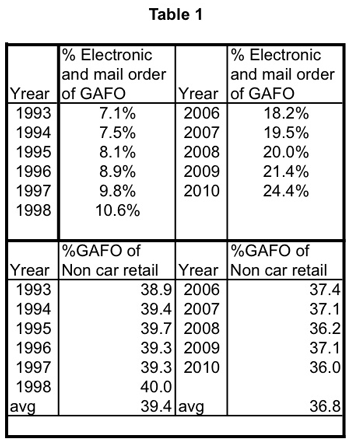
The top part of Table 1 shows the relative strength of the electronic shopping and mail order house sales compared to GAFO sales expressed in percentage terms. The data are for two time spans. The first, 1993 to 1998, is when catalog operations were stronger than the e-retailers; Amazon went online in 1995. The second is a more recent period, 2006 to 2010. In 1993 the nonstore retailers in NAICS 4541 had sales amounting to just 7.1% of the GAFO merchants’ sales, but by 2010 their sales were equal to 24.4% of the GAFO sales. These findings are consistent with the hypothesis that the strength of e-retailing has certainly grown since 1993. Indeed, the fact that NAICS 4541 sales are now the equivalent of about one quarter of GAFO sales is quite impressive.

But, did the NAICS 4541 nonstore sales take sales away from the GAFO merchants? Between 2006 and 2010 NAICS 4541 merchants grew steadily from the equivalent of 18.2% of GAFO sales to 24.4% of GAFO sales or from $202.6 billion to $276.2 billion, while the actual levels of annual GAFO sales in trillions were $1.113, $1.148, $1.144, $1.098 and $1.1320, with a 1.6% net increase over the period. In other words, while the NAICS 4541 had strong growth, there was fluctuation, but no real major erosion in GAFO sales.

The bottom part of Table 1 covers the same time periods, but it shows the proportion of non-auto-related retail sales that GAFO sales account for annually. Both e-retailing and mail order houses as well as GAFO stores are included in the total non-auto-related retail sales figures. So are groceries, supermarkets and pharmacies. Between the two time periods there is a definite drop in GAFO’s share of non-auto-related retail sales:

  • The peak, 40% was in 1998, the low point was in 2010 at 36%
  • The average for the 1993 to 1998 period was 2.7% higher than the average for the 2006 to 2010 period.

These fall offs certainly might be considered as indicators of the sales e-retailers took from the GAFO merchants. If these are valid indicators, then the numerical impacts may not seem large, but events have shown that a 3% to 4% drop in sales can take the wind out of any retail sector.

However, other factors were also present during this time period that could account for the reduction in GAFO sales. For example, as the Great Recession manifested itself, GAFO expenditures, especially for big ticket items, were where consumers cut quickly and deeply, while expenditures for food for the home and health and personal care items grew.


Furthermore, GAFO includes some of the nations largest and strongest retail chains such as Walmart, Target, Home Depot, Best Buy, Macy’s, Saks Fifth Avenue, etc. They are not only strong brick and mortar competitors, but also have developed very strong and elaborate online stores. Many smaller GAFO chains and some independent operators have followed suit. Unfortunately, the GAFO data does not provide sufficiently detailed information to look into these issues.
My Take Aways

Reviewing these data I am inclined toward the following conclusions:
  1. E-retailers have had much more impressive growth than the Census Bureau’s e-commerce data would suggest. The proper benchmark is not all retailing that includes auto dealers, supermarkets and drugstores, but GAFO merchants. The latter sell the department store type merchandise that downtown leaders would like to have available in their districts, though many downtowns are just too small to have numerous GAFO shops.
  2. Pure play e-retailers have knocked out many, if not most, book and recorded music stores, but broad swathes of GAFO brick and mortar merchants remain.
  3. Though some erosion among other GAFO segments has likely also happened, it probably has involved marginal firms that were already poor competitors and/or could not develop significant online presences. Large firms fall into this group — think Borders, Circuit City, Blockbuster — but smaller firms with few financial and skill resources are more prone to having such vulnerability. Of course, many of the GAFO operations in our small and medium-sized downtowns fall into this category.  
  4. Many of these small marginal downtown GAFO firms would still be marginal if the e-retail threat did not exist. They have always been there in the 35+ years I have been working in downtowns. The thing that has changed over time is the nature of the threat.
  5. My reading of various articles indicate that to date, the pure play e-retailers have not captured many sales in the auto, grocery, health and personal care sectors. These often have a strong presence in or near downtowns and are usually where a small or medium-sized downtown’s strongest retail market potentials reside.
  6. E-retailing’s biggest impact is not the “constructive destruction” of most brick and mortar merchants, but in changing what it means to be a retailer: retailing now has an electronic as well as a brick and mortar component.
  7. This means that many small downtown GAFO operations will have to “innovate” by either having their owners/managers learn new internet related skills or by hiring outsiders who have them. This is a strong challenge, as I outlined in my previous blog posting, that admonishments to get on the web alone cannot address.
  8. If the current operations of these GAFO retailers are badly managed — a likely condition if they are marginal — it is unlikely that they will either acquire the necessary skills or be saved if they do.

What do you think?


N. David Milder


The Use of the Internet by Downtown Organizations and Businesses

About a week and half ago I went to a workshop put on by Downtown New Jersey that focused on the use of web sites and social networking media such as Facebook. While I learned a lot and thought the presenters did a good job — they certainly were enthusiastic — I still came away with my major concerns being unanswered.

 
Being Able to Afford the Time, Money and Skill Acquisition Needed to Create and Maintain a Website. For many years I have heard several other downtown revitalization and business development experts strongly recommend that downtown organizations and individual downtown businesses have attractive and effective websites. I certainly concur with the potential positive impacts of effective websites. Moreover, I agree that organizations, with say $300,000+ in annual revenues, can have at least a useful website and that it gets easier for them to have a really effective website as their budget increases.


My problem is: Can most small businesses and small-budget downtown organizations really have effective websites? Many small and medium sized downtowns have numerous businesses that are in the $150,000 annual sales range or perhaps even less. With few, if any, full-time paid employees and modest revenues, these shopkeepers usually work long hours and may not have either:
  • The computer skills needed to create and maintain a website
  • Or the time to acquire them
  • Or the funds and networking skills needed to hire an outsider to build and maintain the website.
These problems can be particularly acute when it comes to a small merchant  building an “e-store.” The chores of keeping the online inventory current and packing and transporting the sold merchandise can be daunting.  
 
Of course, what most downtown managers also know is that getting their small merchants to advertise is very often analogous to pulling teeth. So, if they are resistant to shelling out less than say $100 for a co-op newspaper ad, you can expect that getting them to even entertain a website they fear might cost in the thousands of dollars is likely to be far more difficult. Moreover, if they cannot have online stores, they may doubt the value of a website that is simply something akin to a fancy directory listing.
 
Much the same is true for small downtown organizations — small budgets constrain what can be done — but, my online observations strongly suggest they have both better skill sets for the  electronic media and a greater willingness to spend a significant portion of their budgets on them than the small merchants. Many of their sites are good at promoting their downtown events and sharing news relevant to the downtown community that the local media might be overlooking. They  usually have an online business directory, while some even try to provide a webpage for each business. 


But, too many fail to take on business development functions by providing essential, easy to find and easy to use information that would be useful for a business looking for a new location. This can range from demographic data to information about prevailing rents and the town’s permission and approvals process. 


While small businesses probably will always lag in the creation and quality of their websites, there are reasons to believe that in the coming years there will be significant improvement among them:
  • The younger among them are more adept and comfortable with using computers and the internet — and with time the proportion of the internet capable will rise and be dominant
  • There are website hosting services appearing that make the creation and — most importantly — the maintenance of a website much cheaper and easer to do. They use templates and modules to achieve the fast, easy and affordable website, but they also bound a site’s creative potential.  We are redoing our DANTH, Inc website, under the guidance of our website consultant 180 Interactive,  and using one of these services. I’ll report on the experience in a later posting.

When Is Electronic Social Networking the Answer? At the risk of sounding like an electronic Luddite, I am having a difficult time figuring out how something like Facebook or Twitter could provide real added value in the marketing of DANTH. Though I can see their value to some large downtown organizations and consumer products companies, I keep feeling that many small business people are in a similar position to mine:

  • I barely have the time to operate my business and still write a blog, maintain our website and write periodic email blasts. Where will I find the time and energy to also deal with a Facebook presence, which to me seems like another resource demanding website? 
  • My company does not generate enough “news” to keep a constant information flow through any communication channel  
  • Our clients do not usually come to us from the web, but through word of mouth. They then do go to our website to get more information about us and to “confirm” the positive messages  they have received from other sources. What added value can Facebook offer that has a sufficient cost/benefit justification?
  • The times have been economically desperate and in such conditions people often look for “silver bullet” solutions. The faddish popularity of Facebook and Twitter suggest to me an unthinking groping for magical answers to tough problems. 
I think that there is a real resource threshold for small businesses to properly utilize websites, blogs and the social networking platforms. To do all of them properly and advantageously demands proper staffing and the resources to pay them. To do just one properly takes skill and effort — and time.
 
Our firm’s approach to the design of our website and this blog is based on a set of marketing objectives we want to achieve. So far, we cannot see any objectives that a Facebook or Twitter presence could help us achieve. Perhaps, if we had DANTH events or if we sold my books directly from our website we would have a different assessment of the electronic social networking opportunities.  
 
My fear is that too many downtown organizations are doing Facebook and Twitter without having any substantial strategic justification, but simply because more and more downtown organizations are doing it. I fear, too, that many small businesses are falling into the same trap.
 
 
Are We Taking Our Eyes Off of the Real Prize?  A week or two ago our friend and strategic partner Mark Waterhouse of Garnet Consulting Services sent us this link to an article.
 
It is from a New Haven newspaper and it details how the merchants in downtown Guilford, CT have prospered right through our nation’s Great Recession. No where does it mention the merchants’ slick use of the social networking media. But, there are vivid descriptions of merchants who work hard to have the right merchandise for their customers, who provide a deep level of customer service and who avidly recommend other nearby merchants to their customers. All of this is perhaps just a part of “Being A Successful Merchant 101,” but apparently they are actually doing it in Guilford. The part of the story about the merchant referrals had a particularly strong resonance for me because:
  • I have become increasingly convinced that this is one of the most effective and inexpensive ways to do cross marketing in a downtown
  • I have also become convinced that most downtown organizations do a lousy job of encouraging cross marketing.

Furthermore, I have not heard of any similarly effective downtown cross marketing effort that is based on electronic social networking. 

 
The Bottom Line. I am all for e-marketing and using websites, blogs, social networking platforms, web photo galleries, etc., as long as they can fulfill an organization’s strategic objectives and fit within its resource constraints. Most importantly, I fear that downtown business operators and their downtown organization’s leaders are shifting their attention and resources so much to the web that they will forget the importance of mastering the non-electronic ABC’s of being a successful merchant. If you have dull merchandise, fail in customer service and have not learned how to work with your fellow downtown merchants to generate and SHARE customer traffic, no amount of adept electronic marketing will save you…or your downtown.