Home Depots and Home and Hearth Niches

Conventional Wisdom
Conventional wisdom holds that when “category killer” retailers, such as Home Depot , enter a market area, they decimate many independent retailers in nearby downtown and neighborhood commercial centers. Local hardware stores, lumber yards and paint shops are supposedly doomed, while shops featuring lighting, window treatments, flooring, home decorations, etc., are seen to be in increased danger. The urban Metropolitan Avenue shopping district in the Forest Hills neighborhood of New York City and the suburban Springfield Avenue commercial corridor in Maplewood, NJ, demonstrate that sometimes these small merchants can not only survive, but possibly even thrive, after a Home Depot opens nearby.

Forest Hills, NY
A Home Depot opened five years ago about 500 feet from a 0.70 mile section of Metropolitan Avenue, a two-lane, often congested street, that for decades was a backwater shopping district in this neighborhood. This district is 1.7 miles from the very powerful Queens Center Mall, and about 0.8 miles from the Austin Street shopping area that is tenanted by the likes of The Gap, Eddie Bauer, Benetton, Banana Republic, Sephora, Barnes & Noble, etc.

Five years ago Metropolitan Avenue was anchored by popular independent operations such as Eddie’s Sweet Shop, Continental Hardware, Alberto’s Restaurant, Weston Bros. Appliances and a movie theater. All had been around for over 30 years.

When Home Depot opened many retailers, including the owner of Continental Hardware, thought that a lot of local shops would be crushed. Today, this strip has experienced a surge of growth with better quality shops and restaurants opening that attract more affluent shoppers from nearby neighborhoods, including the famed Forest Hills Gardens enclave. Commercial rents and foot traffic have increased significantly. It now also has a flourishing 24 store “home and hearth” niche that includes: a 4,000 sf hardware store that stocks 60,000 items and has been around for over 80 years; a paint and wallpaper store featuring Benjamin Moore products; six antique shops; two appliance stores, with one specializing in air conditioners and fireplaces and the other in vacuums and sewing machines; two plumbing and plumbing supply stores; two furniture shops; one kitchen cabinet store; one shop specializing in window treatments and two reupholstery and drape shops.

Consumer expenditures provide room for both a Home Depot and a lot of nearby independent retailers: 157,459 households live within a seven-minute drive and they spend over $321 million annually on home furnishings and equipment.

The shops in this commercial area have long experienced heavy competition from Manhattan as well as nearby malls and shopping centers.

Double click photo to access photo album on this niche.

Maplewood, NJ
Springfield Avenue is a 2.5 mile-long suburban commercial corridor. It long has been a secondary shopping area within the community to Maplewood Village in terms of reputation, appearance , store quality, commercial rents and customer traffic. The core of the shopping district is about 3 miles away from the Short Hills Mall, which is famed for its array of high end retailers.

Over eight years ago a Home Depot opened about one mile west of the heart of the area. An Expo also opened near the Home Depot, but it soon closed. Today, Springfield Avenue is definitely improving. The Township has made significant street improvements. Recently, Dunkin Donuts and Pappa John’s Pizza opened as have some attractive restaurants, a toy store, an art gallery, a home decorating shop and a dance school. There also is a 25-store home and hearth niche that includes architects, plumbers, art dealers, upholsterers, paint and home décor shops. The strongest stores in this niche are Riccardi Bros. Decorating, Riccardi Paints (which have been around for 75 years) and Sherwin Williams Paints.

According to Walter Riccardi, his paint store’s revenues took a 5% hit the first year Home Depot opened, but they have since more than recovered. The Expo had a similar impact pattern on his decorating store. While his store’s prices are close, Riccardi states that his key to success is that “We serve our customers to death.” Households living within a 7-minute drive of the heart of the Springfield Avenue corridor spend $260,801,200 annually on household furniture and equipment.

Lessons Learned
There are several apparent reasons why these home and hearth niches have succeeded:

  • These niches represent nearby specialized shopping centers for consumers interested in making their homes more attractive or comfortable. They provide a lot of choice and convenience. Attractive restaurants, coffee houses and ice-cream parlors enhance this shopping experience.
  • Many of the niche shops that pre-date the Home Depots continue to be strong because of their quality products and especially their high levels of service. They never competed on price — and do not today. Many target time-pressed, affluent shoppers who definitely are not do-it-yourselfers and who place a high priority on such things as design, paint selection systems and installation being parts of the purchase package. Such services are definite keys to success.
  • They also had years of experience dealing with strong competitors before the Home Depot arrived. Similar shops in less urban settings may not have similar competitive experiences and are consequently less able to cope with the strong competitive pressures presented by a Home Depot.
  • Many niche shops — e,g., the antiques, art, furniture and decorating shops — do not compete head-on with Home Depot. Their goods and services complement Home Depot’s offerings. They help maintain customer traffic for the stores that do compete more directly with Home Depot
  • The opening of the Home Depot legitimated Metropolitan Avenue as a retail location, attracting better operators and more investment . It also increased consumer awareness of the strip.
  • Consumer expenditures within both market areas for home and hearth goods and services provide ample room for a Home Depot and a lot of independent retailers.
Downtown Friendly Store Designs 2 – Subway


What happened a few years ago when a Subway opened in the Bayonne Town Center demonstrates an important point — it isn’t always the retail chain that causes problems with a new store’s façade or signage.

The franchisee opened his shop and mounted a back-lit sign without getting necessary approvals from the city. City approvals require a letter from the Bayonne Town Center Management Corporation (BTCMC) stating that the design of the new façade (including signage) is in compliance with its façade design guidelines.

The franchisee finally applied for BTCMC approval, but, since the guidelines prohibit back-lit signs, the design was rejected. The city made him remove his sign. The franchisee maintained that Subway required the use of back-lit signs and that if he could not do so he would have to close his shop. His landlord became irate about possibly losing a quality tenant — and the BTCMC certainly wanted the Subway in its district.

The situation was saved by Walter Chatham, a well-known architect who the BTCMC hired to review new façade designs and assure their compliance with its design guidelines. Chatham noted that Subway used a number of sign formats and that the one they used in historic districts would be in accord with the design guidelines. Begrudgingly, the franchisee put up the sign suggested by Chatham.

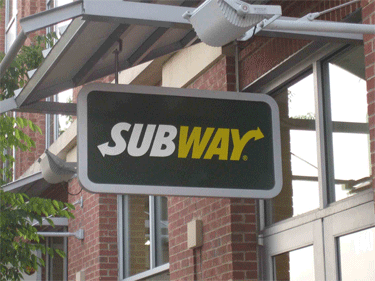
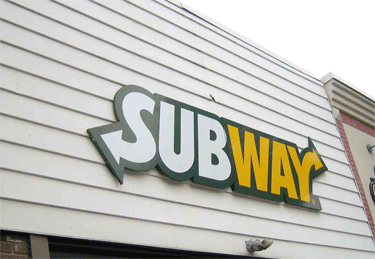
I learned from this experience that chains can have many formats for their storefront signs. To illustrate this point, I have posted above three Subway signs from Bayonne, NJ; Forest Hills, NY, and Columbia, SC. (If the signs are not visible, double click on the empty boxes where they should be.) Such variation can allow the signs to fit in better with the overall design of the buildings in which the Subway stores are located. This makes good business sense.

In this case study, the problem was caused by a franchisee who tried to avoid abiding by existing rules and regulations — not the chain.

This case study also shows that it is great to have design guidelines, but real enforcement is essential if they are to have their intended impacts.

Downtown Friendly Store Designs 1 – Wal-Mart

This is the first in a long series of planned postings intended to demonstrate that a whole slew of major retail chains can — when they want to or are “induced” to — come up with attractive designs for their downtown stores that encourage pedestrian traffic and cross-shopping, while not visually violating the urban fabric. My goals in these postings are to:

  1. Encourage downtown leaders to demand downtown friendly store designs from retailers, no matter how strong and powerful they may be
  2. Provide examples of downtown friendly designs that many of these chains may deny having
  3. Feature some retailers who have shown that they really understand how to fit into a tight urban fabric and do so with strong and successful stores.

For many downtown leaders and activists, Wal-Mart is Public Enemy No.1. It is, therefore, very interesting that Wal-Mart opened in 2002 a very out of character store in CityPlace, a mixed-use development in the heart of downtown Long Beach, CA. (See photo:double click on it for larger view.) This development has 450,000 square feet of retail space and 341 residential units. Retail tenants include Wal-Mart, 134,147 square feet, Albertson’s, 57,945 square feet, Sav-on, 14,884 square feet, Nordstrom Rack, 29,945 square feet, Ross Dress For Less, 28,073 square feet, and scores of smaller operations occupying the remaining space.

The fact that Wal-Mart is anchoring a major downtown open air shopping center with many small stores opening nearby is in itself out of the ordinary. However, the design of the store is also unusual in that it tries to avoid long dead walls, incorporates other stores in an attached “sleeve” and provides parking in a nearby garage. The design seems intended to allow the smaller store to benefit from the customer traffic Wal-Mart generates.

The CityPlace Wal-Mart overcomes the design problems of the Wal-Mart in downtown Rutland, VT, where a huge parking lot in front of the store serves as a moat separating it from the rest of the downtown.

If Wal-Mart can come up with this type of store design in Long Beach, then it is reasonable to demand that it provide store designs of similar quality and sensibility in other downtowns.

If Wal-Mart can do it, then it also is reasonable to demand that other retailers do the same. As I will try to demonstrate in future postings, many, many retail chains are quite capable of opening stores with downtown friendly designs — unfortunately, they often have to be banged over the head to do it. Often, problems are generated not by the rertail chain, but by the developer or franchisee.

Political Leadership and Downtown Redevelopment

The Clear and Eminent Danger.As we all know, the Kelo vs New London decision by the US Supreme Court, although narrowly affirming the use of eminent domain, has thrown a wet blanket over downtown redevelopment projects. Many downtown activists are wondering about how they can proceed and if significant urban renewals will still be viable?

Kelo has certainly made downtown revitalization much more difficult, but significant improvements are still possible. I would argue that there are four keys to future success: 1) Developing and cultivating the needed political leadership; 2) Providing a significant and publicized payment “premium” to displaced commercial and residential tenants; 3) Strenthening a project’s public purpose arguments, and 4) Doing more small and medium-sized projects that do not require the use of eminent domain. In today’s posting I want to focus on the leadership issue.

Representing Is Not Leading. Downtown revitalization by definition means change. Change threatens most people and they usually resist it. Leadership is usually required to help people negotiate the risks of change.

Most elected officials, despite their campaign rhetoric and public statements to the contrary, are risk-adverse: their fundamental drive is to be elected or re-elected. They are more interested in winning office and enjoying its benefits than in winning office in order to implement a particular program, plan or strategy. Most elected officials consequently feel at home playing the role of the representative, which means that they make public policy decisions based upon what they believe their key supporters want. The representative role fits in well with our notions of democracy because the representative is in a sense voicing the will of the people.

But, this is not leadership. Leaders lead. They are in the vanguard and they bring their followers with them.Leaders lead by providing their followers with inspiration, guidance and direction. Leaders are change agents. They have a vision or strategy . They are also able communicators and teachers — that is how they get their vision understood and accepted. They transmute public opinion instead of echoing it.

If the need for political leadership and “political will” has increased substantially because of the Kelo decision, then downtown organizations have to become much more involved in facilitating their emergence on relevant issues, while not becoming too political through overt involvment in electoral campaigns.

Action Steps. At this time I do not pretend to have a definitive action program that I can recommend to downtown officials. Below are some of my current thoughts, which I present to stimulate discussion among my downtown brethren:

  • Some elected officials want to be leaders, but they do not know how. Downtown organizations need to identify and cultivate such potential leaders. This means that most of the downtown organizations I know, especially those in small and medium-sized communities, will have to increase their contacts with elected officials
  • Let’s face it, many elected officials come up with rather thin and often ridiculous suggestions for new policies and programs. Some, however, are really hungry for solid program recommendations that they can make their own. There are obvious advantages in this, but also inherent dangers if they try to alter the programs in ways that make them ineffective or unacceptable to the downtown organization
  • Present elected officials with a very clear, strong and articulate argument about the strong benefits of your redevelopment project. I can not tell you how many times I have seen projects going to council asking for the use of eminent domain with superficial and perfunctory arguments about resulting benefits
  • There are many anecdotal statements by developers and public officials that the commercial and residential tenants displaced through eminent domain usually receive great financial deals and are better off than they were before. But we lack a collection of testimonials or a rigorous survey of those displaced to support such statements. The ULI or ICSC should sponsor such research
  • Have a plan to organize public support for your redevelopment project to provide elected officials with some political cover. Project opposition organizes almost naturally. Project supporters among the public must be intentionally mobilized and organized. Leadership is more likely to emerge if there is a modicum of public support
  • Many elected officials will feel that they know better than the downtown organization what should be done. Effective downtown organizations are less likely to be in such a position. Downtown organizations should not try to prove their effectiveness on a redevelopment project
  • Elected officials need to be convinced that taking an unpopular position does not always mean incurring voter defections. As Bruce Bartlett has noted, in his blog on the New York Times website, American voters are amazingly tolerant of elected officials who take up policy positions different from their own — if the position is based on a clear ethical, moral, religious or political principle. Most political scientists would agree with Bartlett.