Downtown Retail Part II. Food: Capture What You Should Own

People spend a lot of money on food. In 2006, the average total expenditures for food by households in the bottom, middle and top income quintiles were $3,195, $5,614 and $10,212 respectively. And the need to eat is fairly inelastic. Proximity and convenience are major factors driving food purchases, with higher fuel costs just increasing their strength. Food emporiums and eateries bring more customer traffic into small and medium-sized downtowns than any other kind of retail. Additionally, working parents have been able to juggle increased time spent at work and with their children by reducing their time invested in food preparation and food shopping. Therefore, even with the rising cost of food, small and medium downtowns can and should own the food expenditures of local residents.

Restaurants – First, we’ll start with the obvious. Downtown restaurants play critical economic and social roles for their downtowns and entire communities. They are not only places where people eat, but also where people spend time with significant others, friends and family – allowing time-pressed consumers to both dine and meet their needs for “quality time.” Good restaurants help reinforce the downtown as the Central Social District and the social heart of the community. Notably, restaurants often also serve as entertainment venues for their downtowns. Restaurant niches have been pivotal in the revitalization of downtowns – with local restaurateurs opening in many locations that national and regional retail chains initially bypass. While the National Restaurant Association projects slower growth for restaurant expenditures in 2008 as compared to 2007, it still projects growth. Finally, an analysis of BLS data shows that food-away-from-home spending has been increasing faster than inflation, with the largest increases in households in the top income quintile. In 2006, households with children accounted for 40% of all food-away-from-home expenditures. Downtowns with higher income residential neighborhoods and large pools of working mothers should tap into these markets.

Supermarkets and Gourmet Markets – Nationally, households average 2.1 supermarket shopping trips a week, making supermarkets potentially huge generators of downtown customer traffic. For many small and medium-sized downtowns, “food at home” is their most important retail niche: 62% of supermarket shoppers also shop in other nearby shops. However, traditional supermarkets can adversely impact a downtown when they are located in self-contained, pedestrian-hostile shopping centers surrounded by a sea of parking. The good news: Downtown-friendly supermarket chains, such as Whole Foods, that squeeze into tighter urban locations and in mixed-use projects are growing. Additionally, there is a new trend toward smaller downtown food and gourmet markets with stores in the 6,000 SF to 15,000 SF range, including Balducci’s, Trader Joe’s, Aldi, Garden of Eden, Zeytinia and The Natural. This trend towards smaller, often gourmet markets, means it is much easier to locate a quality food market, capable of drawing many customers, in more downtowns without threatening the pedestrian landscape (as traditional supermarkets with their large size and parking requirements do). These stores often take advantage of nearby commuter rail stations and their homeward-bound commuter shoppers. They work well for time pressed shoppers who, often on their way home from work, are shopping without a list for a meal or two and not a week’s worth of groceries. Gourmet food stores also often offer consumers “pick-up” or “prepared” meals that they can simply take home or to the office and reheat – another important retail trend for the time-pressured consumer.

Take Out – As restaurant expenditures are projected to grow at a slower rate in 2008 than in 2007, the National Restaurant Association projects that full-service restaurants will rely more on “take-out, delivery and curbside service to meet Americans’ desire for convenience.” Middle- and upper-income families feeling the squeeze between declining discretionary dollars and time limits (particularly those with two working parents) increasingly will choose take-out as the compromise option. This brings up an interesting issue for downtowns. A large number of auto trips are being generated to stop, order and pick up food. These trips require very short-term use of parking spaces – 15-20 minutes at most. DANTH has found that downtown gourmet markets and local restaurants often do not have enough nearby, short-term parking and as a result their pick-up and take-out sales have suffered (despite pedestrian and commuter traffic). Over the next five years, downtown organizations and their governments may need to look at short-term parking solutions as this niche becomes a strong driver of the downtown economy during tough times.

For the full report on “Food: Capture What You Should Own” visit www.ndavidmilder.com after June 1, 2008 and double click on the red trends button..

This posting was was condensed from my longer report by Mary Mann.
DOWNTOWN MOVIE THEATERS WILL BE INCREASINGLY IN PERIL

Our Lustrum Trends Assessments.

For the past 20 years, about every five years (a lustrum) DANTH, Inc. has engaged in a review of the social, economic and political trends that are — or soon will be– affecting the health and well-being of downtown, urban neighborhood and Main Street commercial districts. We do this because it is an essential asset when we work on any kind of revitalization strategy for our clients.

Being a curmudgeon, I must also strongly opine that being aware of these trends and their potential effects is an essential component of any district manager’s job. Unfortunately it is a job function that too many managers ignore.

The results of DANTH’s last trends assessment in 2003 are available free of charge at: https://www.ndavidmilder.com/pdf/trends_3_25_05.pdf

Below is a “tease” excerpt from the first installment of the 2008 assessment.

Downtown Movie Theaters Are Very Vulnerable.

Downtown movie theater closures are bad news because:
• They are usually important downtown assets
• Closed cinemas are usually large, highly visible spaces, occupying considerable frontage and consequently a huge negative for a downtown’s image. It is also usually very hard to re-tenant an empty cinema — too many stay vacant for numerous years, often for decades. Some of the conversions, e.g., bingo halls and flea markets, are often less than desirable for spaces having prime locations and large size.

Movie theaters are in an increasingly weakened position because:
• Their hold on adult audiences is small and diminishing. By a five-to-one ratio Americans view films more at home than they do in movie theaters. Move theaters account for only about 12% of the movie industry’s revenues.
• Even the most frequent movie goers prefer home viewing
• Many theaters have low operating margins based primarily on revenues from concession stands and screen ads. Just a small drop in the paid attendance can be devastating financially: a mere six percent drop in attendance in 2000-2001 put most of the theater chains into bankruptcy.
• A relatively modest reduction in paid attendance by a small group of frequent moviegoers could easily erase these meager margins. The frequent movie goers do not have to completely stop visiting movies theaters for the impact to be devastating. This is an important point.
• The frequent movie-goers have demographic characteristics that highly correlate with the use of computers and other electronic home entertainment equipment
• Many theaters lack amenities such as many screens, large screens, first run films, stadium seating, clean restrooms and theaters floors. This is especially true of cinemas in small and medium-sized downtowns
• Theaters provide a very small revenue stream for the major movie studios. Consequently, the studios are incentivized to make decisions that will help other film distribution channels although they may hurt the theaters

Rival Home Film Distribution Channels Are Poised To Grab Market Share.

Competing film distribution channels have been improving, many finding formulas that are aimed straight at the three key variables that most impact film viewer behavior — convenience, film selection and cost:
• On-demand cable TV has great convenience, wide household penetration, competitive prices and indications that some large operators will be offering significantly greater film selections. The introduction of HD broadcasts will also improve product quality and enhance competitive strength
• Apple TV and Vudu have a strong films service formula that could really grab market share if they can offer sufficient film variety. They, too, already offer on-demand convenience and competitive prices. Apple, because of iTunes, has a large amount of household penetration and brand loyalty.
• The competitive strengths of the brick and mortar DVD shops and the mail delivered DVD services versus movie theaters has been improved recently by the growing presence of large HD TVs in American households and the final victory of the Blu-ray HD DVD format.

Tipping Point Scenarios.

Below are some scenarios under which a tipping point might occur:
• The cable TV and Internet film services improve their film libraries sufficiently to become real competitors with movie theaters.
• Real household incomes erode to the point that the cost of movie consumption grows in importance in consumer decision-making. The cost advantage of home viewing, popcorn, sodas, baby-sitting, etc, is substantial. Given the recent low growth in median household incomes and the soaring costs of medical services, energy, college educations, etc. and the reduced values of private homes, this scenario is likely to have substantial impact.
• The convenience and comfort of home movie theaters increase to the point that consumers prefer the home viewing experience even more than reported in the 2006 Pew survey. This is occurring now; the question is how big its impact will be.
• The major studios finally go for “simultaneous releases.” In 2006 and 2007 there was a lot of discussion within the major movie studios about releasing films to theaters, cable TV and Internet film services at the same time, with DVDs being released three months later. A major survey of movie audiences in the USA, Japan and Germany, which account for over half of the world’s film market, found that simultaneous releases would enable the studios to increase their revenues by 16%, but cause the revenues of movie theaters to shrink by 40%. More recently there has been some discussion of simultaneous releases for a limited number of films.
• An accumulation of impacts from all of the above.

The Complete Report

DANTH’s complete assessment of the dangers that downtown movie theaters will be increasingly facing will be posted on our website www.ndavidmilder.com and publicly available by March 24th, 2008. As our current work on trends progresses, I plan to periodically post the complete reports of our findings on our website and excerpts on this blog. Here are some of the other topics we’ve been looking at in our assessment:
• Time-pressured people continue to be downtowns’ best friends
• Retailing is in for much tougher times
• Post-Kelo redevelopment
• Boomers are now seniors and a great market segment for downtowns
• Green redevelopment
• Owners or renters: downtown residential redevelopment
• Downtown crime redux
• Downtown solution trends:
— Mixed-use projects
— Transit-oriented development, getting more important every day
— Place-making
— Niche development
• Downtown organizations: a time to alter missions, roles and responsibilities
• The internet and downtown revitalization

Unfortunately, some of the trends DANTH identified suggest that downtowns will soon be confronting major new challenges. DANTH believes that being forewarned enables downtown organizations to be forearmed. Although proven solutions to these emerging threats do not exist, I will try in my postings to outline some approaches to finding them, while welcoming other members of the downtown revitalization community to share their solution suggestions.

Strong Downtown Entertainment Niches

Increasingly, downtown and Main Street commercial districts are finding strength through the establishment or expansion of an entertainment niche. This is happening in communities of all sizes. The theater district around Times Square in Manhattan has long been world famous. At the other end of the scale are communities as small as Weston, VT, with a population of 630, that is home to The Weston Playhouse Theatre Company, the oldest professional theater company in the state. Every summer it presents Broadway plays and musicals in a beautiful white-columned building on the village green. In between are literally hundreds of communities with theaters and performing arts centers for staging plays and concerts such as Carlisle, PA; Rahway, NJ; Englewood, NJ and Rutland, VT.

In most small and medium-sized downtowns, reliance on such formal entertainment venues will result in an entertainment niche that is, perhaps, moderately strong. The problem is that such formal venues, at best, are “lit” a few nights a week and dark during most days. Really strong downtown entertainment niches utilize other resources to attract and amuse visitors throughout most of the day and almost every day of the year.

Informal Entertainments

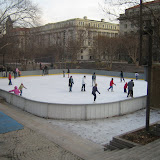
Entertainment essentially involves people being amused by something. In formal venues, they can be amused by plays, movies, concerts and dances — all requiring some kind of formal organization (a theater company, dance troop, orchestra) that is scheduled and “performs” the entertainment. However, strong downtown entertainment niches rely on the fact that people also are entertained when they are amused or pleased by observing other people — who, at the same time, may be amused by watching them. Great public spaces provide opportunities for “informal entertainments” that occur when people engage in activities that they enjoy and that also interest and amuse nearby people-watchers. Think of the ice skaters drawing the ever-present crowds above the rink in Rockefeller Center. Similarly, in Manhattan’s Bryant Park, you’ll find young men and women seated and watching each other and chess players, who always attract an audience. Greenport, NY, has used a carousel and waterfront location to create a wonderful public space where people can watch and be watched by other people. Other downtowns have fostered entertainment with facilities such as: a model boat pond; a children’s pony ride; a Wi-Fi hotspot to access and cruise the Internet on laptops; a place to catch the sun — a favorite pastime for office workers and young tourists in the spring and summer; places to buy food and eat lunch alfresco; outdoor cafes for sipping coffee and eating snacks; slot car racing for kids, playing bocce for seniors, etc.

Visitors will “perform” if the opportunities are there. To sail a model boat, a suitable pond or pool is required; to sit in the sun and people watch requires an attractive place with benches and chairs to sit on, etc.

The following link takes you to a photo album that illustrates a range of “informal entertainments”

Work As Entertainment

People are often engrossed and entertained by watching other people at work.

Decades ago, the people who brought back “historic” villages, — such as Colonial Williamsburg (VA) and Old Sturbridge Village (MA), — cleverly decided to have people at work, using 18th Century technologies, to educate and entertain visitors. For example, in Colonial Williamsburg visitors can watch 100 masters working in 30 trades. Included are an apothecary, blacksmith, cooper, brickyard, foundry, gunsmith, basket maker, etc.

In Old Town, located in San Diego, CA, visitors can watch glass blowing, wood-working and candle-making, though current technologies may be used.

The Simon Pearce retail store at The Mill in Quechee, Vermont, is perhaps the most brilliantly designed and executed retail project in the United States in a small Main Street setting. It combines a superb site in a renovated old mill located over a waterfall with a diverse assortment of retail goods ranging from blown glass to ceramics and superb furniture. In addition, at this diverse destination you can watch glass being blown, ceramics being thrown and decorated, fabrics being woven and enjoy a meal in a three star restaurant that has attractive water views. The Simon Pearce store at Quechee is a strong destination and lots of people leave there with bags full of merchandise.

At the Torpedo Factory in Alexandria, VA, an historic building has been renovated to provide studios for artists and craftsmen where visitors can watch jewelry being made, pots being thrown, lithographs being made, etc. and have opportunities to purchase the products.

At the Chelsea Market in Manhattan, visitors can be entertained by watching bread making at Amy’s Bread, a working kitchen for Sarabeth’s, a skilled knife sharpener, and people learning to dance the Tango.

People like to watch TV shows outdoors, as attested to by the crowds drawn the Today Show and Good Morning America.

Edward Villella has the Miami City Ballet rehearse in a storefront window, where pedestrians flock to watch the dancers.

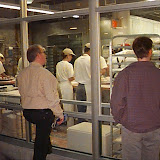
Many diners want to sit at chef’s tables or counters where they can watch the cooking process and interact with the kitchen staff. Chef’s tables are often the hardest to book and offer the most expensive menus at topnotch restaurants. The noted French chef Joel Robuchon specifically designed his recent restaurants so most or all of his patrons sit at counters where they can watch their food being prepared.

Double click on the link below and you an access a photo album that illustrates “work as entertainment.”

Home Depots and Home and Hearth Niches

Conventional Wisdom
Conventional wisdom holds that when “category killer” retailers, such as Home Depot , enter a market area, they decimate many independent retailers in nearby downtown and neighborhood commercial centers. Local hardware stores, lumber yards and paint shops are supposedly doomed, while shops featuring lighting, window treatments, flooring, home decorations, etc., are seen to be in increased danger. The urban Metropolitan Avenue shopping district in the Forest Hills neighborhood of New York City and the suburban Springfield Avenue commercial corridor in Maplewood, NJ, demonstrate that sometimes these small merchants can not only survive, but possibly even thrive, after a Home Depot opens nearby.

Forest Hills, NY
A Home Depot opened five years ago about 500 feet from a 0.70 mile section of Metropolitan Avenue, a two-lane, often congested street, that for decades was a backwater shopping district in this neighborhood. This district is 1.7 miles from the very powerful Queens Center Mall, and about 0.8 miles from the Austin Street shopping area that is tenanted by the likes of The Gap, Eddie Bauer, Benetton, Banana Republic, Sephora, Barnes & Noble, etc.

Five years ago Metropolitan Avenue was anchored by popular independent operations such as Eddie’s Sweet Shop, Continental Hardware, Alberto’s Restaurant, Weston Bros. Appliances and a movie theater. All had been around for over 30 years.

When Home Depot opened many retailers, including the owner of Continental Hardware, thought that a lot of local shops would be crushed. Today, this strip has experienced a surge of growth with better quality shops and restaurants opening that attract more affluent shoppers from nearby neighborhoods, including the famed Forest Hills Gardens enclave. Commercial rents and foot traffic have increased significantly. It now also has a flourishing 24 store “home and hearth” niche that includes: a 4,000 sf hardware store that stocks 60,000 items and has been around for over 80 years; a paint and wallpaper store featuring Benjamin Moore products; six antique shops; two appliance stores, with one specializing in air conditioners and fireplaces and the other in vacuums and sewing machines; two plumbing and plumbing supply stores; two furniture shops; one kitchen cabinet store; one shop specializing in window treatments and two reupholstery and drape shops.

Consumer expenditures provide room for both a Home Depot and a lot of nearby independent retailers: 157,459 households live within a seven-minute drive and they spend over $321 million annually on home furnishings and equipment.

The shops in this commercial area have long experienced heavy competition from Manhattan as well as nearby malls and shopping centers.

Double click photo to access photo album on this niche.

Maplewood, NJ
Springfield Avenue is a 2.5 mile-long suburban commercial corridor. It long has been a secondary shopping area within the community to Maplewood Village in terms of reputation, appearance , store quality, commercial rents and customer traffic. The core of the shopping district is about 3 miles away from the Short Hills Mall, which is famed for its array of high end retailers.

Over eight years ago a Home Depot opened about one mile west of the heart of the area. An Expo also opened near the Home Depot, but it soon closed. Today, Springfield Avenue is definitely improving. The Township has made significant street improvements. Recently, Dunkin Donuts and Pappa John’s Pizza opened as have some attractive restaurants, a toy store, an art gallery, a home decorating shop and a dance school. There also is a 25-store home and hearth niche that includes architects, plumbers, art dealers, upholsterers, paint and home décor shops. The strongest stores in this niche are Riccardi Bros. Decorating, Riccardi Paints (which have been around for 75 years) and Sherwin Williams Paints.

According to Walter Riccardi, his paint store’s revenues took a 5% hit the first year Home Depot opened, but they have since more than recovered. The Expo had a similar impact pattern on his decorating store. While his store’s prices are close, Riccardi states that his key to success is that “We serve our customers to death.” Households living within a 7-minute drive of the heart of the Springfield Avenue corridor spend $260,801,200 annually on household furniture and equipment.

Lessons Learned
There are several apparent reasons why these home and hearth niches have succeeded:

  • These niches represent nearby specialized shopping centers for consumers interested in making their homes more attractive or comfortable. They provide a lot of choice and convenience. Attractive restaurants, coffee houses and ice-cream parlors enhance this shopping experience.
  • Many of the niche shops that pre-date the Home Depots continue to be strong because of their quality products and especially their high levels of service. They never competed on price — and do not today. Many target time-pressed, affluent shoppers who definitely are not do-it-yourselfers and who place a high priority on such things as design, paint selection systems and installation being parts of the purchase package. Such services are definite keys to success.
  • They also had years of experience dealing with strong competitors before the Home Depot arrived. Similar shops in less urban settings may not have similar competitive experiences and are consequently less able to cope with the strong competitive pressures presented by a Home Depot.
  • Many niche shops — e,g., the antiques, art, furniture and decorating shops — do not compete head-on with Home Depot. Their goods and services complement Home Depot’s offerings. They help maintain customer traffic for the stores that do compete more directly with Home Depot
  • The opening of the Home Depot legitimated Metropolitan Avenue as a retail location, attracting better operators and more investment . It also increased consumer awareness of the strip.
  • Consumer expenditures within both market areas for home and hearth goods and services provide ample room for a Home Depot and a lot of independent retailers.