Downtown Crime Problem Redux add-on

Here is an interesting paragraph from today’s NY Times relating to my last posting on the possible reemergence of downtown crime problems:

“In Trenton, a city of 85,000 where the police estimate that the Bloods have as many as 2,000 members, overall crime is down and officials say violence is largely confined to areas where gangs are most prevalent. But gang killings remain a persistent problem. There were 20 homicides in the city last year; the police have made arrests in nine of the 16 killings they consider gang related, and in three of the others. In the first half of this year, murders increased by 50 percent.”

— from David Kocieniewski , “Scared Silent: A Little Girl Shot, and a Crowd That Didn’t See” New York Times, July 9, 2007

THE DOWNTOWN CRIME PROBLEM REDUX?

Is crime again becoming a crippling problem for our nation’s downtowns?

For decades after WW II, crime and the fear of crime first fostered downtown decline and then impeded their revitalization. Happily, since the early 1990s, the crime problem seemed to be abating as violent crime statistics nationally dropped steadily and significantly. This drop in crime was accompanied by reduced fear, increased pedestrian traffic and nighttime activities in downtowns revitalized by:

  • Residential and commercial growth
  • A population trend that reduced the size of the crime-prone age cohort
  • And police departments adopting new and far more effective strategies.

However, the FBI just announced an increase in violent crimes for the second straight year, an occurrence that signals the first continued spike in homicides, robberies and other serious offenses since the early 1990s. This spike is especially noticeable in medium-sized cities and cities located in the Midwest. In large cities such as New York, the crime rate continues to decline.

What is unknown at this time is how this recent uptick in crime has impacted on downtown districts.

The Down Side.

As the introduction of crack cocaine led to a major surge in violent crimes between 1985 and 1992, so the growing use of Methamphetamine — a..k.a. Crystal Meth – appears to be associated with higher crime rates. The Crack Meth problem also appears to have taken particularly strong roots in the Midwest and in small and medium-sized municipalities — localities that trended toward not having major crack cocaine problems.

Many of these same municipalities are reporting the growth of street gangs, especially those having national organizations, such as the Crips, Bloods, MS-13, etc. There is a strong correlation between the growth of Crack Meth use in a locality and the growth of street gangs, since the gangs often are heavily involved in the sale of this drug. There have been some reports of these gangs being active in poor or marginal commercial districts, where they intimidate shoppers and scare and extort local merchants.

There also has been a rise in retail crimes by well-organized rings of professional thieves. While most of the crimes in the larceny/theft statistical category have declined since 2000, shoplifting has increased 11.7 percent.[1]

The Bush Administration’s reduced funding for police departments has had a big negative impact on the police departments in small and medium-sized cities, where, according to the legislative counsel for the International Association of Chiefs of Police, the loss of “one or two or five police officers can make a real difference.”[2]

Nationally, there has been an increase in the teenager/young adult population, the age group most prone to committing crimes and acts of violence, especially in low-income disadvantaged areas.

Also nationally, there are growing numbers of released prison inmates and their recidivism is likely to result in many crimes.

Newspaper articles on the recent crime surge have focused on criminal events in poor and often “ethnic” neighborhoods, which often are located near downtown areas and sometimes in them. As a recent major study found, “Downtowns are home to some of the most and least affluent households of their cities and regions.”[3]

While some of the newspaper articles mention the meth drug connection, others focus on a new and extremely disturbing aspect of this heightened violence – it’s seemingly arbitrary causation. For example:

“And while such crime in the 1990’s was characterized by battles over gangs and drug turf, the police say the current rise in homicides has been set off by something more bewildering: petty disputes that hardly seem the stuff of fistfights, much less gunfire or stabbings.

Suspects tell police they killed someone who ‘disrespected’ them or a family member, or someone who was “mean mugging” them, which police loosely translate as giving a dirty look. And more weapons are on the streets, giving people a way to act on their anger.

Police Chief Nannette H. Hegerty of Milwaukee calls it ‘the rage thing.’”[4]

Arbitrary violence is almost impossible to predict and consequently almost impossible to avoid. It is very fear inducing.

On The Upside.

In the 1980s I directed a major study for Regional Plan Association on how the fear of crime is generated and how it strangled the outer borough downtowns in New York City. A major finding was that the fear of crime did not so much thwart visitation rates – people still had to use the subway connections, courts and hospitals — as it induced a huge amount of pedestrian avoidance behavior and that significantly reduced the number and strength of the multi-purpose trips that are the sine qua non of healthy downtowns.[5]

More recently, as my wife and I have traveled across the nation over the last 10 years, visiting such places as Boston, Chicago, Charlotte, Miami, Midtown Manhattan, Pasadena, Philadelphia, Portland (OR), San Diego, Santa Monica and Seattle, we have been struck by significant evening downtown pedestrian flows, where people seemed to be walking free of fear and not feeling the need to take precautionary measures. Unfortunately, I could not find any statistical evidence to support our “field observations.”

I could offer numerous anecdotal reports of our experiences, but here are just two:

  • Since returning to NYC in 1980, I have often walked, after dark, from Times Square down 7th Avenue to Penn Station to catch a LIRR train home. During the 1980’s and much of the 1990’s, Times Square was a physically frayed, fear inducing area, but walking down 7th Avenue, desolate but for the drunks, drug users and homeless was even worse. Street savvy pedestrians were ever vigilant, watching darkened spaces and scanning who was behind them. Today, Times Square is awash in new development and again the entertainment capital of the world, jammed with pedestrians day and night, and a favorite of tourists. Now, after dark, there is a steady pedestrian flow on 7th Avenue, overwhelmingly comprised of Average Joes and Average Janes, with the quality of life issues greatly abated. Pedestrians are no longer constantly looking over their shoulders. Some even window shop.
  • We love to visit Center City Philadelphia at least once a year because of its superb restaurants, cultural amenities and “walkability.” On our first visit, in 1985, we drove one Saturday evening down Walnut Street to Rittenhouse Square. The street was devoid of pedestrians as was the rest of the downtown we drove through. On recent visits we’ve walked to several restaurants on Walnut from our hotels on Logan Square or East Market Street. On these visits, with its numerous restaurants and bars and nearby hotels and cultural facilities, Walnut always had a significant amount of nighttime pedestrian activity, overwhelmingly by “respectable people”

Back in 1987 I argued that downtowns could reduce the fear of crime if they were designed and developed to make visitors feel that they are interesting and attractive places where “’respectable people’ like themselves tend to frequent.” The key to the emergence of such downtowns was the development of a dense, compact multi-functional core area that would combine residential, office, retail and entertainment functions. Such core areas would be conducive to significant flows of law abiding pedestrians during both day and evening hours.

Today, most of the successful downtowns I visit have such multi-functional cores, These downtowns are often referred to — with some hyperbole — as “24 hour” activity centers, because commercial and cultural activities as well as pedestrian traffic are present during daylight and evening hours.

Entertainment Niches. Vibrant entertainment niches containing restaurants, watering holes, movie theaters, concert halls and/or legitimate theaters have enabled many downtowns to attract substantial numbers of evening visitors, who are not afraid of strolling and window shopping after dark. This is true for large downtowns such as Midtown Manhattan , Center City Philadelphia, downtown Chicago and the Gaslamp District in San Diego as well for smaller downtowns such as New Brunswick, NJ, Englewood, NJ, Old Pasadena, CA, Manayunk, PA

Residential Growth. Also contributing to this “after dark” resurgence has been the growth of downtown residential populations. In her recent study, Eugenie Birch also found that:

““During the 1990s, downtown population grew by 10 percent, a marked resurgence following 20 years of overall decline. Forty percent of the sample cities began to see growth before the 1990s. While only New York’s two downtown areas and Seattle, Los Angeles, and San Diego saw steady increases from 1970 to 2000, another 13 downtowns have experienced sustained growth since the 1980s.”

This influx of downtown residents is important for several reasons:

  • Downtown residents, in Jane Jacobs’ terms, take “possession” of the area they live in; they help make sure it is properly maintained and kept safe
  • More residents help create a built-in demand for many retailers and entertainment functions. They can be especially important for the attraction and development of good restaurants
  • More downtown residents help create a more interesting and safer environment after dark. Directly and indirectly they increase the flow of law-abiding citizens, which in turn serves to reduce the fear of crime

While Birch’s study focused on the nation’s major downtowns, the NY-NJ-CT metropolitan area offers numerous examples of significant growth in residential units in smaller downtowns such as White Plains, Hoboken, Morristown, Cranford, Englewood, South Orange, New Brunswick, Rahway, Livingston, Garden City, etc.

Police Strategies. Downtown security also has been greatly improved by police departments deploying one of more of the following strategies:

1. Community Policing. This usually involves more foot patrol officers who build relationships with the people on their beats, garner better information about criminal activities and problem-solve specific community crime issues

2. Broken Windows. Based on the famous 1982 “Broken Windows” article by James Q. Wilson and George Kelling in the Atlantic Monthly that argued:

‘If disorder goes unchecked, a vicious cycle begins. First, it kindles a fear of crime among residents, who respond by staying behind locked doors. Their involvement in the neighborhood declines; people begin to ignore rowdy and threatening behavior in public. They cease to exercise social regulation over little things like litter on the street, loitering strangers, or truant schoolchildren. When law-abiding eyes stop watching the streets, the social order breaks down and criminals move in.”

A broken windows strategy tries to remove the “signs of disorder” such as broken windows, dirty sidewalks, loitering, public use of drugs and alcohol, prostitution, etc.

3. Comstat. Uses computerized mapping of crime reports to identify “hot spots” of criminal activity. These hot spots are then analyzed and the local police units are tasked to deal with them and evaluated on their ability to succeed.

The 24 Hour Downtown and New Policing Vs The New Crime Wave

How are the 24 hour downtowns coping with the new crime wave? Are the new residents and greater evening pedestrian flows helping to deter criminal activities and/or keeping the fear levels low? How effective are the new police strategies against the new crime wave? Are downtowns experiencing a recent surge in crime and fear doing so because they have not used the above mentioned revitalization and policing strategies or because these strategies have failed? These questions need to be addressed and answered – and quickly – so the downtown revitalization community can take appropriate remedial actions. Perhaps the International Downtown Association can work with the National Institute of Justice and academic experts such as George Kelling to create, fund and execute the necessary research project.


[1] Joel Groover, “ORGANIZED CRIME Retailers combat growing number of professional shoplifters,” Shopping Centers Today ,October 2006

[2] Dan Eggen, “Violent Crime Up For Second Year: Some Point to Cuts in Federal Funding,” Washington Post, Saturday, June 2, 2007; A01

[3] Eugenie L. Birch, “Who Lives Downtown,” The Brookings Institution, November 2006

[4] Kate Zernike, “Violent Crime Rising Sharply in Some Cities,” New York Times, Feb.11, 2006

[5] N. David Milder, “Crime and Downtown Revitalization” Urban Land , September 1987, pp. 16-19
BEING A DOWNTOWN CHANGE AGENT: Facilitating Change for Downtown Business Operators

Small Business Operators Are Slow To Adopt Changes

At conferences and other events where downtown managers congregate, the conversation at some time usually turns into a group therapy session focusing on the seemingly intractable, but certainly dysfunctional attitudes and behaviors of downtown business operators and landlords. Some of the dysfunctional behaviors raised might include deteriorating facades and signs, poor market research, lousy merchandising, “wrong” business hours, inadequate customer service, high rents, poor building conditions, harmful tenant selection, etc. Many readers, I am sure, know the rest of the litany.

Many downtown managers also consider it almost impossible to “re-educate” most downtown business operators and landlords or to otherwise induce them to improve their business behaviors. Years ago, based on my own management experiences and field observations as well as reports from friends managing downtown districts across the country, I came to a kind of Bayesian subjective probability estimate that only about five to seven percent of downtown business operators and landlords can be retrained or otherwise induced to innovate.

However, more recently, based on my program development experiences in the Bayonne Town Center (NJ), I have come to believe that significantly more downtown business operators can be induced to change, if, and this is a critical if, downtown leaders, acting as change agents, can help make it easy for them to change.

How To Get Existing Merchants To Renovate Their Facades?

About four years ago I took on the management of the Bayonne Town Center Special Improvement District. The previous executive director had done a great job of getting a highly respected architect, Walter Chatham, to write design guidelines, which were then adopted by the city as an ordinance. The city was offering then, as it still offers today, strong financial incentives to stimulate façade and storefront renovations in the district: a shop with a frontage of 25 feet can get a grant for as much as $10,000; a corner shop can get up to $15,000. However, while new businesses in the district were improving their facades, none of the existing street-level business operations were doing so, though many storefronts badly needed renovation. Officials in city hall as well as the Town Center board of directors could not understand why the city’s generous financial incentive package was not stimulating more façade improvements in the district.

While I quickly ascribed this situation to the typical change -adverse way I believed small downtown business operators behaved, my intellectual curiosity and feeling of management responsibility led me over the next year to talk informally to many merchants about why they were not improving their facades. Here are the surprising conclusions I reached as a result of those discussions:

  • A lot more merchants than I expected were interested in improving their facades. My rough estimate would be somewhere between 20% to 25%, not my expected 5% to 7%.
  • Merchants who owned their buildings were more apt to be interested in renovation than those who leased their spaces. This was understandable since they had more to gain and one less decision-making gatekeeper to deal with
  • Almost no one had any idea of what kind of new façade they might want!
  • No one felt they had a good idea of how much a façade renovation might cost!
  • Few knew an architect or contractor who might help them! Most small business people will not have architects or contractors in their social networks. They often work long hours and lack the opportunities to establish such contacts on their own
  • There was wide spread concern about getting city approvals for their projects!
  • Almost everyone knew about the city’s façade improvement financial incentives.
  • A minority of those interested in doing a facade improvement felt that even with the city’s financial incentives, they still could not afford to renovate
  • Most of those interested in improving their facades felt that, with the city’s financial assistance, they probably could afford to renovate. They were not moving forward because they did not know how to proceed and lacked the time and energy to remedy this situation!

Facilitating Change

As I mulled about these findings some research I had done in 1989 came to mind. Back then I was trying to find out why manufacturing firms were moving out-of-state from the Bronx, a borough of New York City. My research indicated that:

  • These firms were successful, expanding and needed more space
  • They were too small to have a real estate specialist on staff
  • Management was too busy with their growing business to look for a new location
  • They often need specialized training for their blue collar workforce
  • They had concerns about high crime
  • Recruiters from out-of-state economic development organizations had come in and offered turn-key solutions that included low-cost new space, manpower training, low crime, etc. The recruiters made it very easy for the Bronx firms to move to their states. In other words, the recruiters had facilitated change.

A program that could facilitate change seemed precisely what was needed to unleash façade improvements in the Bayonne Town Center.

The Jump Start Façade Improvement Program

Consequently, I designed the Town Center’s Jump Start Façade Improvement Program sm.

This program provides each participating business operator with the following products and services:

  • A well-known architect in the field, Margaret Westfield of Westfield Architects visits with them to listen to any ideas they might have about their new façades
  • She comes back several weeks later with a rendering of their new façade, cost estimates for the improvement project and samples of the materials that should be used
  • The façade design, because it is done by one of the Town Center’s architect’s in conformance with its design guidelines, has assured acceptance by the city
  • The Town Center’s staff, if necessary, helps participants with the paper work for the city’s incentive program and provides them with contact information about contractors who have done successful façade projects in the district.

Of the five storefronts in the initial round of the program, two renovations have been completed and three are in process, with completions expected by August 2007. The second round of Jump Start has been completed recently. One entire building façade has been renovated; action on six other storefronts is awaited.

The slide show below shows three of the improved building facades, before and after their renovations.


The Kick Start Building Renovation Program

Based on the success of the Jump Start program, the management of the Bayonne Town Center leaped at the opportunity to obtain a technical assistance grant from the Community Preservation Corporation (CPC) to create the Kick Start Building Renovation Program sm. Kick Start is aimed at stimulating district landlords to renovate the upper stories of their buildings and create market-rate residential units.

The CPC is a very large and successful nonprofit that uses CRA funds from over 80 banks and insurance companies to fund housing projects in NY, NJ and CT.

The Kick Start “treatment strategy” is again to facilitate change, this time by having the CPC’s architect-engineer provide each participating Town Center landlord with a feasibility study that describes how many residential units might be built on their property, the types of units that should be created and cost estimates for the project. The CPC also will be ready to finance feasible projects. Furthermore, because of the CPC’s reputation, it is anticipated that the feasibility studies will help ease their associated renovation projects through the city’s permissions and approvals process.

At the time of this blog posting, Kick Start is underway, but none of the three initial feasibility studies have been completed.

Facilitating One Change Can Help Facilitate Other Changes

As consultants have long known, developing a client’s trust and confidence in you and your firm is essential for having your recommendations implemented. Downtown managers, when acting as change agents, face a similar challenge with the business operators and landlords in their district. The Jump Start Program has helped to significantly increase the trust and confidence that district business operators and landlords have in the Town Center’s management team. This is true even among those who have not participated in Jump Start, but knew what happened in it. This has stimulated not only interest in participating in Jump Start and Kick Start, but it has also made some landlords more willing to work with us on business recruitment and redevelopment projects.

Some Additional Observations

My experiences with Jump Start strongly suggest that money, while not a negligible factor, is certainly often not the prime factor that impedes change and innovation among small downtown business operators. Knowing what can be done and easy access to needed professional assistance are also very strong factors.

The city’s permissions and approvals process also can have an enormous impact on downtown change and innovation. The Town Center has city legitimated design guidelines and its architect determines whether or not submitted designs are in accordance with them. The Town Center is thus able to provide designs for renovated facades that are guaranteed to be accepted by the city. This factor alone reduced anxieties about delays and escalating costs among the participating business operators.

BEING A DOWNTOWN CHANGE AGENT: Consensus, Conflict and Crisis

This is the first in a series of postings on being a downtown change agent. It is not a nuts and bolts piece, but rather philosophical in tone. It is, however, a view that has been honed by over 30 years of “working in the trenches.”


A Process of Perpetual Positive Change

One need not be Noah Webster to understand that the term downtown revitalization implicitly means bringing a commercial district from an existing damaged state to one that is significantly improved. In other words, downtown revitalization implicitly means a significant amount of positive change.


It also can be argued that the need of downtowns for positive change is perpetual. The reason is simple: the socially, economically, politically, geographically and technologically defined environments in which they exist are themselves constantly changing, generating new competitive threats and altering consumer desires, expectations and behaviors. Think of how such things as the flight to the suburbs, urban crime, the creation of regional shopping malls, the appearance of big box value retailers, catalog sales and e-retailing have impacted downtowns over the past sixty years. Downtowns languished because they failed to adapt to these changing competitive threats and conditions; they began to succeed when they finally learned how to adapt.

Effective Downtown Leaders Must Be Change Agents

If their environments are in perpetual flux, then downtown leaders must assume the role of “change agent” if they want to be effective. Moreover, the changes that they usually must try to spark are on the order of large systemic changes — e.g., changing the business mix, reducing crime, creating more high quality commercial space, etc.— rather than smaller, incremental changes, such as improving a store facade or putting up Christmas lights. Whether lots of small incremental changes can add up to a significant systemic impact may be debatable, but, personally, I doubt it.

Big Changes Mean Conflicts

Large significant changes require lots of financial, political and organizational resources. They are usually beyond the power of one individual to bring about. Big downtown changes will require the involvement of lots of people, many of whom will be powerful, often egotistical and sometimes downright petty. As organizational theorists, sociologist and political scientists have long recognized, big changes in any social system are likely to arouse strong fears and intense opposition. Just think of the frequent opposition to proposed downtown redevelopment projects and the “not in my backyard” response syndrome. Downtown change agents must expect that they will generate conflicts and be prepared to deal with them.

In my experience, many downtown leaders, unfortunately, are conflict avoiders. I am not suggesting that good leaders should look for fights, just that they should not run from them if an important issue or outcome is at stake.

Downtown Revitalization Means Politics

The local political process is just one available structure for conflict resolution, but it is the most important. Unfortunately, I can’t count the number of times I’ve heard, over the past 30+ years, about significant proposals for downtown improvements being sidetracked because of fears that they might cause a “political problem.” Far too many downtown managers do not understand that their important programs and projects will generate conflicts that become political issues and that they will not only have to become involved in the local political process, but be very adroit at doing it.


Generating Broad Consensus Versus 50% +1
Many of the downtown leaders who are conflict adverse have strong needs to be liked and admired. When conflicts emerge they often seek solutions that can garner a broad consensus of support. They are often inclined to support planning efforts that have large public participation components.

While I certainly see how public input into the downtown revitalization policy/planning process can be valuable, I strongly dispute that the objective should be the creation of a consensus — the correct objective should be to garner enough support so an effective policy decision can be made and meaningful change can happen. In other words, you do not need to get 70% or 90% (or whatever the percentage that for you defines the existence of a consensus) of those involved to agree, just 50% +1. Everyone does not have to love you or your policy or your program — just your 50% + 1 supporters.

A broad consensus is much harder to create and to maintain than a smaller 50% +1 coalition. One of the other negative consequences, in my opinion, is that policy and planning processes that seek a broad consensus usually produce dumbed down policies, plans, strategies, etc., because so many competing interests and views have to be accommodated. Ironically, while the public input can really help inform the policy process about community needs and conditions and increase policy options, the consensus driven policy process then gives veto power to every small group and makes decision-making possible only on a few dumbed down points.

As may be obvious by now, my views about democracy are closer to those of Madison and Hamilton than Jefferson and Jackson.

Crisis Can Be Downtown Revitalization’s Friend
We use the term bureaucratic in a very derogatory way to describe a situation full of paralysis, inaction, system drift, numerous insufferable rules, and a stalemated decision-making process. Bureaucratic organizations and systems are the antithesis of change; instead they freeze and defend the status quo.

How many of us are in or have been in downtowns that are in a bureaucratic situation? How many of us have said to ourselves about our downtown, “Gee, we need a bomb to go off to make anything happen in this place?”

Downtowns in such a situation often can only be loosened from their inertia and power stalemate by encountering a crisis that shatters the existing decision-making structure and brings in new leadership having the desire for — and power to– bring about change.

For many downtowns, crisis can present enormous opportunities as well as enormous challenges.

Good downtown leaders shine during a crisis.

Some downtown leaders may even try to cause something of a crisis in order to bring about change. For example, I know one downtown district manager who was hired by a board that had no landlords or business operators from the district on it. (You read right.) The latter, because of their exclusion and the imposed district assessment resented and ignored the district organization. The district manager, after attempts at wooing failed, adopted a strategy of intentional antagonism and confrontation, hoping to thus stimulate the district’s business operators to become actively engaged and organized against him, when he hopefully would co-opt them into the downtown organization. This was exactly what happened.

Strong Downtown Entertainment Niches

Increasingly, downtown and Main Street commercial districts are finding strength through the establishment or expansion of an entertainment niche. This is happening in communities of all sizes. The theater district around Times Square in Manhattan has long been world famous. At the other end of the scale are communities as small as Weston, VT, with a population of 630, that is home to The Weston Playhouse Theatre Company, the oldest professional theater company in the state. Every summer it presents Broadway plays and musicals in a beautiful white-columned building on the village green. In between are literally hundreds of communities with theaters and performing arts centers for staging plays and concerts such as Carlisle, PA; Rahway, NJ; Englewood, NJ and Rutland, VT.

In most small and medium-sized downtowns, reliance on such formal entertainment venues will result in an entertainment niche that is, perhaps, moderately strong. The problem is that such formal venues, at best, are “lit” a few nights a week and dark during most days. Really strong downtown entertainment niches utilize other resources to attract and amuse visitors throughout most of the day and almost every day of the year.

Informal Entertainments

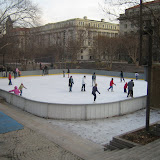
Entertainment essentially involves people being amused by something. In formal venues, they can be amused by plays, movies, concerts and dances — all requiring some kind of formal organization (a theater company, dance troop, orchestra) that is scheduled and “performs” the entertainment. However, strong downtown entertainment niches rely on the fact that people also are entertained when they are amused or pleased by observing other people — who, at the same time, may be amused by watching them. Great public spaces provide opportunities for “informal entertainments” that occur when people engage in activities that they enjoy and that also interest and amuse nearby people-watchers. Think of the ice skaters drawing the ever-present crowds above the rink in Rockefeller Center. Similarly, in Manhattan’s Bryant Park, you’ll find young men and women seated and watching each other and chess players, who always attract an audience. Greenport, NY, has used a carousel and waterfront location to create a wonderful public space where people can watch and be watched by other people. Other downtowns have fostered entertainment with facilities such as: a model boat pond; a children’s pony ride; a Wi-Fi hotspot to access and cruise the Internet on laptops; a place to catch the sun — a favorite pastime for office workers and young tourists in the spring and summer; places to buy food and eat lunch alfresco; outdoor cafes for sipping coffee and eating snacks; slot car racing for kids, playing bocce for seniors, etc.

Visitors will “perform” if the opportunities are there. To sail a model boat, a suitable pond or pool is required; to sit in the sun and people watch requires an attractive place with benches and chairs to sit on, etc.

The following link takes you to a photo album that illustrates a range of “informal entertainments”

Work As Entertainment

People are often engrossed and entertained by watching other people at work.

Decades ago, the people who brought back “historic” villages, — such as Colonial Williamsburg (VA) and Old Sturbridge Village (MA), — cleverly decided to have people at work, using 18th Century technologies, to educate and entertain visitors. For example, in Colonial Williamsburg visitors can watch 100 masters working in 30 trades. Included are an apothecary, blacksmith, cooper, brickyard, foundry, gunsmith, basket maker, etc.

In Old Town, located in San Diego, CA, visitors can watch glass blowing, wood-working and candle-making, though current technologies may be used.

The Simon Pearce retail store at The Mill in Quechee, Vermont, is perhaps the most brilliantly designed and executed retail project in the United States in a small Main Street setting. It combines a superb site in a renovated old mill located over a waterfall with a diverse assortment of retail goods ranging from blown glass to ceramics and superb furniture. In addition, at this diverse destination you can watch glass being blown, ceramics being thrown and decorated, fabrics being woven and enjoy a meal in a three star restaurant that has attractive water views. The Simon Pearce store at Quechee is a strong destination and lots of people leave there with bags full of merchandise.

At the Torpedo Factory in Alexandria, VA, an historic building has been renovated to provide studios for artists and craftsmen where visitors can watch jewelry being made, pots being thrown, lithographs being made, etc. and have opportunities to purchase the products.

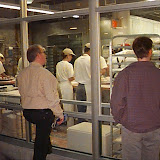
At the Chelsea Market in Manhattan, visitors can be entertained by watching bread making at Amy’s Bread, a working kitchen for Sarabeth’s, a skilled knife sharpener, and people learning to dance the Tango.

People like to watch TV shows outdoors, as attested to by the crowds drawn the Today Show and Good Morning America.

Edward Villella has the Miami City Ballet rehearse in a storefront window, where pedestrians flock to watch the dancers.

Many diners want to sit at chef’s tables or counters where they can watch the cooking process and interact with the kitchen staff. Chef’s tables are often the hardest to book and offer the most expensive menus at topnotch restaurants. The noted French chef Joel Robuchon specifically designed his recent restaurants so most or all of his patrons sit at counters where they can watch their food being prepared.

Double click on the link below and you an access a photo album that illustrates “work as entertainment.”